
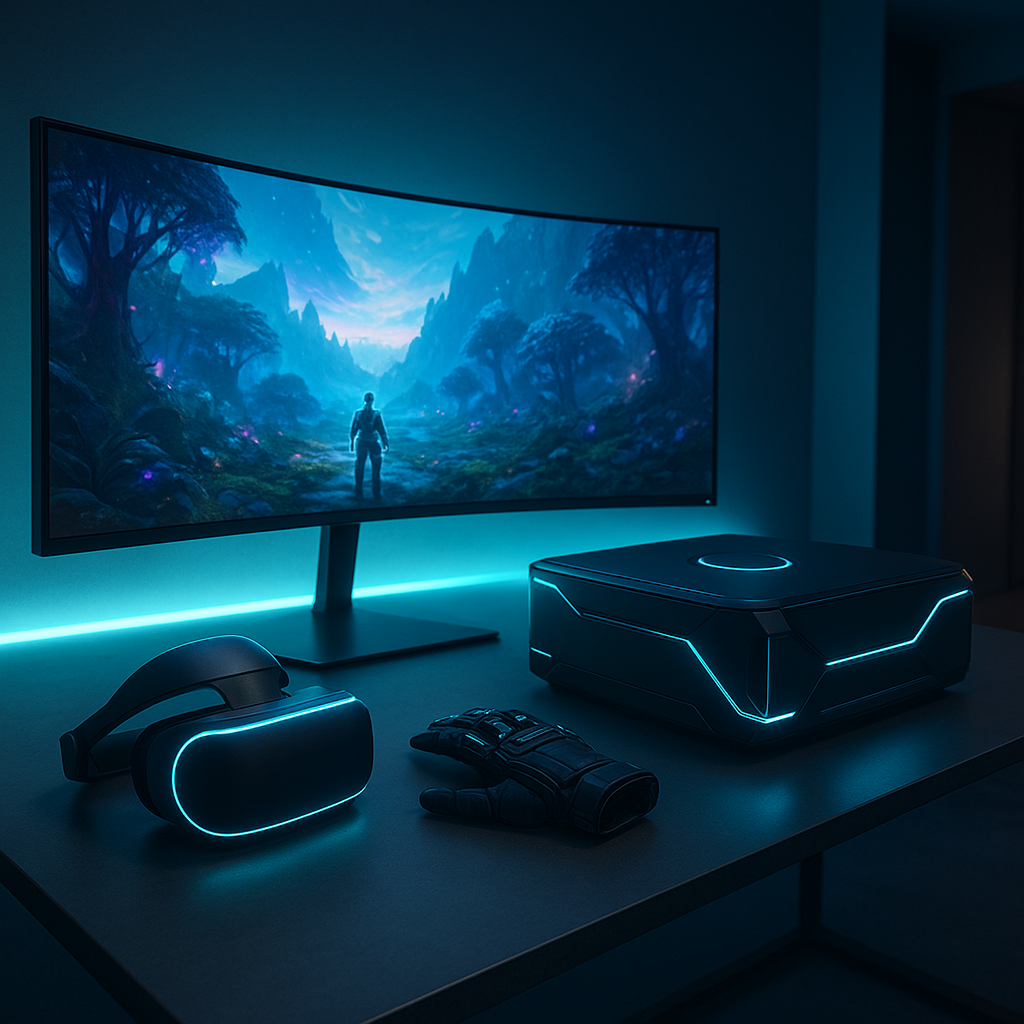
A New Chapter Begins: Gaming Hardware at a Technological Crossroads
In the dimly lit room of a top-tier gaming tournament in Seoul, 2026, a striking scene unfolds. Players don sleek, lightweight headsets connected to compact, modular rigs that deliver breathtaking visuals and near-zero latency. The crowd roars as the line between virtual and reality blurs. This is not a distant sci-fi vision; it is the present state of gaming hardware, shaped by relentless innovation over the past decade. The gaming community is witnessing a profound transformation in the tools that define their experience, driven by advances in processing power, display technology, and form factor design.
According to industry estimates, global spending on gaming hardware surpassed $45 billion in 2025, reflecting a robust appetite for performance and immersion. Yet, beneath the surface of raw numbers lies a more nuanced narrative. Gamers now expect devices that not only crunch pixels faster but also adapt intelligently to their playstyles, environments, and even physiological responses. This shift is orchestrated by breakthroughs in artificial intelligence (AI), edge computing, and materials science, which collectively promise to reshape what it means to engage with digital worlds.
“The future of gaming hardware isn’t just about making things faster; it’s about crafting experiences that feel alive and responsive to each player’s unique interaction.” – Dr. Lena Moritz, CTO of NexaGaming Technologies
Tracing the Roots: How We Arrived at Today’s Hardware Landscape
To appreciate the innovations defining gaming hardware in 2026, it is essential to revisit the past decade’s trajectory. The 2010s and early 2020s were dominated by the rise of powerful graphics processing units (GPUs), ultra-fast solid-state drives (SSDs), and high-refresh-rate monitors. Major players like NVIDIA, AMD, Sony, and Microsoft pursued iterative improvements, delivering consoles and PC components that pushed frame rates and resolutions higher. The launch of ray tracing technology in 2020 marked a watershed moment, enabling real-time lighting effects previously thought impossible.
However, these advancements came with challenges. The increasing power demands led to thermal management issues and bulkier designs. Meanwhile, the growth of cloud gaming services introduced a new paradigm, allowing high-quality play on less powerful devices but dependent on stable internet connectivity. This duality forced hardware makers to reconsider the balance between raw local performance and cloud integration.
The mid-2020s saw the emergence of adaptive AI accelerators embedded directly into GPUs and CPUs, enabling hardware to optimize rendering workloads dynamically. Concurrently, the development of micro-LED and OLED display panels pushed visual fidelity to new heights, with ultra-wide aspect ratios and variable refresh rates becoming standard. Portable gaming devices evolved with foldable displays and battery technologies that extended play sessions without compromising power.
Alongside these technical evolutions, the community’s expectations matured. Competitive gamers demanded hardware with minimal latency and maximum precision, while casual players sought comfort and accessibility features. This spectrum of needs spurred manufacturers to diversify their offerings, from modular PCs to lightweight VR headsets.
Core Innovations Driving Hardware Performance and Immersion
The gaming hardware market in 2026 is defined by five primary innovations that collectively elevate player experience:
- AI-Enhanced Processing: Modern CPUs and GPUs incorporate dedicated AI cores that analyze gameplay context and predict rendering priorities, enabling frame rates to stay consistently high without overtaxing power budgets.
- Advanced Display Technologies: Micro-LED panels with pixel-level dimming and refresh rates exceeding 360Hz have become mainstream, reducing motion blur and delivering vibrant color gamuts.
- Modular and Scalable Architectures: Hardware components now support hot-swapping and cloud-augmented processing, allowing users to customize rigs based on game demands and budget constraints.
- Haptic and Spatial Feedback: Integration of ultra-sensitive haptic actuators and spatial audio systems create a multi-sensory environment, bridging the gap between virtual actions and physical sensations.
- Energy-Efficient Designs: Innovations in semiconductor materials and cooling solutions have reduced power consumption by up to 40% compared to 2020 benchmarks, enabling portable devices with extended battery life.
Data from the International Game Developers Association (IGDA) shows that hardware incorporating these features enjoys a 25% higher user satisfaction rating, emphasizing the importance of experiential quality over raw specs. Furthermore, price elasticity has improved as manufacturers optimize production through AI-driven supply chain management.
“The convergence of AI and hardware is redefining performance metrics. It’s not just about teraflops anymore; it’s about intelligent resource allocation in real time.” – Marcus Li, Lead Engineer at Vertex Gaming Solutions
2026 Snapshot: What’s New and What’s Next in Gaming Hardware
The current year is marked by several notable launches and trends that underscore the direction gaming hardware is taking. Leading the charge is the release of the NVIDIA RTX 6000 series, which integrates fourth-generation tensor cores designed explicitly for gaming AI workloads. These chips enable real-time AI upscaling, drastically reducing the hardware needed for native 4K rendering.
Meanwhile, Sony’s latest PlayStation iteration, the PS6, incorporates a hybrid quantum-classical processor prototype that accelerates physics simulation and AI-driven NPC behavior. This hardware leap allows game worlds to feel more dynamic and responsive, enhancing immersion beyond previous generations.
On the portable front, Valve’s Steam Deck 3 has embraced foldable OLED displays and wireless VR compatibility, allowing users to seamlessly switch between handheld and room-scale VR gaming. Battery life improvements stem from solid-state electrolyte batteries developed in partnership with energy startup IonCore, pushing playtimes beyond 12 hours.
Moreover, the rise of edge computing has led to the proliferation of localized gaming hubs, where powerful servers reduce latency for multiplayer titles. This infrastructure complements home hardware, allowing even budget devices to access premium experiences.
Manufacturers are also prioritizing sustainability. The use of recycled materials and modular repairability standards has increased, responding to consumer demand and regulatory pressures. Major brands have committed to carbon-neutral production processes by 2028.
Industry Voices and the Broader Impact of Hardware Evolution
Experts across the gaming ecosystem recognize that hardware innovation is a critical driver of the industry’s expansion and diversification. As immersive technologies become more accessible, new genres and gameplay mechanics emerge, pushing creative boundaries.
Emily Zhang, Senior Analyst at Horizon Insights, notes that “the democratization of high-performance gaming hardware enables indie developers to create visually stunning and mechanically complex games without prohibitive costs. This broadens the creative landscape and attracts a wider audience.”
The esports sector also benefits significantly. Hardware with ultra-low latency and enhanced precision has raised competitive standards, making matches more engaging for both players and spectators. This evolution fuels investment and sponsorship growth.
From a cultural perspective, the integration of biofeedback sensors in gaming peripherals introduces new dimensions of player engagement. Devices that monitor heart rate, eye tracking, and muscle tension allow games to adapt difficulty and narrative pacing dynamically, creating personalized experiences.
However, these advancements raise questions about privacy and data security, as biometric data becomes intertwined with gameplay. Industry stakeholders emphasize the need for transparent policies and robust protections.
For those seeking guidance, comprehensive resources like TheOmniBuzz’s Unlocking the Power of Gaming Hardware: A Beginner’s Roadmap to Winning Setup and Why Gaming Hardware Innovation Is Driving the Next Level of Player Immersion provide valuable insights into navigating this complex landscape.
Looking Ahead: What Gamers and Developers Should Watch
The trajectory of gaming hardware suggests several key trends that will shape the next five years and beyond. Foremost is the increasing synergy between hardware and AI, where predictive algorithms not only optimize rendering but also enhance accessibility features, including adaptive controls and real-time language translation.
Quantum computing, while still nascent, is expected to influence physics calculations and procedural content generation by the early 2030s, potentially transforming open-world games and simulations. Meanwhile, advances in materials science may yield flexible and transparent displays, further blending physical and virtual realities.
From a market perspective, modularity will become a standard expectation, with consumers demanding devices that can evolve alongside software innovations. Cloud and edge computing infrastructures will deepen, reducing barriers for entry-level gamers while maintaining high-end performance for enthusiasts.
- Increased adoption of AI-driven hardware optimization to reduce energy consumption and boost performance.
- Expansion of hybrid reality devices combining AR, VR, and tactile feedback for seamless immersion.
- Greater emphasis on sustainable manufacturing and circular economy principles in gaming hardware production.
- Enhanced biometric integration with rigorous privacy frameworks to personalize gameplay ethically.
- Development of universal interoperability standards to unify gaming ecosystems across platforms.
For developers and hardware makers alike, continuous collaboration will be essential to realize these possibilities. The future of gaming hardware is not simply a race toward higher numbers but a quest to craft experiences that resonate emotionally and cognitively with players.
“As hardware becomes smarter and more responsive, games will evolve from static entertainment to living worlds that learn and grow with their players.” – Sofia Ramirez, Head of Game Innovation at Lumina Interactive
In summary, the gaming hardware arena in 2026 is a vibrant ecosystem defined by rapid technological progress, diverse consumer demands, and emerging ethical considerations. Those who adapt to this complex matrix will shape the next generation of interactive entertainment, creating experiences that are richer, more immersive, and deeply personal.
For readers eager to deepen their understanding of hardware setups and optimization strategies, TheOmniBuzz offers detailed guidance in Mastering Gaming Hardware: Pro Tips for Ultimate Performance and Longevity. This resource complements the broader discussion here by providing actionable technical advice to maximize both performance and device lifespan.