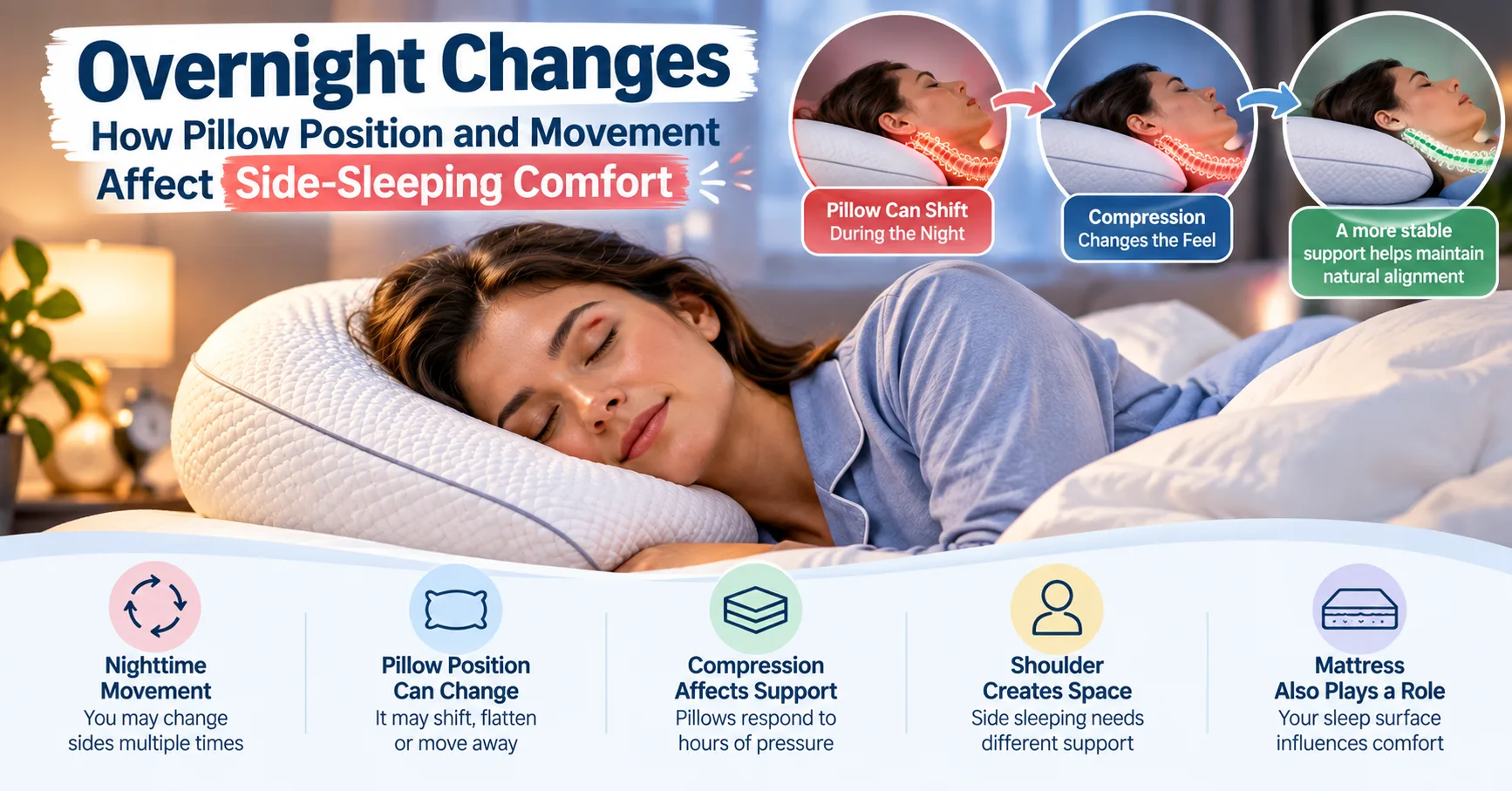
A pillow can feel comfortable when you first get into bed and still feel very different by morning. This is one reason conversations about the best pillow for side sleepers with neck pain can become overly focused on static features such as height, firmness, or material.
Sleep is dynamic. People move, change sides, adjust their shoulders, and gradually settle into the mattress. The pillow responds to those movements too. It compresses under pressure, shifts position, and may interact differently with the head and shoulder as the night progresses.
Understanding these overnight changes can provide a more realistic way to think about pillow comfort.
The Pillow You Start With May Not Be the Pillow You Wake Up With
This does not mean the pillow physically changes into a different product. Its position and feel can change as it is used.
When you first lie down, you may place the pillow exactly where you want it. Your head is centered, your shoulder is positioned deliberately, and you are awake enough to make small adjustments.
Several hours later, the situation can be different.
You may have turned onto your other side. Your head may have moved closer to the edge. The pillow may have compressed under repeated pressure. You may even have pushed part of it forward without realizing it.
This distinction between initial comfort and overnight behavior is often overlooked when comparing pillows.
Side-to-Side Movement Changes the Setup
Many people who describe themselves as side sleepers do not stay exclusively on one side.
A person may spend most of the night on the left side, turn to the right, briefly move onto the back, and then return to the original position.
Every transition changes the way the head interacts with the pillow.
A pillow that works well when the head is centered may feel different after the sleeper moves toward an edge. Likewise, the amount of pressure placed on a particular section can change when the sleeper turns.
This is why nighttime movement is worth observing before making assumptions about what is causing morning discomfort.
Pillow Movement Can Be an Overlooked Variable
The position of the pillow itself can matter.
Some sleepers naturally push their pillow away from the head during the night. Others pull it closer, fold it, or repeatedly reshape it.
These actions may happen without conscious awareness.
If you regularly wake up with your pillow several inches away from its original position, that observation may be more useful than a product description claiming a particular firmness level.
It can also help explain why a pillow seems comfortable at bedtime but less satisfactory in the morning.
The issue may involve not only how the pillow feels, but how well its position works with your normal movements.
Compression Is Part of the Sleeping Experience
Every pillow responds to pressure in some way.
When your head rests on it for hours, the filling and outer construction determine how the pillow responds. Some designs compress more noticeably, while others are intended to maintain a more consistent structure.
Neither response is automatically appropriate for everyone.
A sleeper who prefers a softer, more adaptable feel may appreciate some compression. Another person may prefer a pillow that feels more stable throughout the night.
The important consideration is how the pillow behaves after extended use, rather than only how it feels during the first few minutes.
Your Shoulder Does Not Stay Completely Still
Side sleeping creates a close relationship between the shoulder, mattress, and pillow. But the shoulder itself can move during the night.
You might move your arm forward, pull it closer to your body, or change the amount of pressure against the mattress.
These small changes can alter how your head rests on the pillow.
This is one reason it can be misleading to think of sleeping posture as a fixed position. Your body is constantly making small adjustments, even when you remain broadly on your side.
The pillow therefore needs to function within movement rather than only within one carefully arranged position.
The Mattress Can Change During the Same Night
The mattress does not physically change dramatically from hour to hour, but your body's interaction with it can.
As you relax and settle into the sleeping surface, the relationship between your shoulder and mattress can feel different from the moment you first lie down.
A softer sleeping surface may allow more body compression, while a firmer surface may provide a different level of resistance.
This means pillow comfort cannot always be separated from mattress behavior. A pillow that seems comfortable in one bedroom may feel different after moving to another mattress.
That is one reason replacing a pillow immediately may not always explain a change in sleep comfort.
Pillowcases and Bedding Can Influence Movement
The pillow itself is only one part of the surface you interact with.
The texture of a pillowcase can affect how easily your head moves across the pillow. Bedding layers can also influence how freely you reposition yourself during the night.
These details are easy to ignore because they are not usually included in discussions about pillow specifications.
However, if your pillow repeatedly slides, bunches, or shifts, examining the entire bedding setup may provide useful clues.
Sometimes a small environmental change can alter the experience of an otherwise familiar pillow.
A Pillow Should Work With Your Sleep Transitions
A useful way to evaluate a pillow is to think about transitions rather than one static position.
Imagine turning from your left side to your right side.
Does the pillow remain reasonably positioned?
Does it require significant rearranging?
Does its surface feel noticeably different after you turn?
What happens if you briefly sleep on your back?
These questions do not identify a universal “correct” pillow. Instead, they help reveal how a particular design behaves when your normal sleep pattern changes.
That can be especially relevant for people who move frequently during sleep.
When a Different Design May Be Worth Investigating
If a conventional pillow repeatedly shifts away from the position you prefer, it may be reasonable to investigate designs created specifically for side sleepers.
The goal should not be to assume that a specialized design will automatically resolve neck discomfort. Rather, specialized construction gives sleepers another category to compare.
The current Eli & Elm Side Sleeper Pillow, for example, uses a U-shaped design and adjustable fill options. These are product-specific characteristics rather than guarantees of a particular health outcome.
For anyone comparing different side-sleeping pillow options, the more useful question is whether the design fits their actual sleeping behavior rather than whether it simply carries a “side sleeper” label.
What Morning Symptoms Can—and Cannot—Tell You
Morning discomfort can be useful information, but it should not automatically be interpreted as proof that a pillow is responsible.
Consider whether the discomfort occurs repeatedly, whether it changes when you sleep in a different position, and whether other aspects of your routine have changed.
A pillow is only one component of the sleep environment.
Persistent or significant neck pain, particularly when accompanied by other concerning symptoms, should be discussed with an appropriate healthcare professional rather than treated solely as a bedding problem.
This distinction is important because a pillow can influence sleep comfort without being the underlying cause of every neck symptom.
Look for Patterns Instead of a Perfect Formula
There is a temptation to reduce pillow selection to one measurement: height, firmness, material, or shape.
But overnight comfort is an interaction between several moving parts.
Your sleeping position changes. Your shoulder moves. The pillow compresses. Your head changes position. Your body settles into the mattress. Bedding can shift. You may wake briefly and reposition yourself without remembering it the next morning.
These variables help explain why two people can have very different experiences with the same pillow.
They also explain why the search for the best pillow for side sleepers with neck pain is better approached as an individual sleep-comfort question than as a universal product ranking.
The Bigger Picture
A pillow does not have to feel identical at every moment of the night to be comfortable. What matters is how its construction, position, and response interact with the way you actually sleep.
Instead of focusing exclusively on what a pillow looks like when it is new, consider what happens after several hours of real use.
Does it stay where you need it? Does it maintain a feel you find comfortable? Does it work when you change sides? Does your overall sleep environment support the way you naturally move?
Those questions provide a more realistic picture of overnight comfort than a single specification ever can.
And when choosing among different pillow designs, understanding how the pillow behaves while you sleep may ultimately be just as important as understanding what is inside it.