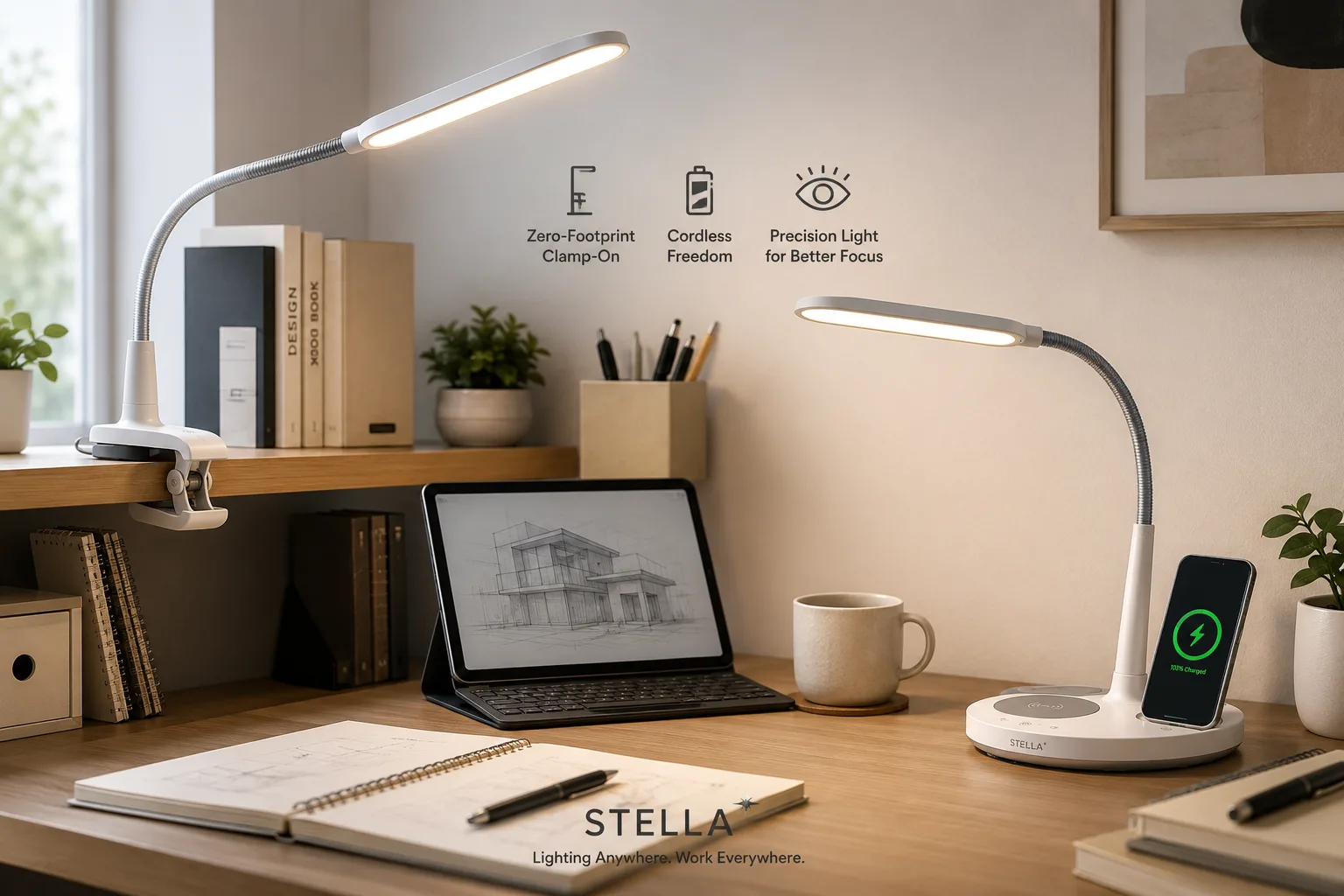
In contemporary home offices, design studios, and multi-use craft rooms, desktop real estate is at a premium. Traditional, bulky lighting fixtures often consume essential working space and force desk layouts to revolve around proximity to electrical outlets. Transitioning to a high-performance battery powered desk lamp or incorporating versatile led clamp on lights delivers total spatial flexibility, allowing you to direct color-accurate illumination precisely where it is needed without cord tangles or placement restrictions. Advanced lighting solutions, such as those engineered by Stella Lighting, combine optical-grade LED technology with cordless mobility and adaptable mounting to minimize glare, free up desk surfaces, and sustain visual comfort throughout long working sessions.
1. The Spatial and Ergonomic Limits of Traditional Lighting
An effective work environment requires a clear visual field and ergonomic adaptability. Fixed, heavy lamp bases often create physical obstacles and cast deep shadows across drafting boards, keyboards, or reading materials.
When working on compact desks, drafting tables, or specialized crafting stations, standard lamp bases occupy space better reserved for documents, tools, or digital devices. Utilizing clamp-on fixtures or cordless, battery-operated lamps resolves these spatial challenges through key structural advantages:
- Zero Desktop Footprint: Securing clamp fixtures directly to shelf edges, table rims, or drafting boards leaves 100% of the flat working surface clear.
- Untethered Positioning: Rechargeable battery mobility enables users to shift light instantly between a primary desk, an armchair, or a workbench without searching for available wall sockets.
- Reduced Physical Friction: Wire-free setups prevent power cables from catching on equipment, mice, or stitching frames during delicate tasks.
2. Key Technical Standards for Visual Health
Whether secured to a drafting board or standing freely on a studio table, high-quality task lighting must meet rigorous optical specifications to prevent ocular fatigue during extended use.
High Color Rendering Index (CRI 90+)
Color Rendering Index (CRI) measures how accurately a light source reveals natural colors compared to mid-day sunlight (CRI 100). Standard utility lights typically score between CRI 70 and 80, which dulls fabric tones, flattens paper contrast, and distorts digital color proofing. High-CRI (90+) LEDs ensure precise color fidelity required for detailed reading, illustration, and fine handiwork.
Tri-Spectrum Color Temperature
Different tasks require specific light wavelengths to maintain visual acuity and support healthy circadian rhythms:
- Warm White (2800K): Soothing, low-blue illumination ideal for late-night reading and relaxing.
- Natural White (4000K–4500K): Balanced daylight output tailored for computer work, writing, and administrative tasks.
- Cool White (5500K): Crisp, high-contrast illumination that highlights intricate details, dark textiles, and small print.
Constant-Current Power Regulation
Many standard battery-operated lights steadily lose brightness as their charge decreases, forcing the eye's ciliary muscles to continually adapt to fading light levels. Professional-grade units use constant-current driver circuitry to maintain full, uncompromised lumen output until the battery requires recharging.
Flicker-Free Dimming Circuitry
Inexpensive LED lamps adjust brightness using rapid Pulse-Width Modulation (PWM) power cycling. Although this flicker is often imperceptible to the naked eye, it causes eye muscle fatigue, dryness, and headaches. Advanced constant-current drivers ensure smooth, flicker-free illumination across all dimming levels.
3. Task Lighting Performance Standards
Specification / FeatureGeneric Utility LampPremium Optical & Clamp SolutionsColor Rendering Index (CRI)CRI 70–80 (Color distortion)CRI 90+ (Optical-grade precision)Color Spectrum AdjustmentsSingle Fixed OutputTri-Spectrum (2800K, 4000K, 5500K)Brightness Modulation1–3 Basic StepsMulti-Level Tactile / Stepless ControlPower StabilityDims as battery charge dropsConstant-Current (100% steady output)LED Lifespan Rating~10,000–15,000 Hours50,000+ Hours (e.g., Philips Lumileds)4. Strategic Positioning Guidelines for Task Lighting
To maximize visual comfort and efficiency when setting up portable or clamp-mounted fixtures, follow these ergonomic practices:
- Mount Opposite the Dominant Hand: Position clamp lights on the side opposite your writing or guiding hand to prevent your arm from casting shadows over your work area.
- Keep the Head Below Line of Sight: Adjust flexible goosenecks or articulating arms so the light head remains below eye level, angling the beam downward to avoid direct glare.
- Balance Task and Ambient Light: Avoid working in a completely dark room with only a single spotlight active. Maintaining soft ambient lighting reduces extreme contrast variations that cause eye strain.
5. Frequently Asked Questions
What is the average runtime for a rechargeable task light on battery power?
Depending on the brightness setting used, high-performance battery lamps typically provide up to 11+ hours of continuous illumination on a single charge, supporting a full workday or creative session.
Can a rechargeable task lamp remain connected to power during continuous use?
Yes. Quality task lights include internal battery management systems that regulate charging, allowing the unit to be operated continuously via wall outlet or unplugged for portable use.
Do clamp-on mounts damage furniture surfaces?
Professional led clamp on lights feature non-marring rubber padding on the mounting jaws, allowing them to attach securely to wooden desk edges, drafting tables, or shelving without leaving marks or scratches.
Why is High-CRI 90+ output important for reading and detailed work?
High-CRI illumination provides clear contrast between text and background materials or fine thread and fabric weaves, enabling the eyes to focus comfortably without straining to resolve fine details.
Summary
Upgrading workspace illumination is an effective way to improve task accuracy, optimize desk space, and prevent daily visual fatigue. Deploying a versatile battery powered desk lamp offers complete freedom to work in any location without reliance on wall outlets, while sleek led clamp on lights provide zero-footprint illumination directly above key work areas. By prioritizing high CRI output, variable color spectrums, and constant-current power drivers standards emphasized in engineering by brands like Stella Lighting—you can build a clean, highly functional workspace tailored to long-term visual health.