Businesses are moving beyond basic AI experiments and looking for practical ways to build, deploy, and scale generative AI solutions. As demand grows, many companies are evaluating the best nearshore Generative AI consulting firms to access specialized talent, improve development speed, and control project costs. A nearshore team can provide technical expertise while keeping collaboration relatively close in terms of time zones, communication, and working practices.
Why Generative AI Projects Need Specialized Teams
Generative AI development involves much more than connecting an application to a large language model. Successful projects often require expertise in AI architecture, data engineering, model selection, application development, security, evaluation, and deployment.
Companies may want to build AI-powered customer support platforms, internal knowledge assistants, document processing systems, recommendation tools, content generation applications, or AI agents. Each use case brings different technical and business requirements.
McKinsey reported in 2025 that 71% of surveyed organizations were regularly using generative AI in at least one business function. Marketing and sales, product and service development, service operations, and software engineering were among the leading areas of adoption.
This growing adoption creates a need for teams that understand both AI technology and business processes.
What Is a Nearshore AI Team?
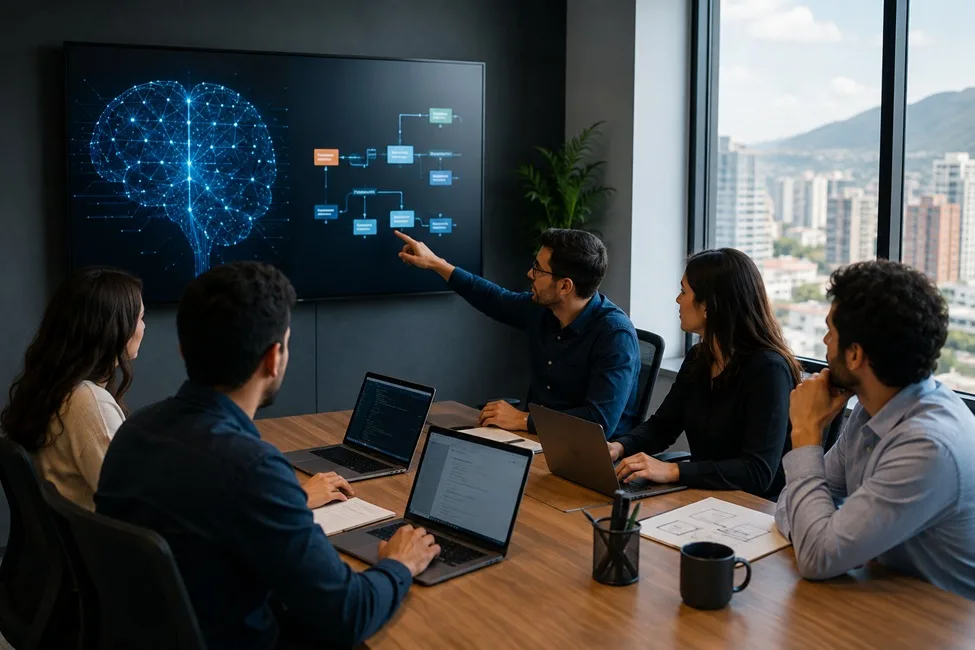
A nearshore AI team is a group of technology professionals located in a country or region that is relatively close to the client geographically and often shares overlapping working hours.
For US companies, nearshore development teams are commonly located in Latin America. Depending on the location, teams can offer several hours of working-time overlap with US-based employees.
A typical generative AI team may include:
- AI engineers
- Machine learning engineers
- Data engineers
- Software developers
- Cloud engineers
- AI architects
- Product managers
- Quality assurance specialists
The exact structure depends on the project's scope. A small proof of concept may require only a few specialists, while an enterprise AI platform may need a larger multidisciplinary team.
Why Companies Use Nearshore AI Teams
Access to Specialized Talent
Finding experienced AI professionals can be difficult, particularly when a company needs several skills at the same time.
The World Economic Forum's Future of Jobs Report 2025 projects a 40% increase in demand for AI and machine learning specialists, equivalent to about 1 million additional jobs. The report also identifies AI and big data among the fastest-growing skill areas.
Nearshore staffing gives companies access to a broader talent pool without requiring every specialist to be hired as a full-time internal employee.
Better Time Zone Alignment
Time zone differences can create friction in software development. A team working on the opposite side of the world may complete work while the client is offline, but questions and decisions may need to wait until the next business day.
Nearshore teams can reduce this problem through overlapping working hours. Product managers, developers, and business stakeholders can communicate during much of the same workday.
For generative AI projects, this can be especially useful because requirements often change during experimentation.
Faster Communication
Generative AI development involves continuous testing and adjustment. A prompt, workflow, retrieval strategy, model, or user experience may need to change after testing.
Direct communication helps teams respond to these changes faster. Shared meetings, collaborative planning, and regular demonstrations can also help business stakeholders understand what the AI system can realistically accomplish.
Flexible Team Scaling
AI projects often have different staffing requirements during different stages.
A company may need a small team during discovery, additional developers during application development, and more infrastructure or data specialists during deployment. Nearshore providers can often support this type of flexible staffing model.
This approach can be useful for companies that want to avoid building a large permanent AI department before they know how much AI development they will need.
Generative AI Projects Nearshore Teams Can Support
Nearshore AI teams can work on a broad range of applications.
AI-Powered Business Assistants
Companies can develop internal assistants that help employees find information, summarize documents, answer questions, and interact with business knowledge.
For example, an organization could connect an AI assistant to approved internal documents and knowledge bases. Employees could then use natural language to find policies, product information, procedures, or other business resources.
Retrieval-Augmented Generation
Retrieval-augmented generation, commonly called RAG, can help AI applications use information from company-specific data sources.
A development team can design the data pipeline, document processing workflow, retrieval system, model integration, evaluation process, and security controls needed for the application.
This is particularly useful when companies need AI responses grounded in their own information rather than relying only on a general-purpose model.
AI Agents
AI agents are another major area of development. Rather than simply generating text, an agent can be designed to perform tasks using connected tools and business systems.
McKinsey reported in 2025 that 62% of surveyed organizations were at least experimenting with AI agents. However, most organizations were still early in their efforts to scale AI across the enterprise.
This creates an opportunity for experienced development teams to help companies move from experimentation toward practical applications.
Customer Service Automation
Generative AI can support customer service through conversational assistants, automated response generation, knowledge retrieval, call summaries, and agent-assistance tools.
A nearshore team can help connect these capabilities with existing customer relationship management systems, help desk platforms, databases, and other business applications.
How to Build a Successful Nearshore AI Project
Hiring a team is only the beginning. Companies also need a clear development process.
Start With a Specific Business Problem
A strong AI project begins with a measurable business objective.
Instead of starting with a question such as, "How can we use generative AI?" companies can identify a specific challenge, such as reducing customer support response time or helping employees search thousands of documents more efficiently.
A defined problem makes it easier to select the right technology and measure results.
Select the Right AI Architecture
Different projects require different architectures. Some applications may use an existing foundation model, while others may require retrieval systems, specialized models, fine-tuning, or multiple AI services.
The development team should evaluate factors such as accuracy, latency, data privacy, scalability, infrastructure requirements, and operating costs.
Build Evaluation into the Process
Generative AI systems can produce inconsistent or incorrect responses. Testing should therefore be part of development rather than something performed only at the end.
Teams can establish evaluation criteria based on accuracy, relevance, response quality, safety, latency, and business outcomes.
McKinsey has highlighted well-defined KPIs as an important practice for organizations seeking measurable value from generative AI.
Plan for Security and Governance
AI applications may process sensitive business information, customer records, intellectual property, or other confidential data.
Security should therefore be considered from the beginning. Access controls, data protection, monitoring, model governance, and appropriate human oversight can help reduce operational and compliance risks.
Trends Shaping Nearshore AI Development
Generative AI development is moving from simple chatbots toward more integrated business applications.
One major trend is the growth of AI agents that can perform multi-step tasks. Another is the integration of generative AI into existing enterprise software rather than treating AI as a separate application.
The World Economic Forum also reports that employers are increasingly focused on AI, big data, cybersecurity, and technological literacy as important future skills.
At the same time, companies are becoming more focused on measurable results. McKinsey's 2025 research found that many organizations were still experimenting with AI rather than scaling it across the enterprise.
This shift creates demand for development teams that can connect AI experimentation with real business outcomes.
Choosing the Right Nearshore AI Partner
Companies should evaluate potential partners based on more than hourly rates.
Relevant factors include experience with generative AI applications, cloud platforms, data engineering, AI security, application development, and production deployment. Previous project experience can also reveal whether a provider understands the difference between an AI prototype and a reliable production system.
Communication practices are equally important. Companies should understand how teams handle project management, technical documentation, meetings, quality assurance, security, and ongoing support.
The strongest partnerships typically combine technical expertise with a clear understanding of business objectives.
Final Thoughts
Nearshore AI teams can give US businesses a practical way to access specialized generative AI talent while improving collaboration and maintaining flexibility. As organizations move from AI experiments toward production applications, experienced teams can help with everything from strategy and architecture to development, testing, deployment, and ongoing optimization.
The key is to treat generative AI as a business transformation initiative rather than simply a technology project. With clear goals, strong technical expertise, appropriate governance, and measurable outcomes, a nearshore team can become an effective extension of an internal technology organization.