
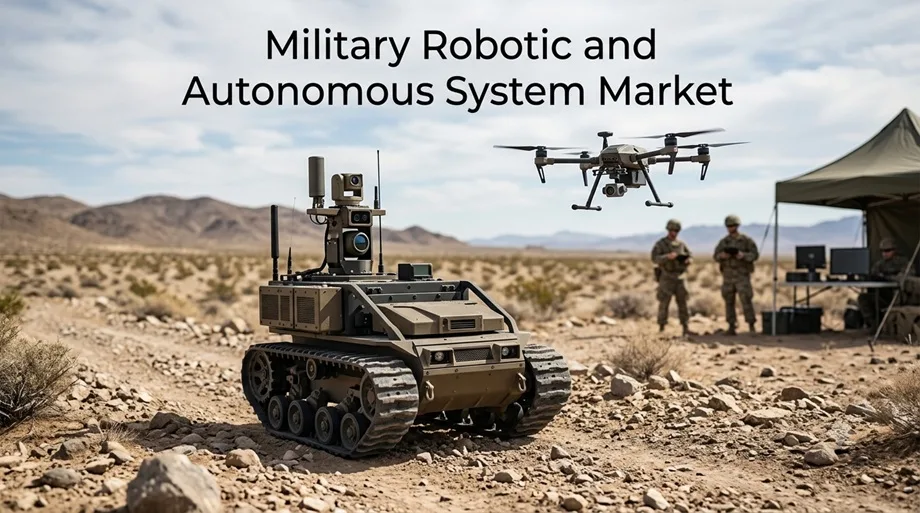
The global military robotic and autonomous system market is expanding as defense organizations adopt unmanned technologies for surveillance, target acquisition, logistics, combat support, and hazardous missions. The market is projected to grow from $63.34 billion in 2025 to $205.55 billion by 2035, registering an 11.31% CAGR during 2026–2035. Adoption is increasingly focused on scalable, resilient, and mission-integrated autonomous capabilities.
What are the Key Drivers of the Market?
- Rising defense investments: Increased military spending is creating greater procurement capacity for unmanned aircraft, ground robots, maritime systems, and supporting autonomy technologies.
- Need to reduce personnel exposure: Robotic systems can perform reconnaissance, explosive ordnance disposal, mine clearance, and other hazardous missions while reducing risks to military personnel.
- Growing ISR requirements: Persistent intelligence, surveillance, and reconnaissance requirements across borders, maritime zones, and contested environments are supporting demand for unmanned platforms.
- Advances in AI and autonomy: Improvements in artificial intelligence, sensing, communications, and autonomous decision-support capabilities are enabling more sophisticated human-machine teaming.
How are Military Robotic and Autonomous Systems Being Applied?
Military robotic and autonomous systems support a broad range of defense missions, including intelligence, surveillance and reconnaissance, combat operations, target acquisition, logistics, mine clearance, explosive ordnance disposal, and infantry support. Unmanned aircraft remain particularly important because of their flexibility across reconnaissance and surveillance missions. Ground and maritime robotic platforms are also expanding where persistent operation, hazardous-environment access, or reduced personnel exposure is required.
Get A Sample for Military RAS Market - Focus on Application, Platform, and Country Analysis and Forecast, 2026-2035
What are the Key Trends Shaping the Market?
- Shift toward attritable autonomous systems: Defense forces are increasingly evaluating lower-cost, scalable platforms that can be deployed in larger numbers and replaced more economically.
- Expansion of maritime autonomy: Autonomous surface and underwater systems are gaining importance for surveillance, reconnaissance, seabed security, and operations in littoral environments.
- Greater emphasis on human-machine teaming: AI-enabled systems are increasingly being designed to complement human operators rather than operate independently across every mission.
- Integration across mission systems: Suppliers are moving beyond standalone platforms toward integrated combinations of sensors, communications, software, payloads, and command-and-control capabilities.
What is the Regional Outlook for the Market?
Europe represented the largest regional market in 2025, with its market value projected to increase from $43.08 billion in 2025 to $134.99 billion by 2035. Demand is supported by defense modernization, NATO capability requirements, and increasing interest in unmanned and autonomous systems. North America and Asia-Pacific also remain important markets, supported by defense technology investment, domestic development programs, and growing adoption of advanced unmanned platforms.
What are the Challenges and Opportunities?
The market faces challenges related to electronic warfare, counter-drone technologies, autonomy testing, governance, legal assurance, and critical-component supply constraints. Ensuring reliable operation in contested environments while maintaining secure communications and interoperability remains a key technical consideration.
At the same time, significant opportunities exist in localized drone production, loitering-munition ecosystems, autonomous maritime systems, UGVs, EOD robots, and infantry-support robotics. Suppliers that combine scalable manufacturing with secure communications, resilient autonomy, sensor integration, and lifecycle support can strengthen their competitive positioning.
Click Here to Download the ToC
Conclusion
The military robotic and autonomous system market is transitioning from experimental deployments toward broader force integration. UAS currently represents the dominant platform category, while demand is also expanding across ground and maritime robotics. Future market development is expected to emphasize scalable autonomous systems, human-machine collaboration, resilient communications, and mission-level integration. These developments are creating opportunities for defense manufacturers, technology providers, and specialized robotics companies.