Building an AI training cluster is a bit like assembling a race car: every component has to work in harmony, or the whole system stalls under pressure. As machine learning models grow larger and more data-hungry, organizations are discovering that generic servers simply can't keep up. This is where purpose-built HPC hardware solutions come into play. From GPUs and memory architecture to networking fabric, the right high-performance computing stack determines whether your training runs finish in days or drag on for weeks.
In this article, we'll walk through the key considerations for selecting HPC hardware solutions for AI training clusters — covering GPU selection, memory and interconnect design, and how to source components from a reliable partner without compromising on quality or lead times.
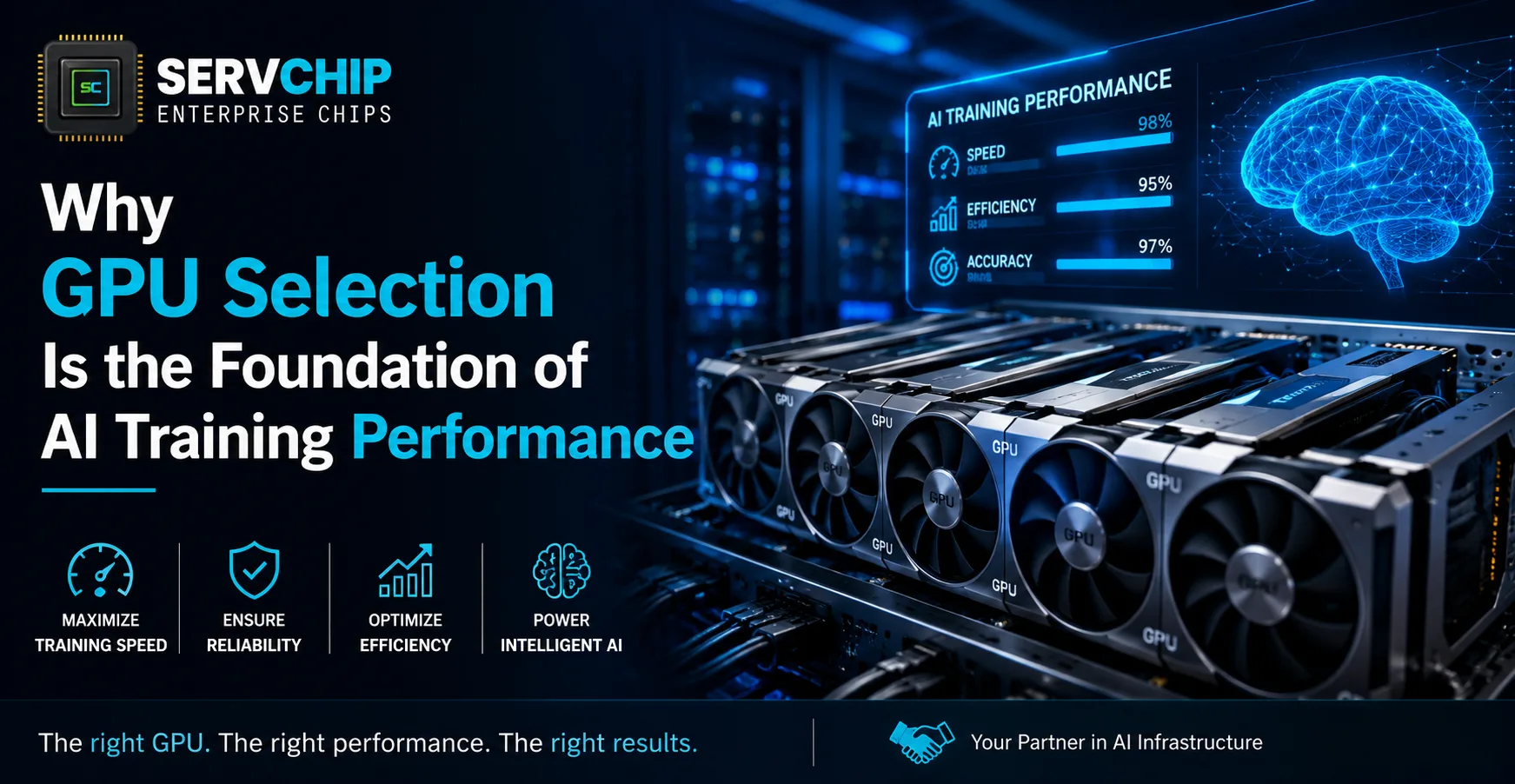
Why GPU Selection Is the Foundation of AI Training Performance
At the heart of any AI training cluster sits the GPU. Unlike general-purpose CPUs, GPUs are designed for the kind of massively parallel matrix operations that deep learning depends on. But not all GPUs are created equal, and choosing the wrong one can quietly sabotage your entire training pipeline.
When evaluating HPC hardware solutions for GPU-heavy workloads, teams should weigh a few core factors:
- Memory capacity and bandwidth — Large language models and transformer architectures are memory-hungry. A GPU with insufficient VRAM forces developers into workarounds like gradient checkpointing or model sharding, which slow training considerably.
- Compute precision support — Mixed-precision training (FP16, BF16, and increasingly FP8) can dramatically cut training time without sacrificing accuracy, so hardware that natively supports these formats is worth prioritizing.
- Scalability — Clusters rarely stay the same size for long. Choosing GPUs with a clear multi-node scaling path protects your investment as workloads grow.
Getting this layer right is non-negotiable, because every other design decision in the cluster — power, cooling, networking — is built around the GPUs you choose.
Memory and Interconnect: The Unsung Heroes of Cluster Performance
It's tempting to focus purely on GPU horsepower, but memory bandwidth and interconnect design are just as critical to real-world training speed. A cluster with world-class GPUs but a bottlenecked network fabric will still underperform, because distributed training requires constant communication between nodes as gradients are synchronized.
Two areas deserve particular attention:
- System memory and storage throughput. Training pipelines ingest enormous datasets continuously. If your storage layer can't feed data fast enough, GPUs sit idle waiting on I/O — an expensive form of waste in any HPC hardware solutions deployment.
- Interconnect topology. High-speed interconnects like InfiniBand or NVLink dramatically reduce the latency of gradient synchronization across nodes. For clusters running distributed data-parallel or model-parallel training, interconnect bandwidth often matters as much as raw GPU compute.
Industry benchmarking bodies have done extensive work quantifying how interconnect and memory architecture affect real-world AI training throughput. For teams designing at scale, it's worth reviewing published results from organizations like <cite index="0-1">MLCommons, which produces widely recognized benchmarks such as MLPerf that measure training and inference performance across a range of hardware configurations</cite>, to benchmark design choices against industry standards before finalizing a cluster architecture.
Sourcing HPC Hardware Solutions Through a Trusted Distribution Partner
Even a perfectly designed architecture is only as good as the supply chain behind it. Component shortages, counterfeit parts, and long lead times have become real risks in the current chip market, which makes vendor sourcing one of the most overlooked aspects of building AI infrastructure.
Working with an established enterprise chip distributor gives engineering teams access to authenticated components, predictable lead times, and volume pricing that's difficult to secure through smaller resellers. Distributors with strong OEM relationships can also provide visibility into upcoming hardware generations, helping teams time their procurement around new GPU or memory releases rather than getting stuck with soon-to-be-outdated inventory. Companies like Servchip specialize in exactly this kind of enterprise-grade chip distribution, sourcing HPC hardware solutions and semiconductor components for organizations building demanding compute infrastructure.
When evaluating a distribution partner, look for:
- Verified component authenticity and traceability
- Transparent lead-time communication
- Experience supporting large-scale HPC and AI deployments
- Flexible fulfillment for both prototype and production-scale orders
Integration and Consulting Support: Closing the Gap Between Hardware and Deployment
Purchasing the right components is only half the battle — integrating them into a functioning, optimized cluster is where many projects run into trouble. Rack design, cooling requirements, power distribution, and firmware configuration all need to align with the specific HPC hardware solutions being deployed, and mistakes here can be costly to unwind later.
This is why many organizations pair their hardware procurement with dedicated integration and consulting support. Experienced engineers can help validate architecture decisions before purchase, assist with rack-level design and thermal planning, and support the initial bring-up and benchmarking of the cluster once hardware arrives. For teams without deep in-house HPC expertise, this kind of support can shorten deployment timelines significantly. If you're planning a build and want architecture guidance alongside procurement, Servchip's services page outlines the integration and consulting support available for AI infrastructure projects of varying scale.
Conclusion: Building a Cluster That Scales With Your AI Ambitions
Choosing the right HPC hardware solutions for AI training clusters isn't a single decision — it's a series of interconnected choices spanning GPU selection, memory and interconnect design, and dependable component sourcing. Get each layer right, and you build infrastructure that scales gracefully with your model ambitions. Get it wrong, and even the most promising AI project can stall under hardware constraints.
If you're planning your next AI training cluster and want to talk through hardware options, availability, or integration support, reach out to our team to request a quote and start the conversation.
Frequently Asked Questions
1. What should I prioritize first when selecting HPC hardware solutions for AI training? Start with your workload profile — model size, batch size, and precision requirements — since these determine GPU memory and compute needs before anything else is decided.
2. How much does interconnect bandwidth actually matter for training speed? For any multi-node distributed training setup, interconnect bandwidth can be as important as raw GPU compute, since slow gradient synchronization creates idle GPU time.
3. Why work with an enterprise chip distributor instead of buying directly from manufacturers? A distributor can offer better lead-time visibility, component authentication, and flexible order volumes, which is especially valuable during periods of chip supply constraints.
4. Do I need consulting support if my team already has HPC experience? Even experienced teams often benefit from a second set of eyes on rack design, cooling, and power planning, since small oversights at that stage can be expensive to fix later.
5. How long does it typically take to procure and deploy an AI training cluster? Timelines vary widely based on component availability and cluster size, which is why early conversations with a sourcing partner about lead times are worth having before finalizing a budget.