In an era where remote and hybrid work have become commonplace, organizations face a new operational reality: visibility is no longer optional — it’s essential. Teams are dispersed, workflows are complex, and outputs are often intangible until it’s too late. As a result, traditional management tools and manual reporting fall short in helping leaders make confident decisions.
This is exactly where a workforce intelligence platform becomes transformative. Rather than merely capturing attendance or task completion, a workforce intelligence platform synthesizes meaningful signals about work patterns, productivity trends, and process bottlenecks — turning raw activity into strategic insight. In today’s competitive landscape, this isn’t just a “nice-to-have.” It’s a foundation for growth, resilience, and smarter execution.
Understanding Workforce Intelligence Software
At the heart of modern performance management is workforce intelligence software — a class of solutions that goes beyond basic time tracking or employee monitoring. Instead of focusing on isolated metrics, workforce intelligence software interprets how work flows across people, processes, and systems. It blends data from time logs, project systems, collaboration tools, and workforce operations to create a unified picture of organizational performance.
By presenting this data in intuitive dashboards and actionable reports, workforce intelligence software equips leaders to spot trends, anticipate challenges, and support teams in real time. In other words, it’s not just about measuring productivity — it’s about understanding why outcomes are happening and how to improve them.
Why Visibility Still Eludes Most Organizations
Even with a plethora of digital tools, many businesses struggle with:
- Disconnected systems that don’t talk to each other
- Fragmented data that lives in spreadsheets or emails
- Lack of real-time insight into who’s working on what
- Delayed reporting cycles that reflect past work, not current reality
- Manual effort to compile performance metrics
The result? Leaders make decisions based on assumptions rather than evidence. Teams feel misunderstood or undervalued. And productivity improvements are hard to sustain because the underlying patterns remain hidden.
A workforce intelligence platform addresses these gaps by bringing all relevant data into context and emphasizing insight — not just reporting.
What Makes a Leading Workforce Intelligence Platform
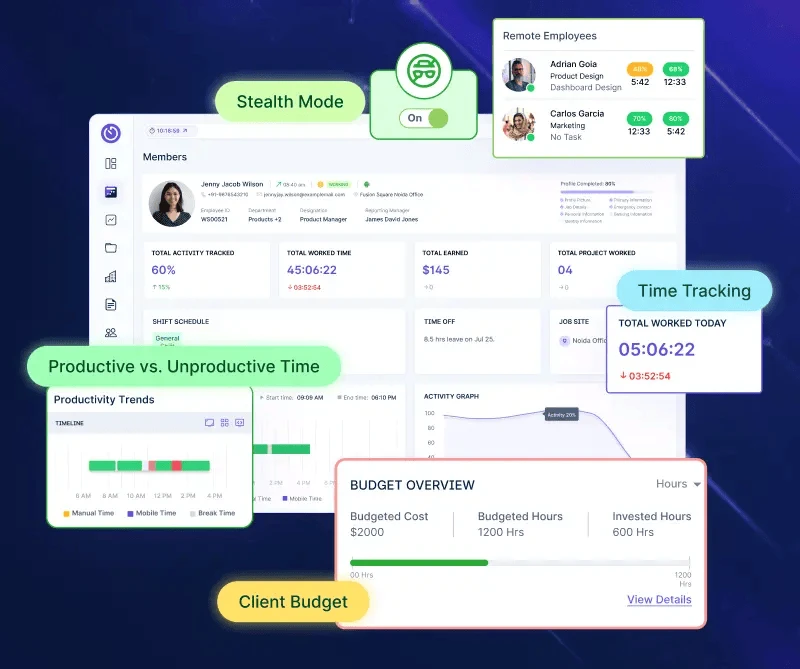
Not all platforms are created equal. A leading workforce intelligence platform excels in several key areas:
1. Unified Data Integration
Instead of siloed data, a strong intelligence platform connects time tracking, task workflows, attendance logs, and performance signals into a single view. This eliminates guesswork and aligns data sources.
2. Real-Time Insight
Businesses don’t operate in slow motion. The best platforms deliver current metrics, alerts, and trends so managers can respond quickly when workflows stall or demand surges.
3. Predictive Value
Beyond historical reporting, leading solutions apply analytics to forecast capacity needs, identify burnout risk, and highlight productivity bottlenecks before they become problems.
4. Intuitive Visualization
Compelling dashboards and customizable reports help leaders interpret complex data without wrestling with spreadsheets or manual calculations.
5. Actionable Recommendations
The platform doesn’t just show what is happening — it helps teams decide what to do next. This might include workload redistribution, process optimization, or targeted training.
By combining these capabilities, a workforce intelligence platform becomes not just a measurement tool, but a decision support system.
Business Benefits You Can Realize
A workforce intelligence platform drives value across multiple dimensions of operations and culture:
Better Operational Agility
With real-time insight into workflows, organizations can pivot quickly when priorities change, demand fluctuates, or unexpected challenges emerge.
Smarter Resource Allocation
Visibility into who is working on what and how long tasks take helps managers assign work more effectively — reducing overcapacity in some areas and underutilization in others.
Stronger Team Performance
Teams benefit when leaders understand their workflows and pain points. With clear data, coaching becomes more constructive, and performance expectations become transparent.
Improved Employee Experience
Contrary to fear-driven monitoring, intelligence platforms can show where teams are overloaded or unengaged, enabling leaders to adjust workloads and foster healthier rhythms.
Data-Driven Planning
Quarterly planning, hiring decisions, and operational forecasts become far more reliable when rooted in evidence rather than estimation.
These benefits translate into measurable improvements: higher productivity, lower operational costs, stronger team engagement, and more reliable delivery outcomes.
How Workforce Intelligence Software Supports Strategic Leadership
At the executive level, a workforce intelligence platform shifts leadership from reactive to proactive:
- Chief Operations Officers gain clarity into process efficiency and capacity constraints
- HR Leaders better understand performance patterns and engagement dynamics
- CFOs can link workforce activity to revenue outcomes
- CEOs see real drivers of execution and strategic alignment
This wide applicability makes workforce intelligence a strategic investment that links operational insight with business outcomes.
See workforce intelligence in action — book your Workstatus demo today.
Common Misconceptions About Workforce Intelligence
As organizations explore workforce intelligence platforms, a few misconceptions often surface:
“It’s Just Another Monitoring Tool”
Workforce intelligence is not surveillance. It doesn’t exist to judge individuals. Instead, it provides context around workflows so teams and leaders understand patterns and act constructively.
“It’s Only for Tech Teams”
While tech teams may adopt these tools early, any team with workflow complexity — finance, ops, service, support — can benefit from a more intelligent understanding of work.
“It Replaces Human Judgment”
On the contrary, it enhances human judgment by presenting reliable data — not gut feelings — as the basis for decisions.
Understanding these distinctions helps organizations choose and implement the right platform with confidence.
Choosing the Right Workforce Intelligence Platform
To get the most value, organizations should evaluate platforms that:
- Integrate seamlessly with existing tools
- Deliver real-time insight without heavy manual setup
- Offer predictive analytics and customizable reporting
- Support both operational leaders and executives
- Respect data privacy and ethical use
The right solution doesn’t just measure work — it translates that measurement into meaningful insight.
Final Thoughts
In a world marked by rapid change and dispersed teams, legacy tools and spreadsheets no longer provide the visibility required to lead effectively. A workforce intelligence platform offers a new paradigm — one that combines automation, analytics, and actionable insight to help teams perform at their best.
Rather than simply reacting to delays or inefficiencies, organizations that embrace intelligence platforms can anticipate challenges, optimize workflows, and lead with confidence in a data-driven world.
By leveraging a leading workforce intelligence platform and modern workforce intelligence software, teams can unlock the clarity and foresight needed to stay ahead of the curve — without adding noise or complexity.