
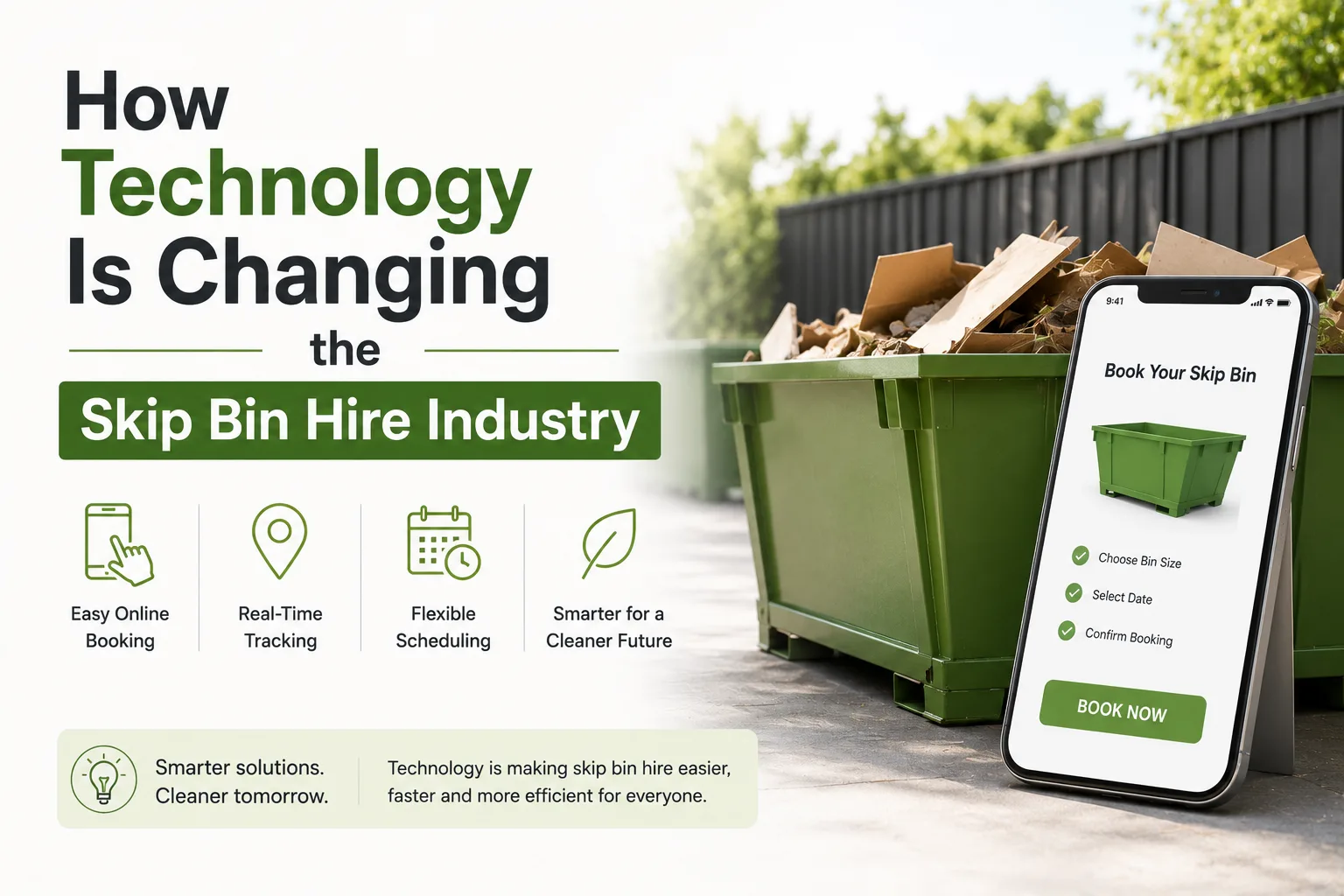
Skip bin hire has traditionally been a fairly manual industry, phone bookings, paper job sheets, and drivers working out their own routes based on experience. That's shifting. Across Australia and internationally, waste management operators are adopting GPS tracking, route optimisation software, online booking platforms and smarter sorting technology to run more efficient, transparent operations. This article looks at how technology is changing the skip bin hire industry, from the systems working behind the scenes to the tools customers now interact with directly.
From Paper Job Sheets to Digital Booking Systems
For most of the industry's history, booking a skip bin meant a phone call, a rough description of the job, and a written note passed along to a driver. Online booking platforms have changed that process considerably. Customers can now select a bin size, enter a postcode, choose a waste category and get a quote in minutes, without needing to speak to anyone. This shift toward digital booking systems for skip bin hire has made pricing more transparent and given customers a clearer sense of what to expect before a truck ever leaves the yard.
On the operator side, digital systems also reduce the back-and-forth that used to happen over the phone, since waste category, delivery address, and access notes are captured upfront rather than relayed verbally between customer, office and driver.
GPS Tracking and Fleet Visibility
GPS tracking has become one of the more significant additions to waste management fleets in recent years. Devices fitted to trucks and, in some cases, to the bins themselves allow operators to see exactly where a vehicle or container is at any point in time. Waste-tracking technology provider Geoforce notes that this kind of monitoring helps ensure containers are placed in optimal locations and reduces the time and resources spent locating misplaced equipment (see Geoforce's overview of GPS tracking in waste management).
For skip bin operators specifically, this has practical value: it becomes far easier to confirm a bin has actually been delivered or collected, track how long a bin has been on site, and respond quickly if a customer asks where their delivery is.
Route Optimisation Software
Route planning used to rely heavily on a driver's local knowledge and instinct. Increasingly, it's supported by software that analyses live conditions and adjusts accordingly. Waste collection route optimisation platforms generally work by analysing traffic, road conditions, waste volumes and vehicle capacity, then generating routes that can adjust in real time when conditions change, as outlined in NextBillion.ai's guide to waste collection route optimisation.
The impact of this isn't purely about convenience. Reducing unnecessary driving distance has a direct effect on fuel use and operating costs, and by extension, emissions. Academic research published in the journal Waste Management has examined how route optimisation models can link cost savings with emission reduction as part of broader sustainability goals, a study available via ScienceDirect.
Smart Bins and IoT Sensors
While more common in municipal kerbside collection than skip bin hire specifically, Internet of Things (IoT) sensors are worth understanding as part of the broader shift in the waste sector. Fill-level sensors placed in bins allow operators to monitor capacity remotely rather than relying on fixed collection schedules. Research on IoT-based smart collection systems has found that directing trucks only to bins that are genuinely full can meaningfully cut fuel use and emissions, with one project reporting operational cost reductions of roughly a third, according to a study published on arXiv.
For larger commercial and construction skip bin arrangements, this kind of sensor-based monitoring is starting to appear as an option, allowing a business to be notified when a bin is nearing capacity rather than guessing at collection timing.
Data and Reporting for Waste Recycling
Technology isn't only changing how bins get delivered and collected, it's also improving how operators track what happens to the waste afterwards. Digital reporting systems make it easier to record how much material from a given load is recycled versus sent to landfill, which supports both regulatory compliance and more accurate customer-facing information. Industry analysis from waste technology firm Basestation points to data analytics platforms turning collection data into forecasting and compliance insights, alongside AI-assisted recycling systems that improve sorting accuracy.
This matters for skip bin customers too, since it's part of how a provider can confidently report a recycling rate for the waste it collects, rather than relying on estimates.
What This Means for Customers Booking a Skip Bin
Most of these systems operate in the background, but they still shape the customer experience in a few practical ways:
- Faster quotes and bookings, since online systems can calculate pricing instantly based on bin size, waste type and location
- More accurate delivery windows, since GPS-tracked fleets and route optimisation reduce the guesswork in scheduling
- Better waste category guidance, since digital booking flows can walk a customer through what's accepted in a given bin type before it's delivered.
- More transparent pricing, since digital systems reduce the need for phone-based quoting that can vary between calls
If you're comparing options for a project, our page covering bin dimensions and typical use cases reflects this same shift toward self-service information, letting customers work out sizing themselves before making contact.
Where the Industry Is Likely Headed
A few emerging trends are worth watching, even where adoption is still early-stage:
- Predictive and dynamic routing, moving beyond simple GPS navigation toward systems that anticipate waste generation patterns based on seasonal trends, economic shifts and local demand rather than assuming steady, predictable volumes, a shift discussed in NANDO's analysis of next-generation route optimisation
- AI-assisted sorting, using machine vision and robotics to improve recovery rates at recycling facilities
- Autonomous and electric vehicles, which several industry commentators expect to eventually play a role in collection fleets, alongside renewable-powered equipment
- Blockchain-based waste tracking, proposed as a way to create secure, auditable records of where waste travels from collection through to disposal or recycling
Adoption of these varies significantly by market and company size, but the overall direction, more data, more automation, and more visibility for both operators and customers, appears consistent across the sector.
A Note on Adelaide's Skip Bin Market
Locally, the shift toward online booking and digital quoting has made it considerably easier for South Australian households and businesses to compare skip bin sizes and waste categories before committing to a booking. If you're planning a project and want to see how these tools apply in practice, our skip bin size guide and accepted waste categories overview are built around the same self-service approach discussed in this article.
Conclusion
The skip bin hire industry has moved a long way from phone bookings and paper job sheets. GPS tracking, route optimisation software, digital booking platforms and smarter waste reporting are changing how operators run their fleets and how customers interact with the service, often without either side thinking of it as "new technology" anymore. As sensor-based monitoring, predictive routing and AI-assisted sorting continue to mature, the gap between how waste management used to work and how it works now is likely to keep widening.
Frequently Asked Questions
How does GPS tracking benefit skip bin customers directly?
It allows operators to confirm delivery and collection times more accurately and respond quickly to questions about where a bin or truck currently is.
Are IoT sensors common in residential skip bin hire?
They're more established in municipal kerbside collection at this stage, though fill-level monitoring is starting to appear in larger commercial and construction bin arrangements.
Does route optimisation actually reduce costs for waste operators?
Research suggests it can. Studies on IoT-based route optimisation have recorded operational cost reductions of around one-third in some projects, alongside meaningful cuts to fuel use and emissions.
Will autonomous trucks be used for skip bin delivery soon?
Not widely yet. It's discussed as a future direction in industry commentary, but current adoption in the skip bin sector remains limited.
How does online booking improve pricing transparency?
Digital booking platforms calculate pricing instantly based on standardised inputs like bin size, waste category and location, reducing the variability that can come with phone-based quoting.