The phrase "best restaurant near me" is quietly losing ground. Diners still want a great meal, but the way they hunt for one has shifted. Instead of scrolling a list of ten blue links, more of them now ask ChatGPT or Perplexity something conversational: a spot with good vegan options, nice for a first date, open late on a Sunday. The AI reads across the web and hands back two or three names. If your restaurant is not one of them, you were never in the running.
That is the real challenge behind Restaurant Online Visibility in 2026. It is no longer only about star ratings and a tidy Google listing. It is about whether AI systems understand your restaurant well enough to confidently recommend it when a hungry person asks a specific question.
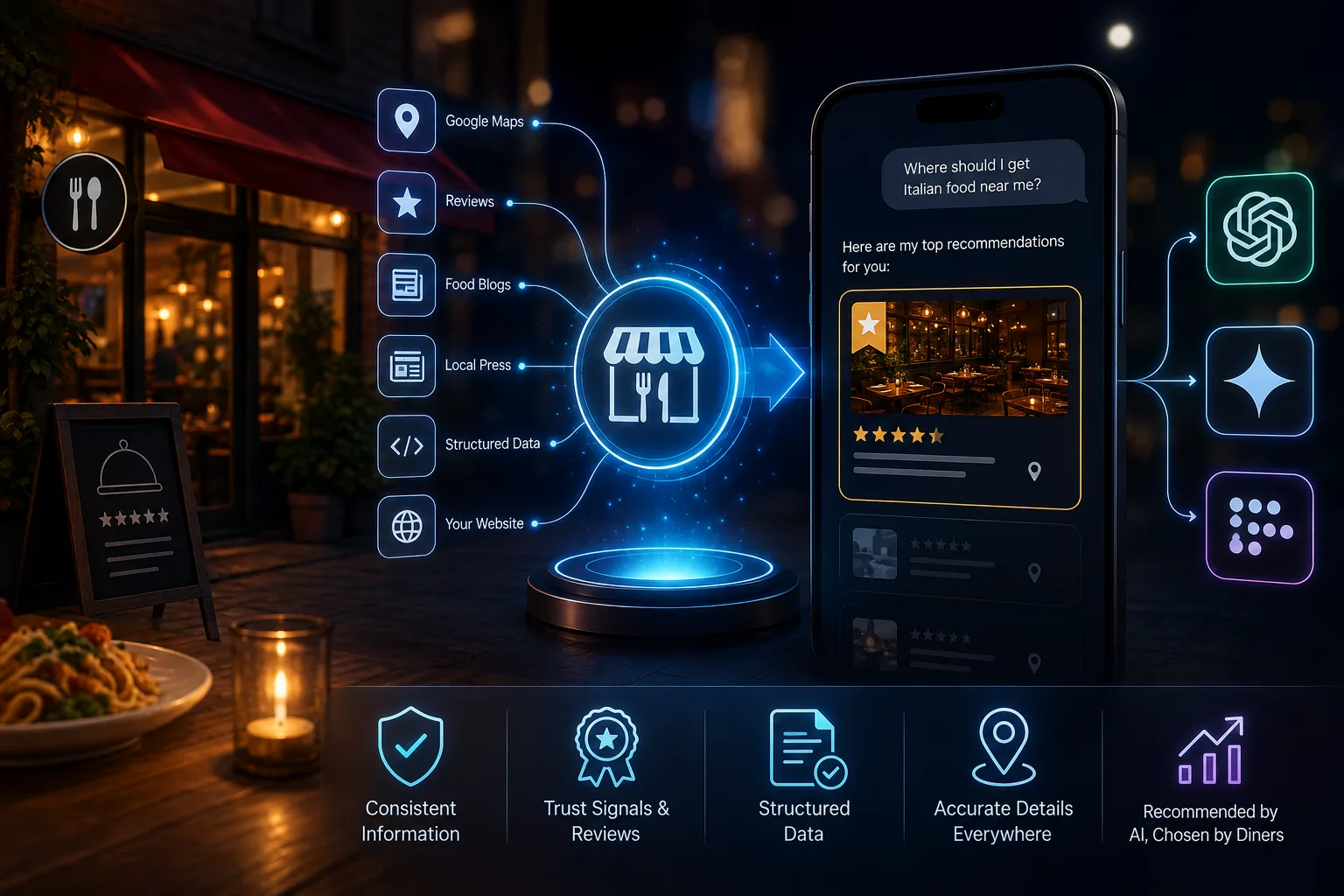
Short answer: A restaurant gets recommended by AI when its core details, cuisine, location, hours, standout dishes, and dietary options, are structured clearly and reinforced by trusted local sources. AI tools like ChatGPT, Perplexity, and Google AI Overviews pull from that clarity to name specific businesses inside their answers.
Why AI Search Changed the Rules for Restaurant Discovery
Traditional search gave every diner a list and let them choose. AI search does the choosing first. It filters, compares, and returns a short recommendation, often before the user visits a single website.
This compresses your competition. Ten listings on a results page become three names in an AI answer, and the businesses that get named tend to win the table. For a restaurant, that is the difference between a full Friday night and a quiet one.
The uncomfortable part is that a strong reputation does not automatically translate. A packed local favorite can still be invisible to AI if its information is scattered, inconsistent, or buried in a format the models struggle to read.
What Makes an AI Tool Confident Enough to Name Your Restaurant
AI systems do not guess when they recommend a business. They lean on signals they can verify and trust. Three matter most for restaurants.
First is clarity of core information. Your cuisine type, neighborhood, price range, hours, and signature offerings need to be consistent everywhere they appear. When an AI finds the same facts stated the same way across multiple sources, its confidence climbs.
Second is structured data. This is the behind-the-scenes formatting that tells a machine exactly what it is looking at, that "Sunday roast" is a menu item, that you are open until 11pm, that you serve gluten-free options. Humans infer this. Machines need it spelled out.
Third is local authority. Mentions in credible local sources, food guides, and community listings act as trust votes. The more reputable places that reference you consistently, the more an AI treats you as a safe answer to recommend.
How Restaurant GEO Differs From the SEO You Already Do
If you already run some SEO, you are not starting from zero, but you are missing a layer. Traditional SEO fights for a ranking position on a page of links. Generative Engine Optimization aims for something different: a direct mention inside the answer itself.
The two overlap but reward different work. SEO leans heavily on keywords and links. GEO leans on data clarity, entity relationships, and how trustworthy your information looks to a model that is summarizing rather than listing.
A practical way to see the split: SEO helps a diner find your website. GEO helps an AI assistant say your restaurant's name out loud when the diner never opens a browser at all. Many of the same principles that drive ranking on perplexity answers apply to restaurants specifically, since these platforms weigh clear, well-sourced information heavily when they generate local recommendations.
A Simple Checklist Before You Invest in AI Visibility
Before spending on any agency or tool, run your own quick audit. It costs nothing and tells you where you stand.
Open ChatGPT, Perplexity, and Google's AI Overview. Ask each the kind of question a real diner in your area would ask, something like a good place for dinner in your neighborhood with your cuisine. Note whether your name appears at all, and which competitors show up instead.
Then check your consistency. Are your hours identical across Google, your site, and major listings? Does your cuisine get described the same way everywhere? Is your menu readable, or trapped inside an image or PDF a machine cannot parse easily?
Finally, ask whether credible local sources actually mention you. If the only place your restaurant exists online is your own website, AI systems have little external evidence to trust.
If those three areas, appearance, consistency, and outside mentions, all come back weak, that is your starting point. It also explains why a restaurant with great food can still be missing from AI recommendations.
What a Focused Restaurant GEO Approach Actually Involves
A structured effort usually moves through a few connected stages rather than one quick fix. It starts with AI search optimization that maps how discoverable you are today and where the gaps sit.
From there, structured content optimization cleans up how your information is formatted so machines read it correctly. Local authority building then strengthens the outside signals, the mentions and references that make an AI trust you as a recommendation. And ongoing attention to your broader Google presence keeps the traditional and AI layers reinforcing each other.
The reason this tends to work faster than classic SEO is that AI systems respond quickly to clean, well-structured information. Fix the clarity and the signals, and models can start picking you up in a matter of weeks rather than the many months traditional ranking often demands. NotionX, which handles this kind of restaurant work behind the scenes so owners can stay focused on service, points to early visibility movement in that shorter window when the underlying data is corrected properly.
None of this replaces good food or genuine hospitality. It simply makes sure that when someone asks an AI where to eat tonight, the answer has a real chance of being you.
The One Shift Worth Acting On Now
Diner behavior is moving toward conversational search faster than most restaurants are adapting, which means early movers gain an outsized advantage. AI systems favor sources they already trust, so the restaurants that get their information clean and their local signals strong now will be the defaults later, harder for latecomers to displace.
The kitchen still matters most. But being findable is the part that fills the seats, and increasingly that means being the name an AI says first.
Want to see where your restaurant currently stands in AI answers? Claim an AI visibility audit and find out exactly which recommendations you are showing up in, and which you are missing.