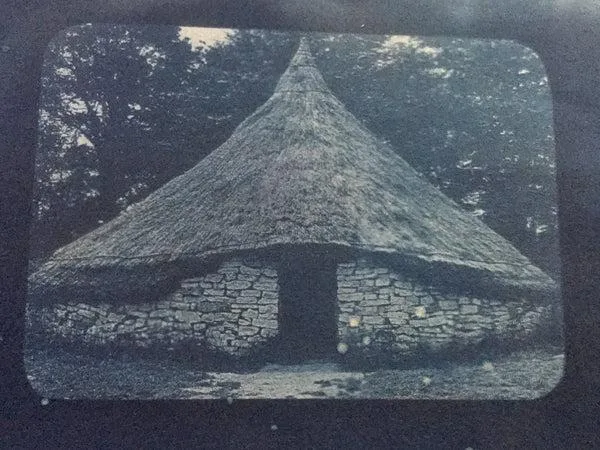
Buildings hold their own kind of history, visible in the wear of a doorway, the settling of stone, or the details a builder chose for no purely practical reason. For a printmaker working from photographs, that history becomes raw material. Architectural art prints at Hummingbird Fine Arts draw directly from Frank and Brooke Remmert's travels, turning historic structures across several countries into limited-run prints built through solar plate etching and cyanotype.
Cyanotype and the Missions of New Mexico
Frank's Early Spanish Missions of New Mexico series uses cyanotype, a photographic printing process that produces a distinctive blue tone, to document churches built centuries ago under Spanish colonial rule. Pieces like San Miguel Mission, Santuario de Chimayo, and St. Francis Cathedral - Santa Fe aren't reinterpretations so much as records; the cyanotype process stays close to the photographic source while giving it a handmade, slightly uneven quality that a straight photograph doesn't have. San Miguel Mission Bell Tower isolates a single architectural detail rather than the full facade, which is often where the most interesting print comes from — a bell tower's proportions say as much about the building's era as the whole structure does.
This series matters beyond its visual appeal. These missions are working buildings with documented construction histories, and printing them in cyanotype ties a contemporary art practice back to a very old photographic method, itself over 180 years old.
Cyanotype Applied to Dwellings Worldwide
Frank extends the same cyanotype technique globally in The Diversity of Mankind's Dwellings series, comparing structures across cultures and eras. Acoma Pueblo sits alongside Langeais Château, a French Renaissance castle, and Mayan House, drawing a direct visual line between vastly different building traditions using the same printmaking process for each. Printing unrelated structures in the same technique and tone makes their differences and similarities easier to see side by side than a straight photograph collection would.
Solar Plate Etching and Global Doorways
Where cyanotype gives Frank's mission and dwelling work its blue-toned consistency, solar plate intaglio brings more contrast and detail to Brooke’s Architecture Around the World collection. Sintra Dreams, based on a photograph of Sintra Castle in Portugal, uses pressure printing and etching on plexiglass to capture the castle's texture and age. The Astronomical Clock - Prague takes on one of Europe's most detailed surviving medieval mechanisms, translating its ornamentation into a print rather than a photograph. Terracotta Angel and The Bagpipe Angel shift from architecture into architectural sculpture, showing that Brooke’s interest extends to the decorative figures built into historic structures, not just the structures themselves.
Why the Print Matters as Much as the Subject
None of these pieces function as documentary photography, even though most begin as photographs Frank and Brooke took while traveling. The printmaking process changes what the viewer sees: cyanotype flattens color into a single tone that emphasizes shape and shadow, while solar plate etching keeps more surface detail but adds the texture of an inked plate and a hand-cranked press. A photograph of the Astronomical Clock in Prague and a solar plate print of the same clock are not the same object, as the print asks the viewer to look at proportion and pattern rather than color and light.
Pro tip: When displaying architecture-based prints together, group them by process rather than by subject. A cyanotype grouping reads as a cohesive set even across different buildings and countries, while mixing cyanotype and solar plate pieces in one cluster can feel visually disjointed.
Frequently Asked Questions
1- What's the difference between cyanotype and solar plate etching?
Cyanotype uses light-sensitive chemistry to produce a photographic image in a single blue tone. Solar plate etching also uses light exposure, but etches the image into a metal or plastic plate that's then inked and run through a press, producing full-color or tonal detail rather than a single color.
2- Are these prints based on real historic buildings, or artistic interpretations?
They're based on real structures Frank and Brooke Remmert photographed directly, including specific missions in New Mexico and named landmarks in Portugal, the Czech Republic, and France.
3- Can architecture-based prints work in a modern interior?
Yes. The abstraction that comes from cyanotype and solar plate processes tends to soften a building's literal detail, which allows these prints to sit comfortably in contemporary spaces rather than only period-appropriate ones.
Hummingbird Fine Arts offers architectural art prints for sale drawn from historic missions, ancient dwellings, and landmark structures across several countries. The studio's original online artwork collection includes both cyanotype and solar plate work, giving collectors access to printmaker-made pieces at a range of price points. Those interested in original art for offices or study spaces can browse the full Architecture Around the World collection directly on the Hummingbird Fine Arts website.
Contact them for any queries.