Enterprise AI application development is moving toward systems that can work with business-specific information rather than relying only on the knowledge built into a general-purpose AI model. In 2026, an AI Development Company can combine technologies such as large language models, Retrieval-Augmented Generation (RAG), machine learning, NLP, APIs, and enterprise data sources to build applications around specific business requirements.
RAG has become an important part of this development approach because it allows AI applications to retrieve relevant information from connected data sources and use that information when generating responses.
Where RAG Fits Into Enterprise AI Development
RAG is not a standalone AI application. It is an architecture that can be incorporated into a larger AI solution.
For example, an enterprise AI application may need to work with thousands of internal documents, product records, support resources, technical files, or company policies. Instead of expecting the language model to contain all of this information, developers can create a retrieval layer that searches the relevant business data and provides useful context to the model.
This makes RAG particularly relevant when developing AI applications that need to work with frequently changing or organization-specific information.
How RAG Improves AI Applications
The usefulness of an enterprise AI application depends heavily on the information available to it. RAG can help connect an AI model with current and relevant business information at the time a user makes a request.
For example, an AI-powered support application can retrieve relevant product documentation before generating an answer. An internal knowledge application can retrieve company policies or operational documents when employees ask questions.
The objective is not simply to add RAG to an application. Developers need to design the retrieval process, data sources, permissions, model integration, and response generation around the application's actual purpose.
Enterprise AI Applications That Can Use RAG
RAG can support a wide range of custom AI applications.
Enterprise knowledge systems can help employees find information across internal documentation and business resources.
AI customer support applications can retrieve product information, troubleshooting documents, service policies, and other relevant resources before generating responses.
Document intelligence applications can combine document retrieval with language models to help users analyze large collections of business documents.
Internal enterprise search can provide a conversational interface for finding information across different business repositories.
Product knowledge applications can connect AI systems with product catalogs, specifications, manuals, and frequently updated information.
RAG can therefore become one component of a broader enterprise AI software strategy.
RAG Architecture for Custom AI Applications
A production RAG system generally involves multiple components working together.
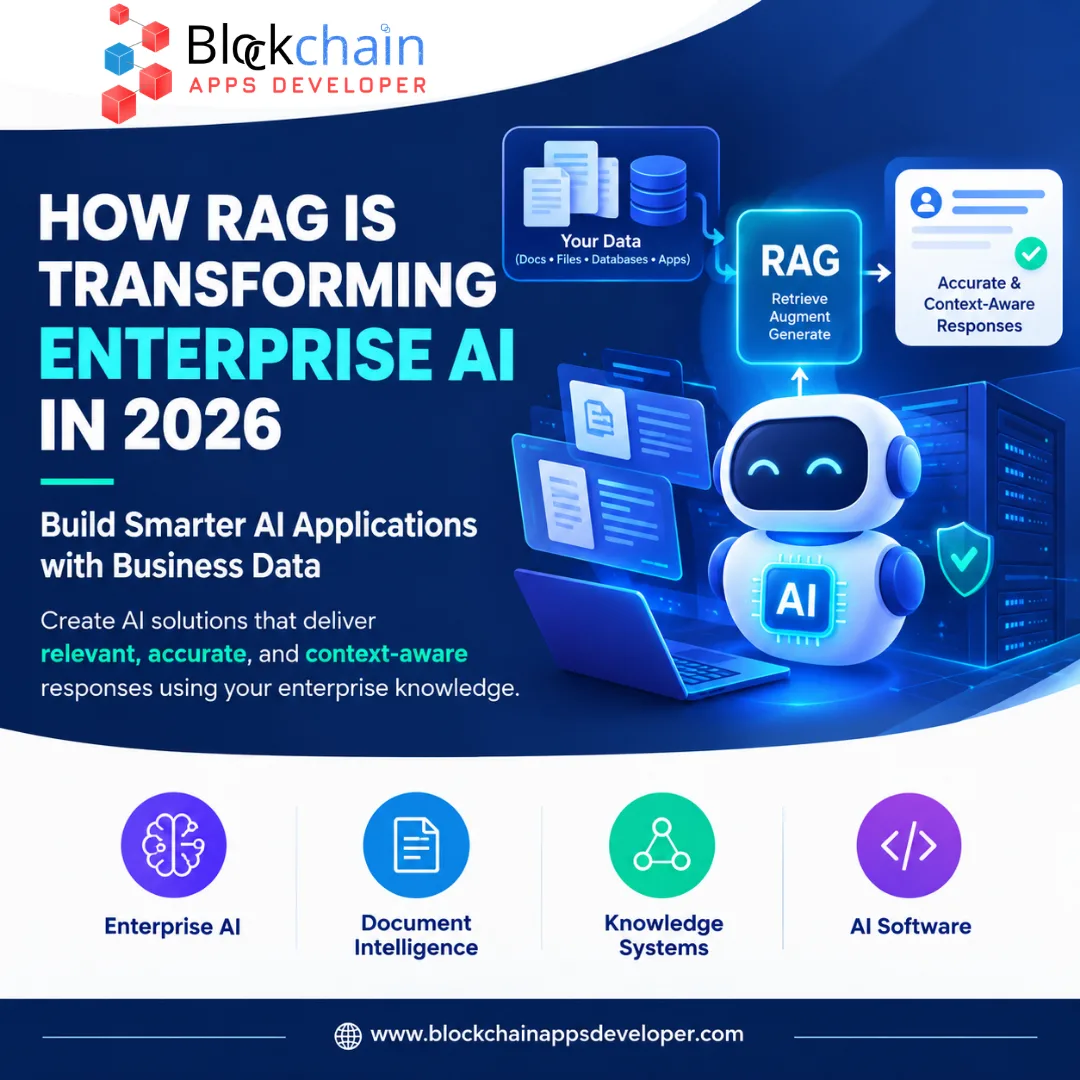
Business Data → Data Processing → Embeddings → Vector or Hybrid Search → Retrieval → Context → LLM → Response
Business documents and other data sources first need to be processed and prepared for retrieval. Embedding models can represent information in a form suitable for semantic search, while vector databases can store and retrieve those representations.
Depending on the application, developers may also use keyword search, hybrid retrieval, reranking, metadata filtering, and other techniques to improve the relevance of retrieved information.
The retrieved context is then provided to the language model, which generates the final response within the application's workflow.
RAG Development With LLMs and Enterprise Data
Modern RAG development often involves more than connecting a vector database to an LLM.
Developers need to consider the business data sources, data processing pipeline, embedding model, retrieval strategy, language model, API integrations, authentication, access permissions, monitoring, and evaluation.
For enterprise applications, permissions are especially important. Different users may have access to different documents or business information. The retrieval system therefore needs to respect the application's existing authorization structure.
Data freshness is another consideration. If business information changes regularly, the retrieval pipeline needs a suitable process for updating indexed information.
Key Considerations When Developing RAG-Based AI Applications
RAG can improve how an AI application accesses business information, but implementation quality matters.
Businesses should consider the quality and structure of their source data, retrieval accuracy, data freshness, security, access controls, model selection, scalability, and application performance.
Evaluation is also important. A RAG application should be tested using realistic business questions to determine whether it retrieves appropriate information and produces useful responses.
Security should be considered throughout the architecture, particularly when applications process confidential company information or customer data.
Building RAG-Powered Enterprise AI Solutions
RAG is most valuable when it is connected to a clearly defined business requirement. A company may need an AI knowledge assistant, document analysis system, customer support application, internal search platform, or another AI-powered workflow.
The development approach should therefore begin with the business problem rather than the technology alone. Developers can then determine whether RAG is appropriate and select the models, data sources, retrieval methods, integrations, and infrastructure required for the application.
An AI Development Company can help businesses design and develop these custom AI applications by combining RAG with LLMs, NLP, machine learning, AI software, APIs, databases, and enterprise systems.
Final Thoughts
Enterprise AI development in 2026 is increasingly focused on building applications that can work with relevant business information and fit into existing workflows. RAG provides a practical architecture for connecting generative AI models with external knowledge sources without treating the model as the only source of information.
However, successful RAG development depends on the complete system. Data quality, retrieval strategy, model selection, security, permissions, integrations, evaluation, and scalability all influence how useful the final application becomes.
For businesses exploring enterprise AI, RAG can be one component of a broader development strategy that combines intelligent models with business data and real-world applications. When implemented around a specific business requirement, it can help create AI software that is more closely connected to the information and workflows an organization actually uses.