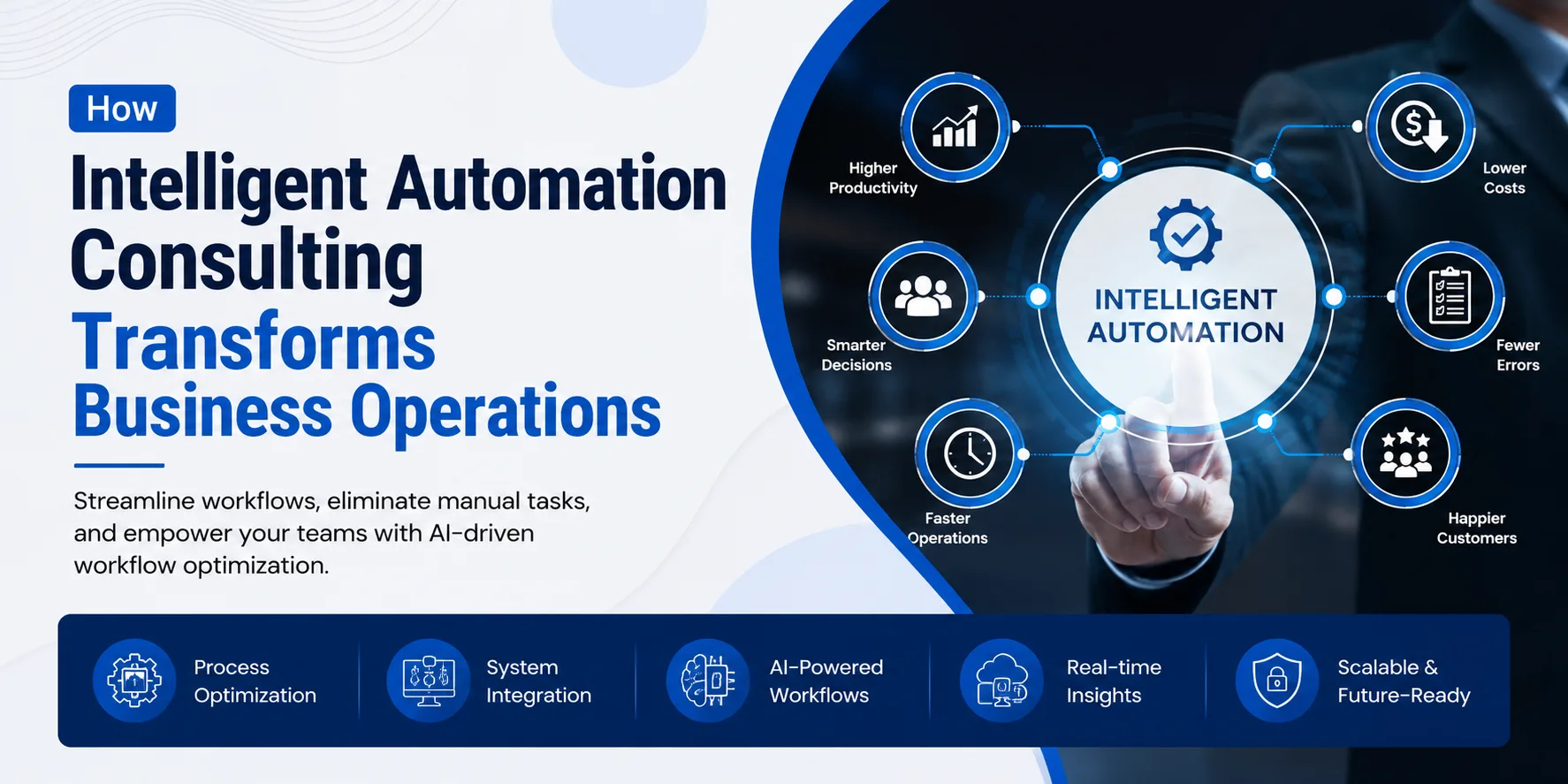
How Intelligent Automation Consulting Transforms Business Operations
Most businesses don't have a technology problem. They have a process problem, and AI Workflow Optimization is what helps them finally fix it. If your team is constantly putting out fires, chasing updates, or redoing work because something slipped through the cracks, the issue usually isn't the people. It's the way work is set up. Hence Workflow Automation Services are helping companies across the USA and India rethink how operations actually run, when paired with proper consulting, don't just speed things up. They change how decisions get made, how teams communicate, and how work moves from one step to the next.
This post looks at what intelligent automation consulting actually involves, how it changes day to day operations, and why more businesses are treating it as a serious investment rather than a nice to have.

What Intelligent Automation Consulting Actually Means
A lot of people hear "automation consulting" and think it's just about picking software. It's not.
Intelligent automation consulting starts with understanding how your business actually works. Not how it's supposed to work on paper, but how things actually happen day to day. Where do tasks stall? Where do people spend the most time on things that shouldn't need human attention? Where does information get lost between systems?
Once you understand that, you can start designing solutions that actually fit. The consultant's job is to connect the problem to the right approach, whether that's basic automation, AI driven decision making, or full system integration.
Where Most Businesses Go Wrong Before Consulting
Plenty of companies try to automate before they understand their own processes. They buy a tool, set up some workflows, and then wonder why things don't improve much.
The problem is usually that automation amplifies what's already there. If a process is broken, automating it just means the broken version runs faster. That's not progress.
AI Workflow Optimization only works well when the underlying process makes sense first. Consulting helps you get that right before anything gets built.
The Operational Areas That Change the Most
Workflow Automation Services consulting is done properly, a few areas tend to see the biggest shifts.
Approvals and sign offs. In most organizations, approvals are one of the biggest sources of delay. Work sits in someone's inbox waiting for a response. Automation can route requests automatically, send reminders, escalate if needed, and log everything without anyone having to chase it manually.
Data handling. Teams spend a huge amount of time moving data from one place to another. Pulling reports, updating records, copying information between systems. When systems are properly integrated, most of this happens automatically. People stop being human copy paste machines.
Client and customer communications. Follow up emails, status updates, onboarding steps. A lot of this is predictable and repeatable. Automating the routine parts frees people to handle the conversations that actually need a human touch.
Internal reporting. Instead of someone spending hours each week pulling numbers together, automated dashboards pull the data in real time. Teams make faster decisions because the information is always current.
How AI Changes What Automation Can Do
Basic automation follows rules. If this happens, do that. It works well for straightforward, predictable tasks.
But AI Workflow Optimization goes further. It can look at patterns, learn from past outcomes, and make better decisions over time. For example, instead of routing every support ticket the same way, an AI driven system can assess the ticket type, urgency, and context, and send it to the right person automatically.
This kind of intelligence makes automation useful in situations where the rules aren't always clear. And that covers a lot of real business scenarios.
What the Consulting Process Looks Like Step by Step
The first step is always an audit. A good consultant won't start recommending solutions until they understand the current state. That means interviews, process mapping, and looking at where time and effort are actually going.
From there, the team redesigns the process. Not just layering automation on top of what exists, but cleaning up the workflow first so it actually makes sense to automate.
Then comes implementation. Tools get selected, integrations get built, and automations get tested before going live. A good consulting engagement includes that testing phase, not just a handoff.
After launch, the work isn't done. Workflows need to be reviewed and adjusted as the business changes. The best consulting relationships are ongoing, not one-time projects. Hence, many points of Workflow Automation Services are there that help major and minor projects.
Final Thoughts
Intelligent automation consulting works because it treats process improvement as a real discipline, not just a tech project. When the foundation is right, automation and AI can do a lot. But without that foundation, even the best tools underperform.
If your business is ready to look seriously at how work gets done and where it can improve, that's a good place to start. For more information, contact NotionMind, your all in one platform solution partner.