
A job is posted at nine in the morning, by the end of the day there are eighty-seven applications. By the end of the week it is closer to three hundred.
There is someone who has to do something with all of them, figure out who qualifies, who doesn't, who needs to be contacted, who is being moved towards an interview, who needs to be rejected politely before finding out where they stand.
Without an ATS, that someone is a recruiter who has a full inbox, who has a spreadsheet that they have little confidence in and the nagging suspicion they might have missed something great around application one hundred and forty.
With an ATS those three hundred applications are sorted, filtered and ranked before the recruiter opens their laptop. An understanding of the process by which that happens - not theoretically, but in practical steps - is what this guide covers.
Before the Applications Even Start: How ATS Works at the Job Posting Stage
Most discussions on how ATS systems work begin with resume parsing. The reality is that the process begins earlier, at the creation of a job in the system.
When a recruiter designs an ATS job, they are setting up the logic for how every application for the role will be processed. The criteria for required qualifications, preferred experience, must-have skills, and knockout questions, are all decided on before a single person applies.
Knockout questions are worth elaborating on in isolation, as they are where the first level of filtering in the process occur. The answers to questions asking minimum years of experience, what certifications are needed, if a candidate is open to relocation, or which locations qualify them for the job are handled automatically by the ATS, but those which make it past and those which fall short all begin with the decisions of the recruiter setting up the role.
Once an ATS job is ready, it is distributed. Much of this is the same as you would assume with your own job distribution - post to your careers page, LinkedIn, Indeed, and several other boards at once from one place rather than several, and every application that comes in from any source gets funneled into the same system, with its source flagged for reference.
That sourcing data is important, more than most recruiters use it, as it is a metric of what job boards consistently provide the best candidates for what sort of roles, and will affect where you post your budget goes as well.
How Does an ATS Work? The Full Picture Before the Steps
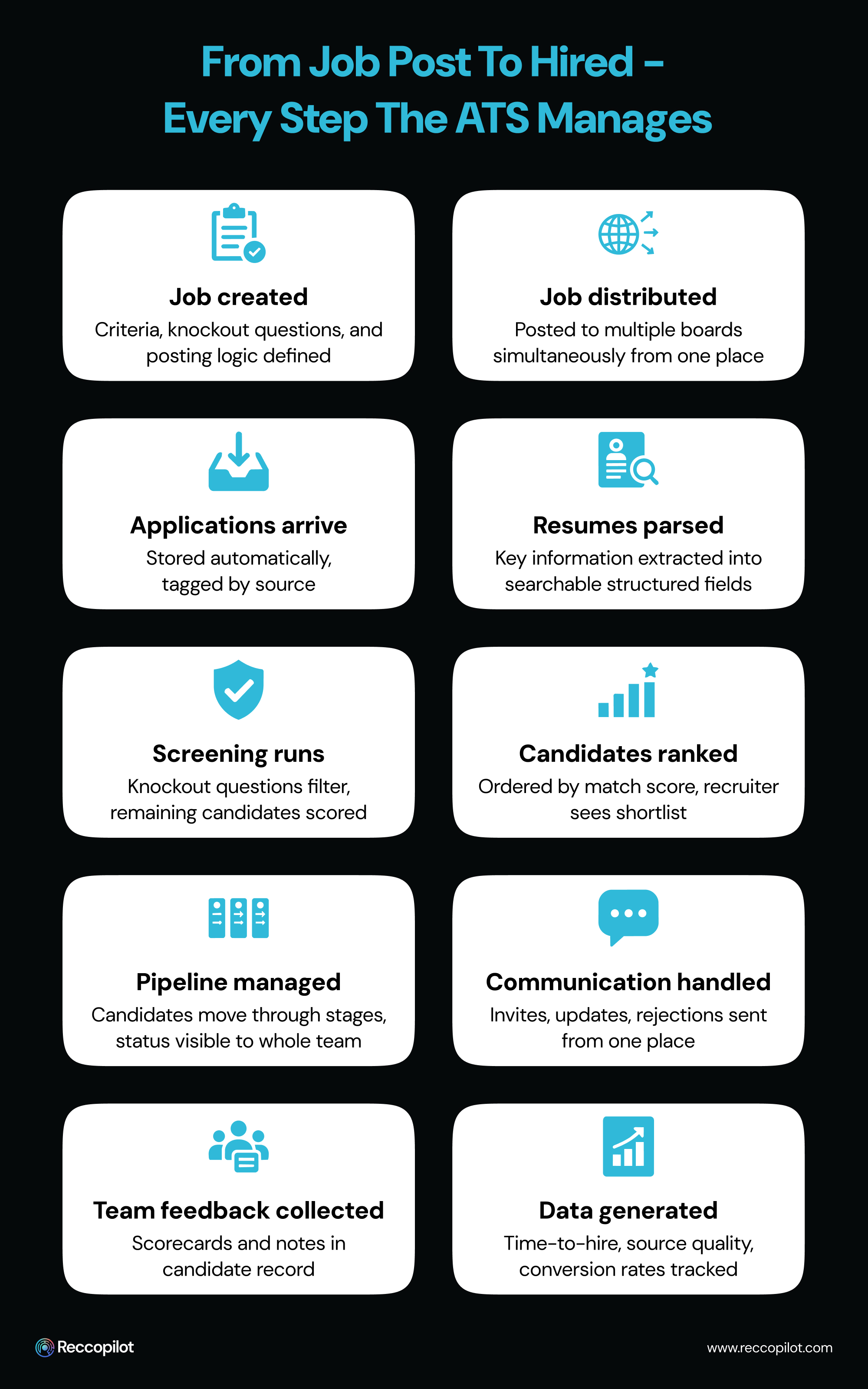
Most people think of an ATS as something that happens to a resume after a submission. The reality is that the system is running before a single application arrives, setting up logic, distributing the job and preparing to process whatever volume comes in. Once it arrives, the ATS moves through a clear set of steps that guide an unknown name in a pile to a decision a recruiter can make on.
How Exactly That Sequence Works:
Step 1: Applications Come in and Get Organized Automatically
When someone applies - through your careers page, a job board, or a direct link - their application doesn't end up in a recruiter's inbox.
It lands in the ATS database.
Contact details, their resume, cover letter, the source they applied from, the role they applied for, the answers to any knockout questions - all of it is stored, organized and ready to be accessed without a single bit of data having to be manually entered. Every applicant gets a record. Every record is searchable by anyone who has access to the hiring team.
This sounds simple, but the operational difference is massive. Applications that arrive by email have to be manually tracked. Applications that arrive in an ATS are organized the moment they land. At low volumes the difference is manageable, at three hundred applications for one role it becomes the difference between a working and non-working process.
Corporate job postings now attract an average of 250 applicants - up 182% since 2021. That volume jump is exactly why ATS software went from a tool for large companies to an infrastructure for teams of almost any size.
Step 2: Resume Parsing Turns Unstructured Documents Into Searchable Data
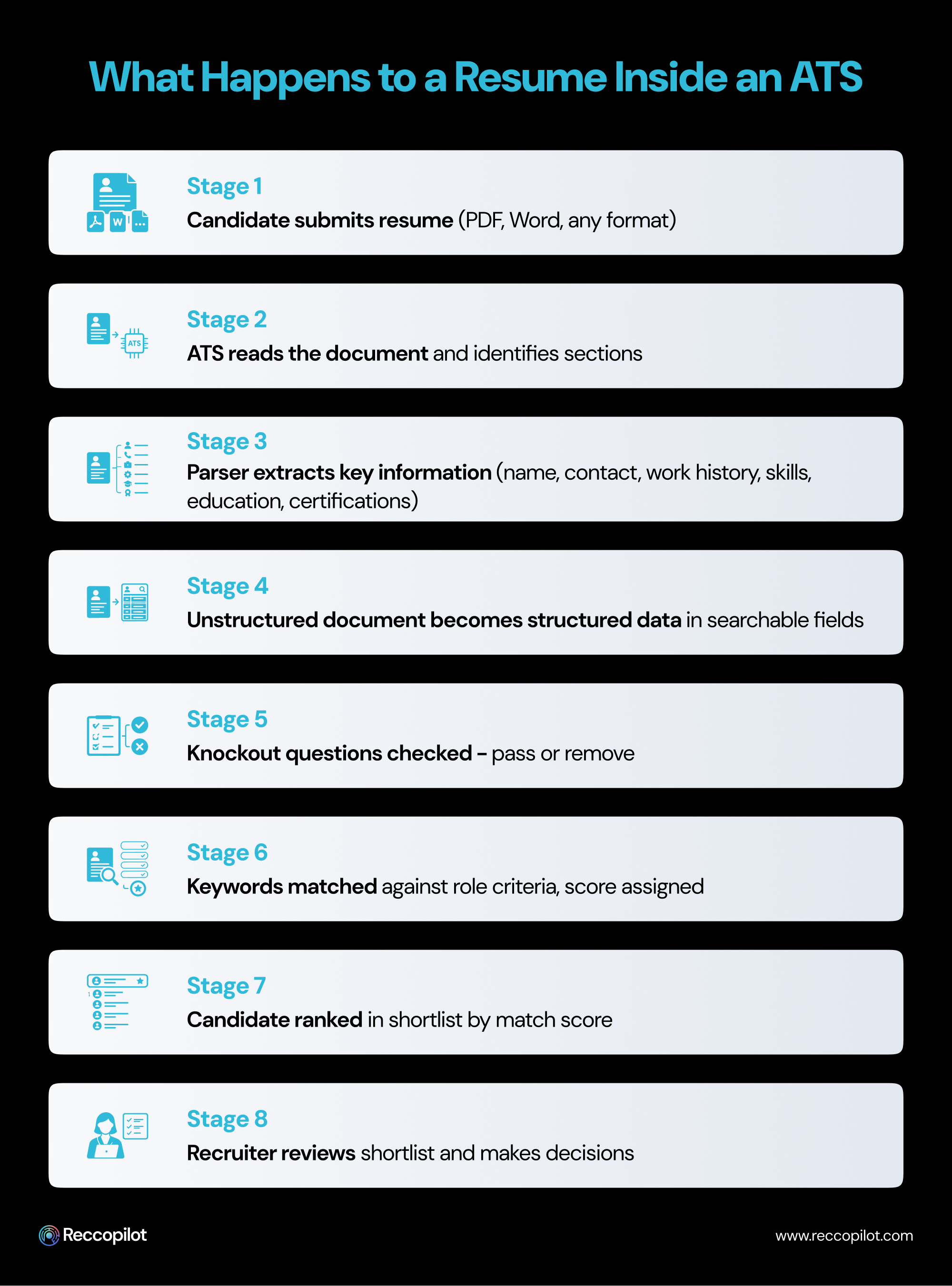
Resumes come in every format imaginable. PDFs, Word documents, different layouts, different section headings, different ways of describing the same experience. A recruiter adjusting the text to read manually will have an intuitive feel, but a system has to extract the relevant information regardless of presentation.
This is what resume parsing does. The ATS reads each resume and pulls out the key information - name, contact details, education, work history, skills, certifications - in structured fields that can be searched and compared across hundreds of applications at once.
The best parsing technology hits right around 95% accuracy compared to human processing. The remaining 5% is worth knowing, as unusually formatted resumes, non-standard section headers or documents parsed incorrectly can misrepresent a candidate in the system. It is one of the legitimate reasons a qualified candidate can appear weaker in an ATS than they would in person.
Once parsed, every resume becomes searchable. Instead of opening each document to find, a recruiter can search across the entire pool of applicants for qualifications, skills, or experience in seconds. Search for 'project management' and every candidate that mentioned it, anywhere in their resume, is surfaced immediately.
Step 3: Screening Filters Reduce the Pile
Parsing organizes the data. Screening begins reducing it.
Based on the criteria set when the job was created, the ATS filters applications automatically. Candidates who didn't meet the knockout question criteria have already been removed. The remaining applications get ranked based on how well they match the role - skills, experience level, relevant background, keyword presence.
According to a Jobscan survey, 99.7% of recruiters use keyword filters in their ATS to identify candidates worth interviewing. The specific things they filter by most are job title (55.3%), certifications or licenses (50.6%), years of experience (44.3%), and location (43.4%).
This is the stage that gets the most attention, and the most criticism - as it is where qualified candidates can fall out of the process without a human ever seeing their application. The system is not evaluating fit in a nuanced sense, it is matching what the candidate submitted against the criteria the recruiter set. If those criteria were set up well, the filter works well. If they were set up hastily, or have not been updated since the role evolved, the filter reflects those gaps.
Understanding how applicant tracking software works at this stage also explains something candidates find frustrating - the same resume that gets no response at one company sails through at another. The difference is not always the candidate, it is often the criteria.
Step 4: Candidates Get Ranked and the Recruiter Sees a Shortlist
The result of the screening is ranked, highest match to lowest, and the recruiter sees a prioritized list instead of a chronological pile.
This is the moment how ATS works becomes visible to the hiring team. Instead of starting with three hundred applications, the recruiter opens a ranked shortlist of the most relevant candidates, with their parsed information displayed in a consistent format that makes comparison easy.
The recruiter still makes decisions here, the ATS surfaces candidates by match score. Whether a candidate actually moves forward, gets a phone screen, or gets rejected is still a human call. In a survey of 25 US recruiters, 92% said their ATS does not auto-reject candidates based on formatting or missing keywords alone. The system reduces and ranks, the human decides.
This distinction is important as it is the most common misconception about how do ATS systems work. They are not gatekeepers making hiring decisions, they are filters making the volume manageable so the humans making the actual decisions can do that job well.
Step 5: The Pipeline Moves Candidates Through Stages
Once a recruiter begins engaging with the shortlist, the ATS manages what happens next. Every candidate has a status - applied, under review, phone screen scheduled, interviewing, offer extended, hired, rejected, and the system tracks movement through each stage.
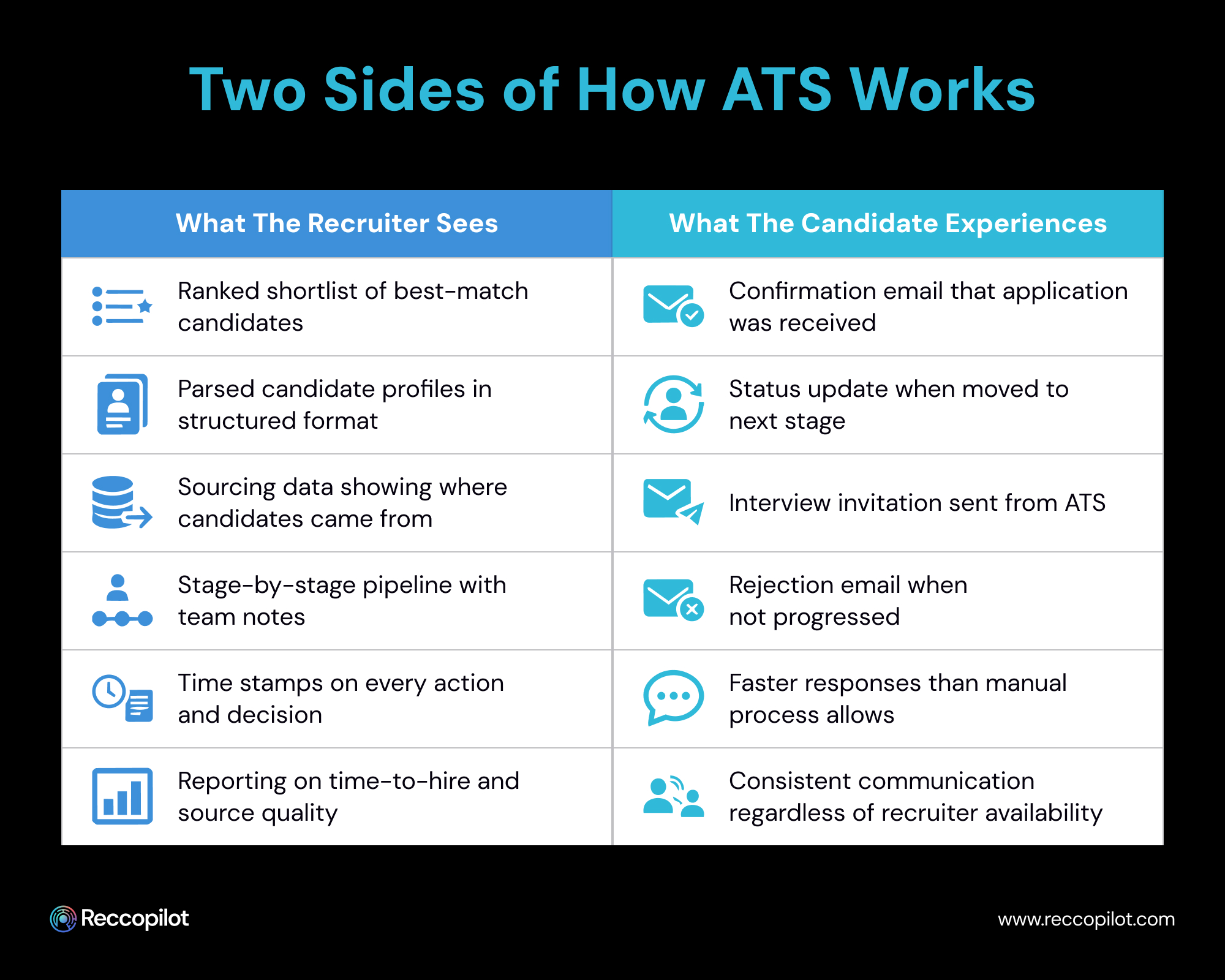
The change to a candidate's status updates their record in real time, and everyone who needs to see it without having to ask each other where things stand. A hiring manager can log in and see which candidates are at which stage without a recruiter sending a status update email.
This pipeline view is what sets how do applicant tracking systems work from a simple database. It is not just storing information, it is managing a workflow with multiple people involved, multiple candidates at different stages, and decisions happening in parallel across all of them.
Step 6: Communication Gets Managed From One Place
Candidate communication is where a lot of recruiting processes quietly fall apart. Interview invitations from personal email accounts, rejection emails that take two weeks to go out because nobody remembered, status updates that never happen at all.
How does applicant tracking software work for communication? Templates, automation, and sending from one place. Interview invitations go out from inside the system. Status change emails trigger automatically when a candidate's stage updates. Rejection messages reach everyone who didn't progress without a recruiter sending each one.
The candidate experience this creates - faster responses, consistency, timely updates - reflects on the employer brand in ways that will compound over time. How a company treats applicants who don't get the job shapes how those people talk about it afterwards.
Step 7: Team Collaboration Happens Inside the System
Hiring is rarely a one-person decision. Interviewers need to share feedback. Hiring managers need to weigh in. Multiple people need to compare notes on the same candidate without them living in different email threads.
This is where ATS software handles something that spreadsheets fundamentally can't. Interview scorecards, shared notes, structured feedback forms - all of it lives in the candidate's record inside the system. A recruiter can see every interviewer's feedback, a hiring manager can review notes from a panel interview, without chasing people individually.
This collaboration capability is often what finally pushes teams from spreadsheet-based tracking to a proper ATS. Not the volume problem, but the coordination issue that gets worse as more people get involved with hiring decisions.
Step 8: Data and Reporting Tell You What's Working
The final piece of how ATS works that most teams under-use is the reporting.
Every action in the system is logged. Every stage change, every time-stamp, every source tag. Over time this data tells you things you genuinely can't know without it - which job boards send the strongest candidates, how long each stage of your process takes, where candidates drop off, which roles take longest to fill and why, what your offer acceptance rate is and how it trends.
Time-to-hire, cost-per-hire, source quality, stage conversion rates - these aren't just vanity metrics, they are the information that tells you where your hiring process is working and where it has bottlenecks. A team that uses this data adjusts continuously, a team that ignores it makes the same mistakes at increasing volume.
Where ATS Falls Short and What's Changing
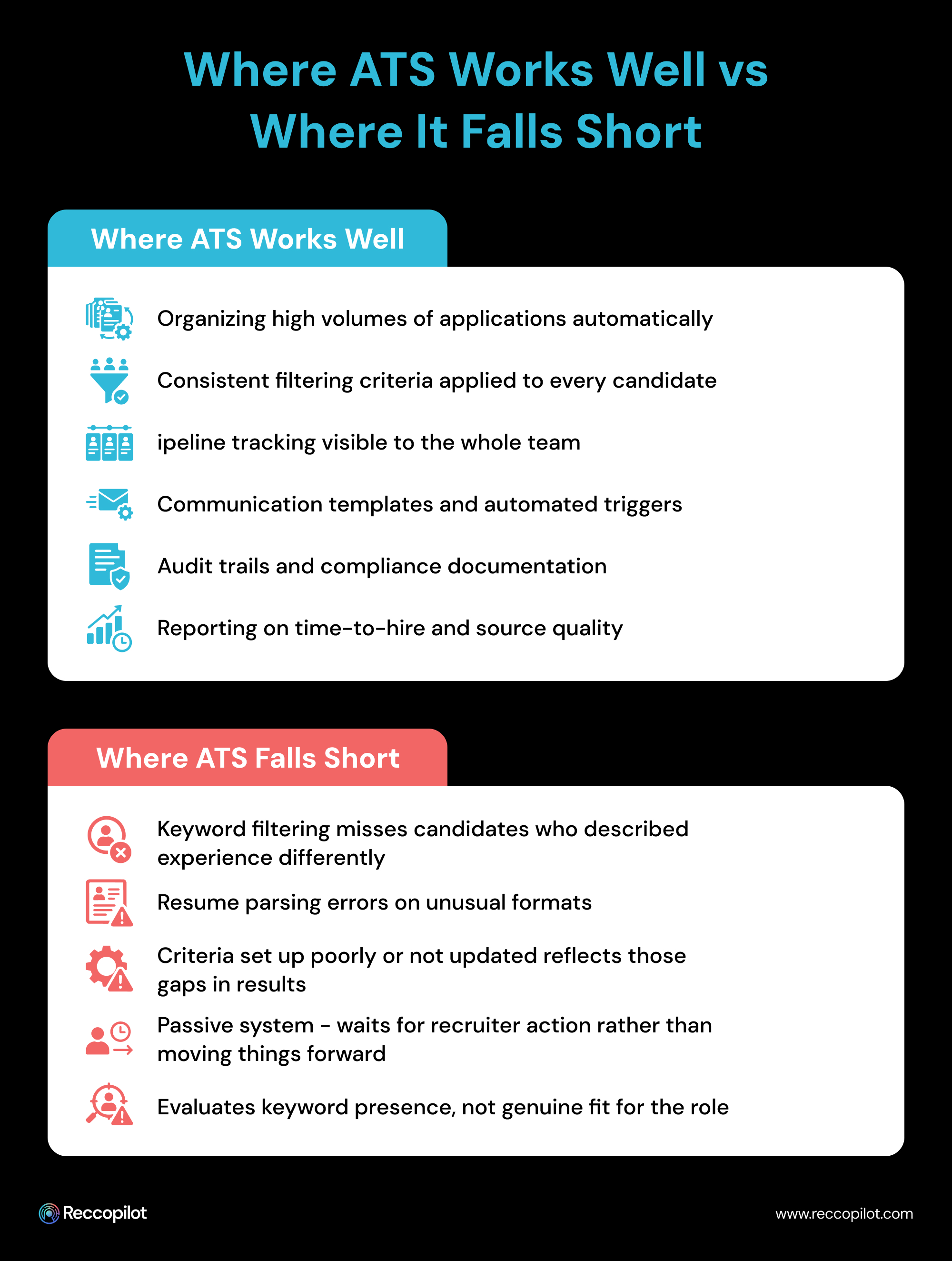
Understanding how does the applicant tracking system work also means being honest about where it doesn't work as well as the marketing suggests.
Keyword-based filtering creates a specific problem every recruiter has encountered: candidates who described their experience in slightly different language get filtered out, while weaker candidates who happened to use the right keywords get through. The system matches patterns, and doesn't evaluate fit.
This gap is why AI-powered recruiting tools are being built on top of or alongside traditional ATS software. Instead of filtering by keywords, they evaluate by context. Instead of ranking by keyword density, they assess relevance. Instead of waiting for recruiter action at each stage, they can move candidates forward autonomously.
Wrapping Up
How ATS works isn't complicated when you follow it step by step. Job posted, applications organized, resumes parsed, applications filtered, candidates ranked, pipeline managed, communication handled, team feedback collected, data generated.
Each step removes a category of manual work that would otherwise fall to a recruiter. Together they turn three hundred applications into a manageable shortlist with a complete record of every decision along the way.
The system doesn't hire anyone, it creates the conditions where the humans doing the hiring can do it well.
FAQs
Does an ATS automatically reject candidates without a human seeing their application?
This is the most searched question about how ATS systems work and the answer is more nuanced than most people assume. In a survey of 25 US recruiters, 92% said their ATS doesn't auto-reject candidates based on formatting or missing keywords alone. What the ATS does is filter and rank, candidates who don't meet knockout question criteria get removed early, and those which score lowest in keyword matching appear further down the ranked list. A candidate at the bottom of the list may never get reviewed if there are enough strong candidates above them.
How does resume parsing actually work inside an ATS?
When a resume arrives, the ATS reads the document and extracts key information - contact details, work history, education, skills, certifications - into structured fields that can be searched and compared against all applicants. This conversion from an unstructured document into organized data is what makes it possible to search hundreds of applications instantly. The best parsing technology hits right around 95% accuracy. The remaining 5% is where things can go wrong - unusually formatted resumes or non-standard section headers can parse incorrectly, which is one legitimate reason a strong candidate can look weaker in a system than they would in person.
How do applicant tracking systems handle keyword filtering and is it fair?
ATS keyword filtering works by matching what candidates wrote in their resume against the criteria a recruiter set when setting up the role. The system looks for specific job titles, required certifications, years of experience, skills, and location preferences. The fairness question depends entirely on how those criteria were set up. Well-defined, regularly updated criteria tend to surface relevant candidates consistently. Criteria set up hastily or not updated as roles evolved will reflect those gaps.
What information does an ATS actually store and who can see it?
An ATS stores everything that comes in with a job application - resume, cover letter, contact details, knockout question answers, the source the candidate applied from. Plus everything that happens afterwards. Stage changes, interview notes, recruiter feedback, communication history, offer details.