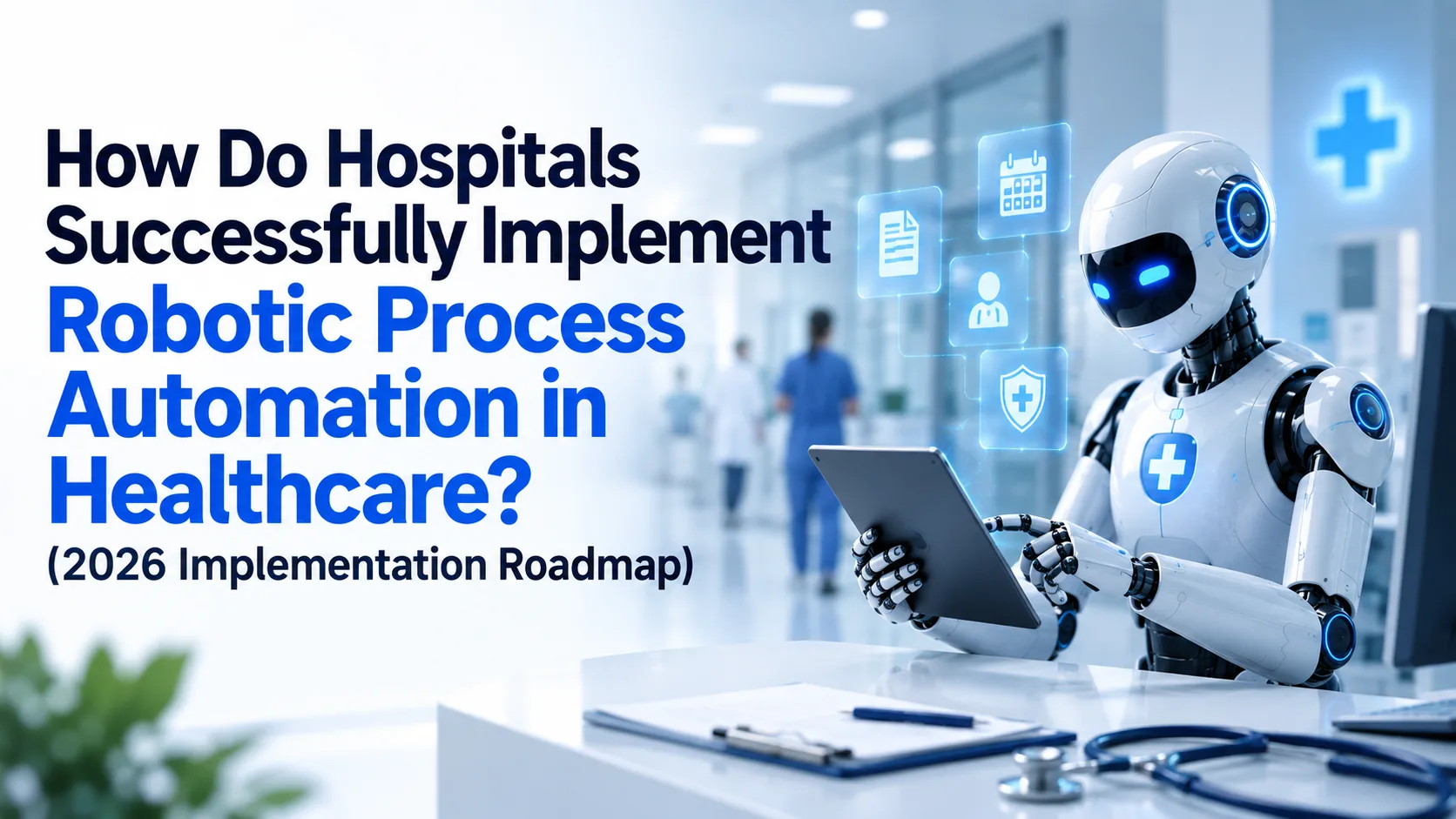
Healthcare administrative costs have climbed to unsustainable heights, consuming over a quarter of every dollar spent on patient care across the United States. Clinical and clerical teams spend hours each day on repetitive digital tasks: copying patient intake numbers across disconnected systems, manually keying in prior authorization codes on commercial payer portals, and tracking down denied claims. These manual touchpoints slow down patient access, drive workforce burnout, and create high rates of clerical error that delay revenue realization.
To resolve this operational gridlock, health systems are turning to robotic process automatio in healthcare. Robotic Process Automation deploys deterministic software robots that emulate human keystrokes, navigation sequences, and data validation steps across digital systems. Software bots bridge legacy Electronic Health Records (EHRs), billing engines, and regional payer clearinghouses without requiring multi-year database overhauls. When combined with clinical natural language processing and optical character recognition, these digital workers operate continuously, eliminating data transcription errors and compressing multi-week administrative backlogs into minutes.
However, nearly half of all initial healthcare RPA pilots stall or fail to scale past their first proof of concept. The failure is rarely due to the robotic software itself; it stems from the absence of a structured implementation roadmap. Deploying bots into mission-critical clinical environments introduces constraints that do not exist in standard commercial IT. Software bots must interact with sensitive Protected Health Information (PHI), navigate fragile virtual desktop environments without locking databases, survive routine EHR software updates, and comply strictly with HIPAA and HITECH mandates.
This operational roadmap outlines the complete six-phase implementation framework for robotic process automation in healthcare, benchmarks the top 10 engineering companies delivering healthcare RPA implementations, and breaks down the governance models required for enterprise-scale success.
Evaluation Framework: Benchmarking Healthcare RPA Implementation Partners
Selecting an engineering partner to guide a health system through an automation roadmap requires technical criteria far beyond standard commercial IT scripting. We evaluated candidate companies based on five core operational benchmarks:
- Healthcare Interoperability and Safe Scripting: Proven engineering capabilities to interface with leading Electronic Health Record platforms (such as Epic, Oracle Health, MEDITECH, and Athenahealth) using both resilient UI-level selectors and secure backend HL7/FHIR protocols.
- Standardized Healthcare Integration Experience: Technical mastery over HIPAA X12 transaction standards (including EDI 270/271 for eligibility, EDI 278 for prior authorizations, and EDI 837/835 for claims and remittances).
- Clinical Safety and Database Concurrency Controls: Architecture designed with keystroke throttling, database lock prevention, and automated fail-safes that immediately route exceptions to human review without corrupting active medical charts.
- Data Privacy and Regulatory Alignment: Strict engineering compliance with HIPAA, HITECH, SOC 2 Type II, and HITRUST requirements, incorporating hardware-isolated credential masking and immutable audit logs.
- Automation Center of Excellence (CoE) Design: The ability to help healthcare organizations transition from an initial pilot project to an internal, self-sustaining governance center that manages digital worker fleets across departments.
Top 10 Companies Delivering Robotic Process Automation in Healthcare
1. Idea Usher
Best suited for: Custom end-to-end healthcare RPA implementation roadmaps, multi-facility EHR bridges, and revenue cycle pipelines.
Idea Usher is a specialized digital health software engineering and automation firm that designs, deploys, and scales custom robotic process automation for hospital systems, ambulatory networks, and health tech enterprises. The company approaches healthcare automation through a comprehensive roadmap methodology, beginning with quantitative process discovery and progressing through infrastructure hardening, bot engineering, clinical acceptance testing, and internal Center of Excellence enablement. Their teams develop both attended desktop assistants and unattended server robots that bridge legacy on-premises clinical backends with modern web portals.
Their primary technical differentiator is their disciplined engineering approach to complex revenue cycle management and patient access workflows. Idea Usher builds automated pipelines that verify patient insurance coverage in real time via electronic data interchange (EDI 270/271 transactions), extract ICD-10 and CPT codes from physician encounter notes, and auto-populate billing claims without manual data entry. Their bots interface directly with insurance clearinghouses to track submission states and automatically correct claims rejected due to minor typographical discrepancies. Every automation workflow built by Idea Usher incorporates end-to-end HIPAA compliance, centralized credential encryption, and HL7/FHIR compatibility to ensure automated tasks protect patient record integrity.
- Core Strengths: Custom healthcare bot development, structured implementation roadmaps, automated insurance eligibility verification, FHIR-compliant data pipelines, and intelligent claims denial remediation.
2. Intellivon
Best suited for: Intelligent process automation (IPA) roadmaps, predictive denial triage, and clinical natural language parsing.
Intellivon operates at the intersection of enterprise artificial intelligence and specialized healthcare automation, developing cognitive process automation systems that handle non-deterministic clinical workflows. While standard RPA relies strictly on fixed, rule-based scripts, Intellivon builds hybrid software architectures combining software bots with specialized machine learning models and clinical natural language processing. This allows health systems to automate workflows involving unstructured physician narratives, handwritten charts, and non-standardized intake forms.
Their technical team builds predictive prior authorization and denial triage pipelines. Intellivon deploys software bots that ingest patient medical charts, evaluate clinical documentation against specific payer coverage criteria, and auto-fill prior authorization requests before submitting them through payer APIs or web portals. Their predictive algorithms inspect claims packages prior to submission, flagging potential medical necessity mismatches or missing clinical documentation to stop denials before they occur. Furthermore, Intellivon provides automated compliance monitoring agents that audit bot transaction logs to ensure all automated data access adheres to institutional data governance standards.
- Core Strengths: Cognitive document processing, predictive claims denial analytics, automated prior authorization workflows, and AI-driven clinical text extraction.
3. UiPath
Best suited for: Enterprise-wide health system orchestration, clinical process discovery, and centralized bot governance.
UiPath delivers an enterprise-grade automation platform widely deployed across large American health systems, regional hospital networks, and academic medical centers. The platform combines robotic task execution with process mining and cognitive document capture, allowing healthcare leaders to identify operational bottlenecks by analyzing digital workflows across hospital departments.
UiPath enables hospital networks to deploy attended desktop robots that assist registration staff with patient check-in, cross-referencing insurance cards against payer clearinghouses in seconds. Its centralized control plane enforces strict role-based access control, detailed transaction audit logs, and automated bot scaling, making it well suited for high-volume institutional environments. Furthermore, UiPath provides pre-trained machine learning models designed specifically to extract structured data from medical invoices, physician order sheets, and insurance cards.
- Core Strengths: Enterprise process mining, pre-trained medical document understanding, attended front-desk automation, and centralized multi-site control planes.
4. Automation Anywhere
Best suited for: Cloud-hosted healthcare automation, generative AI process assistants, and prior authorization workflows.
Automation Anywhere delivers a cloud-native intelligent automation platform (Automation 360) widely utilized across health insurers, pharmaceutical logistics providers, and hospital networks. The platform is designed to scale across distributed clinical networks without requiring heavy local server footprints.
Their engineering focus centers on combining robotic task execution with generative AI models to parse complex payer documentation and medical policy updates. In clinical operations, Automation Anywhere automates prior authorization submissions, referral routing, and pharmacy inventory reconciliation. The platform maintains HITRUST CSF and SOC 2 Type II certifications, ensuring that data processed by cloud bots remains protected under institutional security frameworks.
- Core Strengths: Cloud-native automation architecture, generative AI process orchestration, referral tracking automation, and HITRUST-certified cloud security.
5. SS&C Blue Prism
Best suited for: High-compliance clinical environments, pharmaceutical research trials, and auditable digital worker fleets.
SS&C Blue Prism is an established enterprise automation provider known for developing robust, auditable robotic workers for heavily regulated industries. In healthcare and life sciences, the platform is widely utilized by major hospital networks and clinical research organizations that require comprehensive governance, data provenance, and tamper-proof operational audit trails.
Their software architecture relies on centrally managed digital workers that execute rule-based tasks in virtual environments, isolated from direct user workstations. This design prevents unauthorized data exfiltration and ensures strict adherence to HIPAA and FDA 21 CFR Part 11 requirements. In healthcare systems, Blue Prism digital workers manage inpatient billing reconciliations, clinical trial patient enrollment tracking, and automated reporting of hospital-acquired infection data to public health agencies.
- Core Strengths: Centralized digital worker governance, strict audit logging, clinical trial data automation, and enterprise compliance architectures.
6. ScienceSoft
Best suited for: Custom healthcare IT integration, legacy EHR reconciliation, and ISO 13485-aligned engineering.
ScienceSoft brings over thirty-five years of IT consulting and custom software development experience to healthcare process automation. Operating under ISO 13485 medical device quality standards and ISO 27001 data security frameworks, the company specializes in engineering custom automation solutions that connect legacy hospital software with modern clinical platforms.
Their engineers build software bots that extract clinical findings from scanned paper intake forms and laboratory PDFs, standardizing terminology into SNOMED CT, LOINC, and RxNorm codes before auto-populating patient profiles in the EHR. ScienceSoft also develops automated billing bots that reconcile payments across internal financial software and external clearinghouses, reducing the administrative burden on revenue cycle teams.
- Core Strengths: ISO 13485-certified development processes, clinical terminology standardization, legacy EHR reconciliation, and medical practice management automation.
7. CitiusTech
Best suited for: Payer-provider data interoperability, value-based care reporting, and clinical quality compliance.
CitiusTech is a specialized technology consulting and software engineering firm focused exclusively on healthcare and life sciences. The company develops domain-specific automation routines for health systems, medical technology companies, and health plans, helping them modernize manual operations while maintaining strict regulatory alignment.
Their engineering practice specializes in automating clinical quality reporting and value-based care metrics. CitiusTech builds bots that aggregate patient diagnostic data across disparate clinical databases, compile required quality measures (such as HEDIS and MIPS scores), and format electronic reports for submission to regulatory bodies. Their developers also build automated physician credentialing workflows that verify medical licenses against state licensing boards automatically.
- Core Strengths: Healthcare-exclusive domain expertise, automated HEDIS and MIPS quality reporting, provider credentialing automation, and payer-provider data exchange.
8. Thoughtful AI
Best suited for: Autonomous revenue cycle digital workers, automated claims processing, and electronic payment posting.
Thoughtful AI provides cloud-native automation systems engineered specifically for mid-market healthcare practices, behavioral health clinics, and dental service organizations. The company focuses on deploying specialized, pre-trained digital workers that automate core financial workflows, allowing medical billing offices to scale without linearly expanding administrative headcount.
Their software bots log into commercial payer portals and state Medicaid clearinghouses, download Explanation of Benefits files, and match electronic remittance advice data against open patient accounts in billing ledgers. Thoughtful AI builds intelligent mapping engines that recognize payer-specific adjustment reason codes, automatically posting approved amounts, contractual write-offs, and patient responsibility balances. Their technical infrastructure monitors claim lifecycles continuously, identifying unpaid or stalled claims and generating appeals packets automatically.
- Core Strengths: Pre-built revenue cycle digital workers, automated payment posting, electronic remittance reconciliation, and mid-market clinic specialization.
9. Keragon
Best suited for: Cloud-native HIPAA-compliant clinical workflows, no-code and pro-code medical integrations, and practice management triggers.
Keragon delivers an automation platform built specifically for digital health companies, independent medical groups, and outpatient clinics. The platform provides an API-first environment where healthcare teams can build automated workflows connecting patient engagement portals, billing engines, and EHRs without writing custom middleware.
In clinical practice, Keragon automates patient onboarding, post-visit survey distribution, and chronic care management monitoring. Their architecture ensures that all data processed through automated pipelines is encrypted in transit and at rest, maintaining active Business Associate Agreements with all underlying technical infrastructure. The platform enables practice managers to design visual automation routines that trigger whenever a patient schedules an appointment, changes their insurance coverage, or submits an intake form.
- Core Strengths: Healthcare-exclusive workflow automation, pre-built EHR and billing connectors, native HIPAA compliance, and low-code clinical triggers.
10. Cognizant
Best suited for: Large-scale health plan automation, complex claims adjudication, and enterprise workforce transformation.
Cognizant is an international IT consulting firm with one of the largest specialized healthcare technology practices in the world. The company provides large-scale robotic and cognitive process automation services to national health insurers, large hospital conglomerates, and pharmaceutical enterprises.
Their healthcare practice focuses on automating high-volume transaction lifecycles, particularly around claims adjudication and coordination of benefits. Cognizant engineers fleets of software robots that process claims exceptions, cross-reference coordination of benefits rules across multiple active insurance policies, and automate subrogation reviews. Their automation frameworks handle millions of member transactions annually, enabling healthcare payers and large provider networks to lower administrative transaction costs while meeting strict state and federal turnaround requirements.
- Core Strengths: Large-scale claims adjudication automation, health plan member operations, coordination of benefits management, and enterprise digital workforce scaling.
Comparison Matrix: Top Healthcare RPA Implementation Partners
CompanyBest Suited ForCore Technical SpecializationPrimary Clinical SettingIdea UsherCustom Healthcare Automation RoadmapsCustom bot scripts, FHIR pipelines, and RCM automationAmbulatory networks, hospital systems, and digital health clinicsIntellivonIntelligent Cognitive RPAPredictive claims denial triage, clinical NLP, and prior authorizationMulti-specialty practices, health networks, and billing centersUiPathEnterprise Health SystemsProcess mining, pre-trained medical document AI, and control planesMulti-facility academic medical centers and regional hospital groupsAutomation AnywhereCloud-Native RPA & AICloud-native bot scaling, generative AI orchestration, and HITRUSTIntegrated delivery networks and health insurersSS&C Blue PrismHigh-Compliance EnvironmentsCentralized digital workers, tamper-proof audit trails, and 21 CFR Part 11Academic medical centers and clinical research organizationsScienceSoftLegacy System IntegrationISO 13485 quality standards, terminology mapping, and EHR syncCommunity hospitals, healthcare IT vendors, and clinicsCitiusTechPayer-Provider InteroperabilityHEDIS and MIPS reporting, credentialing, and clinical data flowsManaged care organizations, health insurers, and health systemsThoughtful AIAutonomous RCM WorkersAutomated payment posting, claims scrubbing, and denial remediationMid-market clinics, behavioral health, and dental groupsKeragonLow-Code Clinical WorkflowsHIPAA-compliant API triggers and pre-built EHR connectorsPrivate practices, outpatient clinics, and telehealth firmsCognizantEnterprise Payer OperationsComplex claims adjudication, coordination of benefits, and scaleNational health plans and large health maintenance organizations
The 6-Stage Healthcare RPA Implementation Roadmap
Deploying robotic process automation inside a hospital or clinical network requires a disciplined engineering roadmap that balances operational impact with data security:
Stage 1: Discovery, Opportunity Scoring, and Process Standardization
Before writing automation scripts, the implementation team must assess workflows across clinical and administrative departments. Organizations often make the mistake of automating broken, non-standardized workflows, which merely accelerates operational inefficiency.
During this initial stage, engineers analyze transaction logs and interview staff to evaluate candidate tasks based on volume, rule clarity, structured input consistency, and clinical risk. Standardized, high-volume tasks with low clinical ambiguity (such as insurance eligibility verification and remittance posting) are prioritized for initial implementation. Every chosen process is documented into a detailed Process Definition Document (PDD) that defines happy paths, edge cases, and required data fields.
Stage 2: Architecture Design, Security Hardening, and Compliance
The second stage establishes the technical foundation to ensure bots execute safely without compromising Protected Health Information. Digital workers receive distinct, least-privilege system credentials rather than sharing human staff logins, ensuring that all automated actions can be traced to a specific bot identifier.
Dedicated credential vaults (such as CyberArk or Azure Key Vault) are integrated to inject encrypted session tokens dynamically at runtime. This prevents database passwords and portal logins from existing in plaintext scripts. Security officers execute Business Associate Agreements (BAAs) with all technology vendors and configure encrypted data transmission channels (TLS 1.3) across all automated connections.
Stage 3: Bot Engineering, EHR Protocol Bridging, and Cognitive Capture
Software engineers develop modular, maintainable automation scripts based on the technical design specifications. Wherever feasible, developers avoid fragile surface-level screen scraping by combining UI automation with backend integration protocols, including HL7 v2 messaging, FHIR RESTful resources, and HIPAA X12 transaction sets (EDI 270/271, 837, and 835).
When workflows require processing non-standardized intake documentation, such as scanned faxes or paper charts, engineers integrate an intelligent document processing layer. Optical character recognition engines and clinical natural language processing models extract diagnostic and procedural details, standardizing clinical terminology into recognized formats (such as ICD-10, CPT, and LOINC codes) before passing structured values to the robotic worker.
Stage 4: User Acceptance Testing and Human-in-the-Loop Exception Routing
Automation routines undergo rigorous testing within dedicated staging environments that mirror production EHR systems. In clinical automation, exception handling must be engineered defensively.
If a bot encounters ambiguous clinical records, a missing billing modifier, or an unexpected interface layout change, it must never attempt to guess an entry. The engineering team constructs automated fail-safes: the bot safely halts the specific transaction, rolls back any partial database edits, routes the record to a human administrative queue for review, and proceeds to the next scheduled task without halting the broader bot fleet.
Stage 5: Production Pilot and Phased Rollout
The vetted automation workflow is deployed to a controlled production environment under close supervision. Health systems typically begin with a phased pilot, running the bot on a subset of transactions (for example, verifying insurance eligibility for two specific outpatient clinics or processing a single payer's claims).
Performance is tracked daily against baseline metrics: transaction cycle time, first-pass processing rates, exception frequency, and human intervention hours. Once the bot demonstrates consistent accuracy and system stability, execution volumes are scaled across the broader clinical enterprise.
Stage 6: Center of Excellence (CoE) and Enterprise Scaling
The final stage transitions the automation initiative from an isolated project into an enterprise operational capability. Health systems establish an internal Automation Center of Excellence (CoE) comprising clinical informatics leaders, IT systems architects, revenue cycle managers, and compliance officers.
The CoE establishes standard operating procedures for submitting new automation ideas, enforces coding and security guidelines for bot maintenance, and monitors live bot fleets through centralized control room dashboards. This governance structure ensures digital workers are updated when EHR versions change, tracks enterprise-wide return on investment, and continuously identifies new clinical and operational workflows for automation.
Governance, Security, and System Stability Safeguards
Healthcare IT leaders must enforce strict technical safeguards to protect core hospital databases and comply with regulatory standards:
Database Concurrency and Keystroke Throttling
Electronic Health Record platforms are high-volume, mission-critical transactional databases. If an unattended bot submits thousands of rapid data queries simultaneously, it can lock database tables, slowing down response times for physicians and nurses writing orders on active hospital floors. Automation engineers must implement keystroke throttling, query queue management, and scheduled execution windows, scheduling large batch reconciliations for off-peak overnight hours to protect clinical system stability.
Dynamic Element Selectors Over Screen Coordinates
EHR platforms receive routine software patches and layout updates. If an automation agency designs bots that rely on static screen coordinates, a minor button shift during a software update will cause the bot to fail. Engineering partners must build scripts using dynamic visual selectors, deep Document Object Model (DOM) element tags, and backend API calls where available to ensure bots continue functioning across interface updates.
Hardware-Isolated Credential Vaulting
Software bots must never store system passwords, administrative credentials, or clearinghouse access keys in local script files or desktop configuration profiles. Hospital IT leaders should require that all automation tools integrate with centralized enterprise credential vaults. The bot must request an encrypted, temporary session token at runtime and terminate credentials immediately upon workflow completion.
Immutable HIPAA Audit Logging
Under the HITECH Act and HIPAA Security Rule, every digital touchpoint involving Protected Health Information must be recorded and auditable. Healthcare automation platforms maintain tamper-evident, time-stamped transaction logs documenting the bot ID, the patient medical record number, the data elements accessed, and the originating IP address. These records allow compliance officers to verify during routine audits that automated workers operate strictly within authorized scopes.
Frequently Asked Questions
What are the most common reasons healthcare RPA implementations fail?
Healthcare RPA implementations typically fail when organizations attempt to automate broken, non-standardized workflows without prior optimization, rely on fragile screen-scraping techniques that break during EHR updates, or neglect to involve clinical and IT stakeholders early in the governance process. Without clear exception-handling frameworks and centralized credential management, bots can create administrative backlogs instead of eliminating them.
How long does it take to implement an RPA roadmap in a hospital?
A focused pilot workflow (such as an automated insurance eligibility verification pipeline) typically takes four to eight weeks from initial process discovery to production rollout. Scaling an enterprise-wide automation roadmap across multiple hospital departments, including revenue cycle management, clinical documentation pre-population, and credentialing, generally requires six to twelve months.
How does an Automation Center of Excellence (CoE) function in a healthcare organization?
An Automation CoE serves as the central governing body for all automation initiatives across a health system. It evaluates and prioritizes new automation proposals, establishes security and compliance guidelines, manages bot deployment schedules, and maintains centralized monitoring dashboards to ensure digital workers operate without disrupting active clinical IT environments.
Can RPA bots access legacy clinical systems hosted on Citrix or VMware?
Yes. Modern healthcare RPA tools navigate virtualized desktop environments (such as Citrix or VMware Horizon) using computer vision, dynamic image recognition, and keystroke automation. These bots identify interface elements visually and interact with menus just like a human operator, eliminating the need to install automation software directly on secure host servers.
The successful implementation of robotic process automation in healthcare is fundamentally an exercise in disciplined systems engineering. While software bots offer an immediate, non-invasive mechanism to eliminate administrative overhead, sustainable enterprise adoption requires a structured implementation roadmap that accounts for clinical nuances, regulatory mandates, and database safeguards.
Partnering with an experienced healthcare engineering team ensures your organization navigates each phase of the implementation roadmap with precision. By systematically identifying high-impact tasks, hardening credential security, and establishing a resilient governance framework, health systems can eliminate clerical bottlenecks, accelerate revenue realization, and return valuable time and attention to direct patient care.