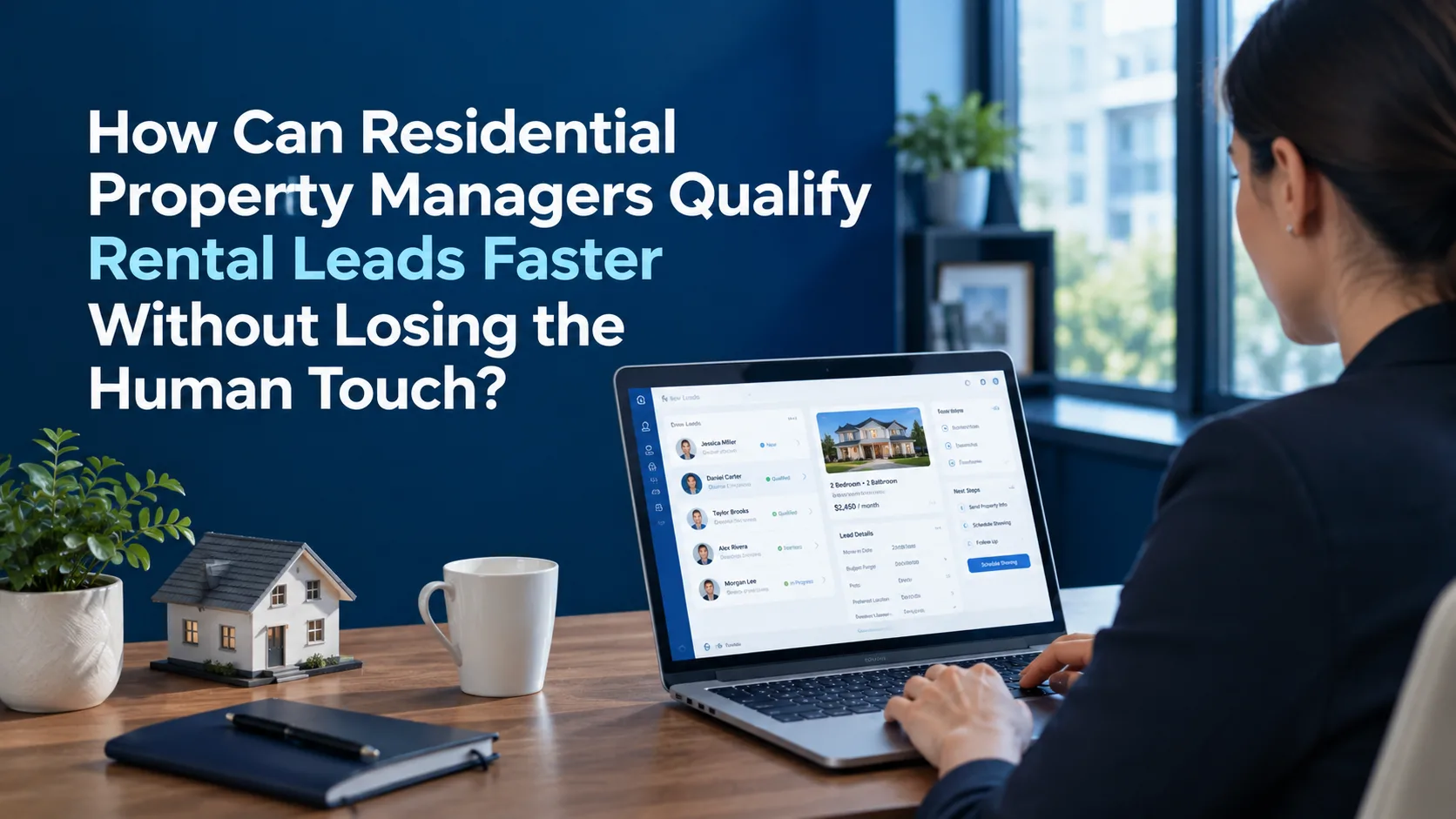
A rental inquiry can arrive at any time.
A prospect asks whether a property is available. Another wants to know if pets are allowed. Someone else is ready to schedule a showing, while another lead has only shared a general interest.
For a residential property manager handling multiple properties, responding to all of these conversations quickly is difficult. The bigger challenge is figuring out which conversations need attention first.
That raises a practical question: Can AI help property managers respond faster while also making rental lead qualification more manageable?
The answer is yes, but the value is not simply in sending an automated reply.
The real opportunity is connecting response, qualification, follow-up, and human handoff into one workflow.
Is Fast Lead Response Enough?
Fast responses matter, but speed alone does not qualify a rental lead.
A generic response such as "Thanks for your interest. We will get back to you soon" may acknowledge an inquiry, but it does not tell the property manager much about the prospect.
A more useful first interaction can answer the immediate question and gather relevant information at the same time.
For example:
- When are you planning to move?
- What type of property are you looking for?
- What is your preferred price range?
- How many bedrooms do you need?
- Do you have pets?
Would you like to schedule a property tour?
This changes the workflow from simply responding to a lead to understanding the lead.
The basic process becomes:
Respond → Ask → Understand → Qualify → Prioritize → Follow up
What Can AI Ask a Rental Prospect?
AI can handle the first layer of a conversation when the questions and qualification criteria are clearly defined.
Suppose someone asks about a two-bedroom rental. Instead of requiring a property manager to manually answer every basic question, an AI system can provide available property information and ask a few relevant follow-up questions.
The prospect might explain their preferred move-in date, budget, location, and other requirements.
That information can then give the property manager useful context before they step into the conversation.
This is where AI for Real Estate Lead Response and Qualification becomes more practical than a generic chatbot. The objective is not simply to have a conversation with a prospect. It is to move the prospect toward an appropriate next step.
Does AI Decide Which Rental Lead Is Worth Pursuing?
It should not make that decision on its own.
AI can help organize and prioritize conversations using criteria established by the property team.
For example, a property manager might want to identify leads that:
- Have a clear move-in timeline
- Are interested in a specific available property
- Have provided relevant rental preferences
- Are actively responding
- Are ready to schedule a showing
Other inquiries may still be useful but require additional information or follow-up.
The important distinction is that AI can help surface signals. The property manager remains responsible for decisions that require context, judgment, or personal interaction.
Can AI Handle Follow-Ups Without Making Conversations Feel Robotic?
Follow-up is one of the easiest parts of the leasing process to overlook.
A prospect may ask for more information and then disappear for a few days. Someone may express interest but never schedule a showing. Another person may start an application and not complete the next step.
Manual follow-up requires someone to remember where every conversation stopped.
AI can help by triggering follow-ups based on defined events and conversation history.
For example:
Inquiry → Initial response → Qualification → No response → Follow-up → Human handoff
The follow-up does not have to be identical for every prospect. It can be based on the information already collected and the stage of the conversation.
That makes automation more useful than simply sending the same reminder to everyone.
When Should AI Hand the Conversation to a Person?
This is one of the most important parts of responsible AI adoption.
Not every rental conversation should remain automated.
A human should be involved when:
- A prospect asks a complex question
- Information is unclear or unavailable
- A sensitive situation comes up
- Negotiation is involved
- A decision requires judgment
- The conversation falls outside predefined rules
A useful AI workflow should make the handoff easy rather than trying to keep the AI involved at all costs.
The goal is not to eliminate the property manager from the conversation.
It is to make sure they enter the conversation with more context and less repetitive work.
What Does an AI-Powered Rental Lead Workflow Look Like?
A practical workflow might look like this:
New inquiry
↓
Immediate AI response
↓
Basic qualification questions
↓
Lead information captured
↓
Lead prioritized
↓
Follow-up or showing request
↓
Human handoff when needed
Consider a prospect who asks about a rental home.
The AI can answer basic questions about the property, ask when the prospect wants to move, understand their requirements, and determine whether they are ready for the next step.
If the prospect wants to schedule a showing, that information can move into the appropriate workflow.
If the prospect asks something that requires a property manager, the conversation can be handed over with the previous context available.
The property manager does not have to start the conversation from the beginning.
Why Use a Lead Response and Qualification Platform Instead of a Standalone Chatbot?
A standalone chatbot can answer questions, but residential leasing involves more than conversation.
A useful workflow needs to connect several activities:
- Lead response
- Property information
- Qualification
- Conversation history
- Lead prioritization
- Follow-ups
- Showing coordination
- Human handoff
That is why the platform layer matters.
Svermo uses products built around residential real estate workflows, including AI-supported lead response, qualification, leasing, and property operations. The idea is to bring AI into the workflow instead of making property managers use another disconnected tool.
The value of this approach is not having more AI features. It is having fewer manual steps between receiving an inquiry and deciding what should happen next.
How Does AI for Real Estate Lead Response & Qualification Fit Into the Bigger Workflow?
The strongest use case is not a single automated message.
It is the connection between several small steps.
Response → Qualification → Prioritization → Follow-up → Human action
When these steps work together, a property manager can spend less time sorting through repetitive inquiries and more time handling conversations that need their experience.
That is where AI for Real Estate Lead Response & Qualification can become part of a broader residential property operation rather than another isolated AI experiment.
How Do You Know If the Automation Is Actually Working?
The easiest way to answer this is to measure the workflow before and after automation.
Property managers can track:
- Average first-response time
- Percentage of inquiries receiving a response
- Qualification completion rate
- Follow-up completion
- Showing requests
- Number of leads requiring human intervention
- Time spent on repetitive conversations
- Progression from inquiry to application
Speed should not be the only metric.
If response time improves but qualified leads are not moving forward, the workflow may need adjustment.
The objective is not simply to send faster messages. It is to create faster and more useful conversations.
Should Property Managers Automate Every Lead Interaction?
No.
Starting with one high-volume, repetitive workflow is usually more practical.
For many residential property teams, that could be:
Initial inquiry → Basic qualification → Follow-up
Once that process is working consistently, other leasing or property-management workflows can be evaluated.
AI does not have to take over the entire leasing operation to be useful.
It can start by handling the work that repeatedly pulls property managers away from higher-value conversations.
What Does the Future of Residential Lead Management Look Like?
The next stage of AI in residential real estate is less about whether a chatbot can answer a question.
It is about whether AI can become a useful part of the workflow surrounding that question.
A prospect receives a faster response. Relevant information is collected. The lead is organized. Follow-up happens when appropriate. A property manager steps in when human judgment is needed.
That is a much more practical model for AI-assisted leasing.
Property managers do not necessarily need AI to replace the human side of leasing. They need systems that give their teams more time for it.
The better question is not "Can AI handle our rental leads?"
It is "Which part of our lead workflow should AI handle first?"