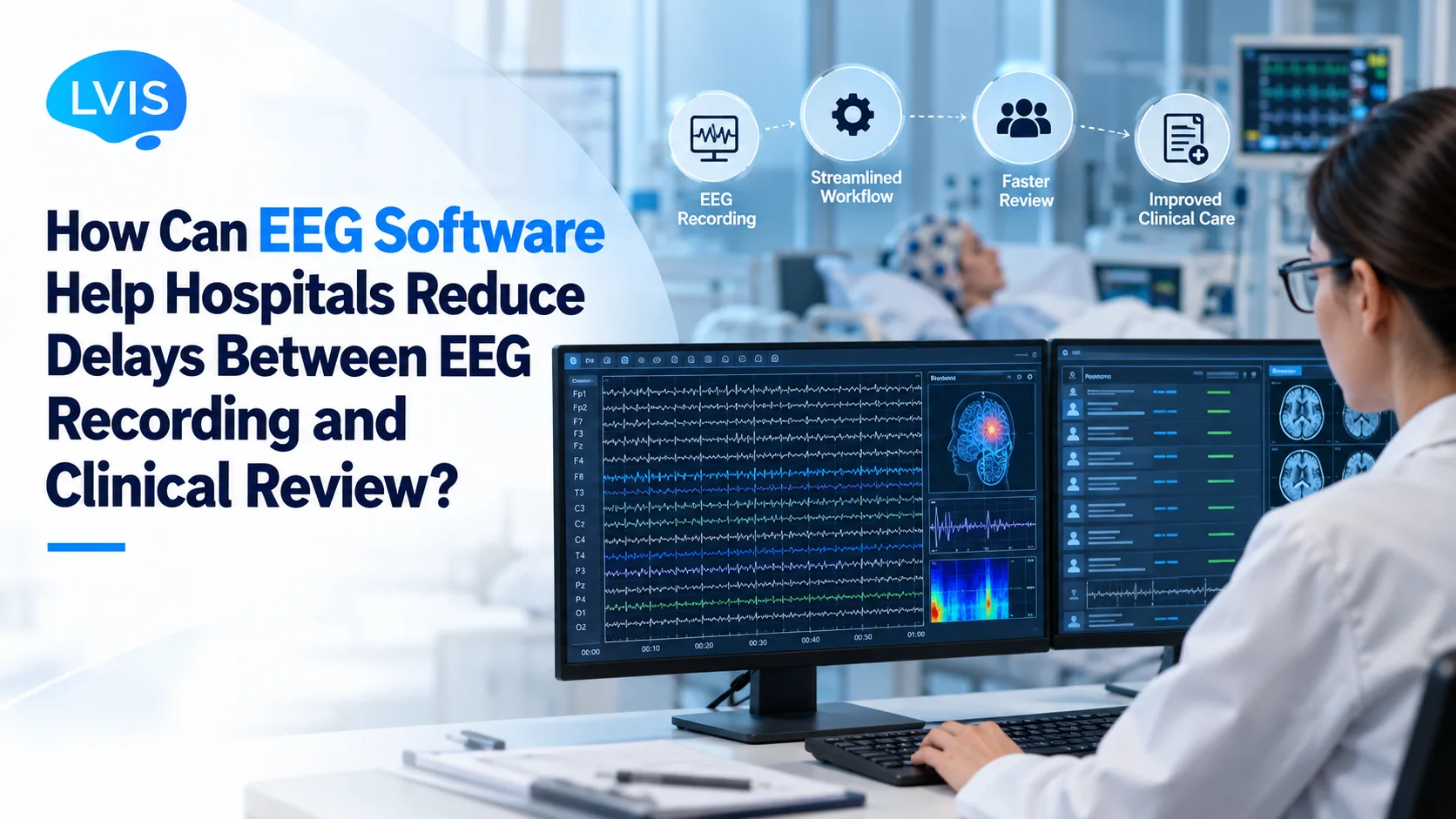
Hospitals and neurology departments often face growing pressure to review EEG recordings quickly while maintaining consistent clinical standards. Increasing recording volumes, limited specialist availability, and complex neurological cases can create delays between EEG acquisition and physician review. These delays may affect clinical workflows, particularly when teams must prioritize urgent findings alongside routine EEG studies. Modern eeg software can help healthcare organizations organize recordings, streamline review processes, and support collaboration between EEG technologists and neurologists. By combining structured workflows with AI-assisted analysis, hospitals can reduce avoidable administrative bottlenecks without compromising the importance of expert clinical interpretation.
Why Do Delays Occur Between EEG Recording and Clinical Review?
EEG recordings generate complex neurological data that requires careful examination by trained clinical professionals. In busy hospitals, the time between recording completion and physician interpretation may increase when multiple studies enter the review queue simultaneously. EEG technologists may need to prepare recordings, identify technical issues, and organize relevant clinical information before neurologists begin their assessments. Staff shortages, fragmented software systems, and manual data transfers can create additional operational challenges. Understanding these barriers is essential for hospitals seeking to improve EEG turnaround times and maintain reliable clinical workflows.
Limited Availability of Experienced EEG Reviewers
Neurologists and clinical neurophysiologists often manage multiple responsibilities, including patient consultations, inpatient care, and EEG interpretation. When experienced reviewers are unavailable, completed recordings may remain in queues longer than intended. Complex studies, including prolonged monitoring and ambulatory EEG recordings, can require substantial review time. Hospitals experiencing staffing shortages may find it particularly difficult to distribute workloads evenly across clinical teams. Standardized review processes and better access to EEG data can help departments manage these challenges more effectively.
Fragmented EEG Data Management
Hospitals may use different systems for EEG acquisition, storage, analysis, and clinical documentation. Moving recordings between disconnected platforms can introduce unnecessary administrative work and delay access to relevant information. Inconsistent file organization may also make it harder for neurologists to locate specific studies or review previous recordings. When clinical teams work across departments or facilities, these challenges can become more pronounced. Integrated digital workflows can help reduce friction between recording completion and clinical interpretation.
How Can EEG Software Reduce Delays in Clinical Review?
Hospitals can improve EEG turnaround times by making recordings easier to access, organizing review responsibilities, and reducing repetitive administrative work. Modern eeg software provides digital tools that support efficient navigation through large EEG datasets and help clinicians identify recordings requiring attention. Instead of relying entirely on manual transfers and location-specific workstations, departments can use connected platforms to improve access to clinical information. These improvements are particularly valuable when neurologists work across multiple facilities or provide remote interpretation services. The objective is to reduce unnecessary workflow delays while preserving comprehensive physician-led EEG assessment.
Using AI-Assisted Event Detection to Prioritize Review
Artificial intelligence can help clinical teams identify potentially relevant EEG segments within lengthy recordings. Modern AI EEG capabilities may include automated seizure detection, spike identification, and tools that help clinicians navigate complex brainwave activity. These features can support the review process by directing attention toward flagged events rather than requiring an entirely sequential examination of every recording segment. However, automated findings must be reviewed in their clinical context because artifacts and other signal characteristics can affect interpretation. LVIS Corporation's NeuroMatch platform includes AI-assisted seizure and spike detection capabilities designed to support clinical review.
LVIS Corporation
+1
Improving Access Through Cloud-Based EEG Platforms
Cloud-based systems allow authorized clinicians to access EEG recordings without depending exclusively on dedicated hospital workstations. This flexibility can support collaboration between neurologists, EEG technologists, and clinical teams working across different locations. Hospitals may benefit when specialists can review studies remotely instead of waiting for physical access to a particular computer or department. Secure browser-based access can also simplify workflow coordination and reduce dependence on manual file transfers. These capabilities are especially relevant for hospital networks managing EEG services across multiple facilities.
How Can Hospitals Maintain Consistent EEG Review Quality During Staff Shortages?
Maintaining review quality becomes more challenging when experienced neurological staff must manage increasing workloads. Hospitals need processes that help clinicians apply consistent review practices regardless of staffing levels or shift schedules. Standardized annotations, accessible patient histories, and organized reporting workflows can support continuity between different reviewers. Technology can also help departments coordinate responsibilities and reduce unnecessary duplication of administrative tasks. Nevertheless, clinical expertise remains essential for interpreting EEG findings and determining their significance for individual patients.
Standardizing EEG Analysis and Documentation
Consistent documentation helps neurologists understand what has already been reviewed and which findings require additional evaluation. Modern EEG analysis software can support this process through digital annotations, event visualization, and organized reporting tools. When multiple specialists participate in a patient's care, shared documentation can improve continuity and reduce the need to repeat completed administrative work. Standardized workflows also help EEG technologists prepare recordings in a consistent format before physician interpretation. Hospitals should establish clear documentation standards and clinical verification procedures to support reliable reporting.
Supporting Collaboration Between Neurologists and EEG Technologists
Effective communication between EEG technologists and interpreting physicians is essential for timely neurological assessment. Technologists help ensure recording quality, document relevant events, and communicate technical observations that may influence interpretation. Neurologists use this information alongside EEG waveforms and clinical findings to determine the significance of recorded activity. Shared digital workspaces can make these interactions more efficient by keeping annotations and recordings accessible to authorized team members. Improved coordination can help reduce administrative delays while preserving appropriate professional responsibilities.
What Role Does EEG Review Software Play in Hospital Efficiency?
Hospitals should evaluate technology based on how well it fits existing clinical responsibilities and operational requirements. Effective EEG review software should support practical tasks such as accessing recordings, navigating events, coordinating reviews, and preparing reports. These capabilities can be especially useful for departments handling routine EEG studies alongside continuous or ambulatory monitoring. Systems that simplify everyday workflows may help clinicians spend less time managing files and more time evaluating clinically relevant information. However, hospitals should assess performance through measurable workflow outcomes rather than assuming that new technology automatically improves turnaround times.
Managing Long-Duration EEG Recordings
Continuous and ambulatory EEG monitoring can generate substantial amounts of neurological data over extended recording periods. Reviewing these studies requires clinicians to distinguish potentially important events from routine background activity and technical artifacts. AI-assisted event identification and artifact reduction may help specialists navigate these large datasets more efficiently. Organized event summaries and visual trends can provide additional context during the review process. Physicians must still examine relevant source recordings and verify findings before making clinical decisions.
Streamlining Reporting and Clinical Communication
The time required to complete an EEG report depends on more than the initial waveform interpretation. Physicians may need to consolidate annotations, compare previous studies, document findings, and communicate results to referring clinicians. Digital reporting tools can support these tasks by organizing information within a more consistent workflow. Integrated reporting may also reduce repeated data entry and improve coordination between clinical team members. Hospitals should ensure that any reporting automation preserves physician review, appropriate documentation, and institutional approval requirements.
How Does NeuroMatch Support Modern EEG Workflows?
LVIS Corporation, headquartered in Palo Alto, California, develops neurotechnology solutions for clinical EEG analysis and neurological data visualization. Its Neuromatch® platform combines cloud-based EEG access with tools for reviewing neurological recordings and supporting collaboration between clinicians. The platform includes browser-based access, artifact reduction, automated reporting capabilities, and AI-assisted identification of seizure and spike events. These features are designed to help healthcare teams organize EEG analysis and reduce operational friction between recording and review. LVIS Corporation reports regulatory clearance for the platform in the United States and South Korea, although availability and clearance of individual features may vary by market.
LVIS Corporation
+1
Supporting Remote Collaboration and Flexible Review
Neurology teams increasingly need flexibility when coordinating EEG interpretation across different departments and clinical locations. Browser-based access can allow authorized physicians to review recordings without being restricted to a particular workstation. This capability may support hospitals that rely on shared specialist resources or coordinate care across multiple facilities. Remote collaboration can also help clinical teams exchange information while maintaining structured documentation and review responsibilities. Hospitals should evaluate network reliability, access permissions, privacy safeguards, and clinical escalation procedures before implementing remote workflows.
Keeping Clinical Judgment Central to AI-Assisted Analysis
AI-assisted analysis should support neurologists rather than replace their diagnostic responsibilities. Automated event detection can identify potentially important waveform patterns, but those findings still require clinical validation. Physicians must consider patient history, recording conditions, artifacts, and other clinical information before interpreting an EEG result. Hospitals should also confirm that the specific software features they intend to use are cleared or authorized for the relevant clinical purpose and jurisdiction. A clinician-led approach helps organizations integrate automation responsibly while maintaining established standards of neurological care.
What Should Hospitals Consider Before Selecting an EEG Platform?
Choosing an EEG platform requires careful evaluation of clinical functionality, integration requirements, security, and operational costs. Hospitals comparing a list of eeg software options should assess whether each solution supports their recording types, specialist workflows, and reporting needs. Compatibility with existing acquisition systems and hospital infrastructure is particularly important when departments use equipment from multiple vendors. Decision-makers should also consider training requirements, technical support, data accessibility, and long-term scalability. A structured evaluation helps hospitals select technology that addresses actual workflow challenges rather than adding unnecessary complexity.
Measure Turnaround Time and Review Quality Together
Hospitals should establish baseline performance measures before introducing changes to their EEG review processes. Useful indicators include the time between recording completion and review assignment, the interval before physician interpretation, and the time required to finalize reports. Departments can also monitor review backlogs, documentation completeness, and the frequency of technical issues that interrupt clinical workflows. Comparing these measures before and after implementation can help determine whether technology is delivering meaningful operational improvements. Review quality, patient safety, and physician accountability should remain central to every performance assessment.
Conclusion
Reducing delays between EEG recording and clinical review requires coordinated improvements in technology, staffing workflows, and communication. Modern eeg software can help hospitals organize complex recordings, support remote collaboration, and streamline administrative processes that contribute to review backlogs. AI-assisted detection and structured reporting may provide additional workflow benefits when implemented with appropriate clinical oversight. LVIS Corporation offers cloud-based neurological technology designed to support these operational needs while keeping qualified clinicians responsible for interpretation. Hospitals interested in improving EEG review efficiency can explore the company's platform capabilities and request a demonstration to evaluate their suitability for existing clinical workflows.
Explore LVIS Corporation's EEG solutions: https://lviscorp.com/en/neuromatch
Clinical disclaimer: AI-assisted EEG tools support clinical workflows and do not replace independent interpretation, diagnosis, or treatment decisions by qualified healthcare professionals.
SEO Metadata
Meta Title: How Can EEG Software Reduce Hospital EEG Review Delays?
Meta Description: Discover how EEG software helps hospitals reduce EEG review delays, improve neurologist collaboration, manage backlogs, and support clinical workflows.
Suggested URL Slug: how-eeg-software-reduces-hospital-review-delays
Hashtags: #EEGSoftware #NeuroMatch #LVISCorporation #EEGAnalysis #Neurology #ClinicalNeurophysiology #AIinHealthcare #EpilepsyMonitoring #Neurotechnology
Keyword note: All six supplied keyword phrases are linked once as requested, but they point to the same destination. For future blogs, linking the main keyword once and using the other phrases without additional links would create a cleaner internal-linking structure.