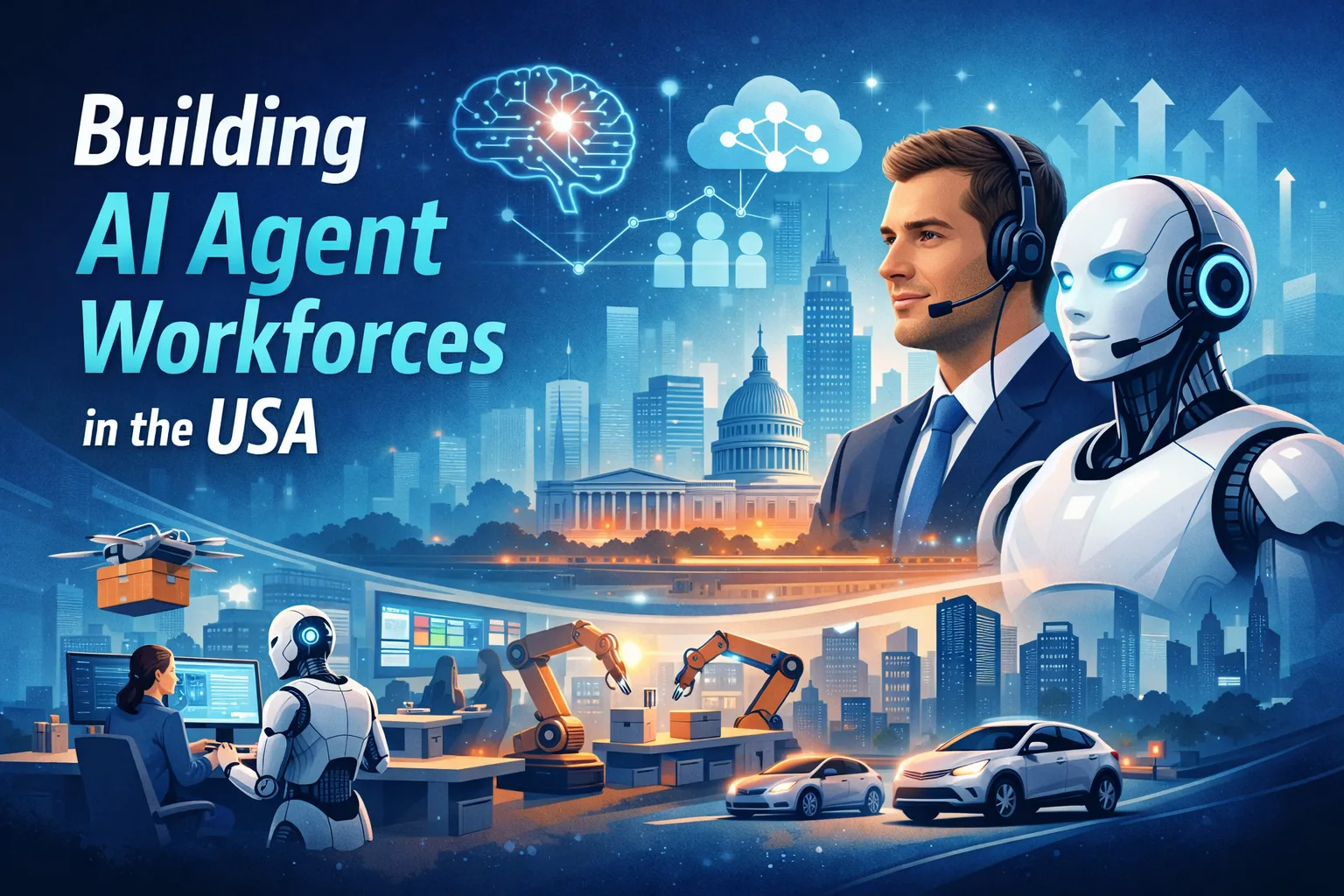
Artificial intelligence is no longer just a tool that helps employees work faster, it is becoming a workforce of its own. Across the USA, companies are actively building systems powered by AI agents for business that can plan, execute, and optimize tasks with minimal human intervention.
This shift marks a major leap from simple automation to what many are calling agentic organizations, where AI does not just assist but actively participates in decision-making and operations.
Let’s explore how this transformation is happening, what technologies are driving it, and what comes next.
The Rise of AI Agent Workforces in the USA
Traditionally, businesses relied on software for specific tasks such as CRM systems, analytics dashboards, or customer service tools. But now, with advancements in AI Development, companies are deploying AI agents that can:
- Understand goals
- Break them into tasks
- Execute workflows
- Learn and improve over time
This evolution is powering a new wave of enterprise AI automation, where entire business processes, not just individual tasks, are handled by intelligent systems.
For example:
- A marketing AI agent can plan campaigns, generate content, and analyze performance
- A finance agent can track expenses, forecast budgets, and flag anomalies
- A customer support agent can resolve queries from start to finish without human input
From Automation to AI Workflow Automation
One of the biggest shifts is the move toward AI workflow automation.
Instead of automating isolated steps, businesses are now automating complete workflows. This means AI agents can:
- Coordinate across departments
- Handle dependencies between tasks
- Adapt in real time
For instance, in e-commerce:
- An AI agent detects a drop in sales
- Another analyzes customer behavior
- A third launches a targeted campaign
- A fourth tracks results and adjusts strategy
This interconnected system is far more powerful than traditional automation, and it is becoming the backbone of modern AI operations automation.
Multi-Agent Systems: Building AI Teams
A single AI agent is useful, but the real power comes from multi-agent systems.
In this model, businesses deploy multiple specialized agents that work together like a team:
- Manager agents oversee goals and assign tasks
- Worker agents execute specific functions
- Evaluator agents monitor performance and outcomes
This structure mirrors human organizations, which is why many companies are transitioning into agentic organizations.
These AI teams can:
- Collaborate across functions
- Scale instantly
- Operate 24 by 7
- Continuously improve through feedback
For businesses in the USA, this is unlocking new levels of efficiency and scalability.
AI Productivity Tools Are Becoming Autonomous Systems
What started as simple AI productivity tools such as writing assistants or chatbots is now evolving into autonomous systems.
Modern tools can:
- Draft reports
- Schedule meetings
- Analyze data
- Make recommendations
- Execute decisions
This transformation is driving AI business transformation across industries like healthcare, finance, retail, and logistics.
Companies that once used AI for small productivity gains are now redesigning entire operations around it.
The Role of AI Companies in Driving This Shift
Behind this transformation are innovative AI companies building platforms and frameworks for agent-based systems.
These companies focus on:
- Scalable agent architectures
- Secure AI deployment
- Integration with enterprise systems
- Real-time decision-making
As a result, businesses no longer need to build everything from scratch. They can adopt ready-made solutions and customize them to fit their workflows.
This accessibility is accelerating the adoption of AI agents for business across startups and large enterprises in the USA.
Benefits of AI Agent Workforces
Businesses are adopting AI agent workforces because they offer clear advantages:
Increased Efficiency
AI agents handle both repetitive and complex tasks faster than humans.
Cost Reduction
Automation reduces operational expenses over time.
Scalability
AI systems can scale instantly without hiring delays.
Better Decision-Making
Agents analyze large datasets and provide useful insights.
Continuous Operation
AI agents can work around the clock without fatigue.
Challenges Businesses Must Address
Despite the benefits, there are important challenges:
- Trust and accountability in AI decisions
- Data privacy and security concerns
- Integration with legacy systems
- Skill gaps in AI Development
Addressing these challenges is essential for long-term success.
What Comes Next?
The future of AI agent workforces in the USA is just beginning. Here is what to expect:
Fully Autonomous Business Units
Entire departments may run mostly on AI agents, with humans supervising.
AI to AI Collaboration
Agents from different organizations will interact and complete tasks together.
Smarter Multi-Agent Systems
Improved coordination and decision-making abilities.
Personalized AI Agents
Custom agents designed for specific roles, industries, or individuals.
Stronger Regulation
More structured policies to ensure ethical and safe AI usage.
Final Thoughts
The shift toward agentic organizations represents one of the most important changes in modern business.
With the growth of AI agents for business, enterprise AI automation, and multi-agent systems, companies in the USA are not just adopting AI, they are restructuring around it.
This transformation is not only about efficiency. It is about redefining how work gets done in the future.
Businesses that embrace this change early will gain a strong competitive advantage, while those that delay may struggle to keep up in a rapidly evolving landscape driven by AI.