
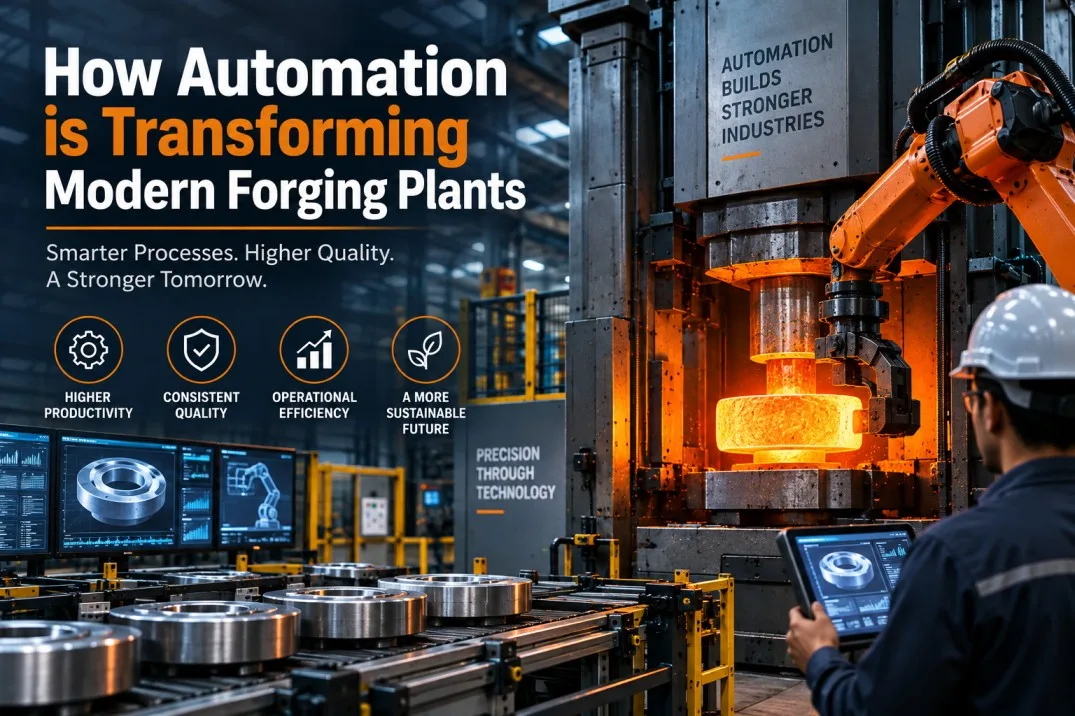
The forging industry has always depended on precision, controlled processes, and skilled manufacturing expertise. But as global industries demand higher productivity, consistent quality, shorter lead times, and greater efficiency, traditional manufacturing methods are evolving.
Automation in forging is becoming an increasingly important part of this transformation.
Modern forging plants are integrating automated handling systems, robotics, process monitoring, digital inspection, and data-driven manufacturing to improve how components are produced.
The objective is not simply to replace manual work with machines.
It is to create a manufacturing environment that is more consistent, efficient, safe, and capable of meeting increasingly demanding industrial requirements.
Why Is Automation Becoming Important in Forging?
Forging involves several demanding manufacturing stages, including heating, material handling, forming, heat treatment, machining, and inspection.
Many of these operations involve:
- High temperatures
- Heavy components
- Repetitive movements
- Strict process parameters
- Significant mechanical forces
Automation can help manufacturers control these operations more consistently while reducing unnecessary manual intervention.
For global OEMs, this can translate into improved production reliability and greater confidence in supplier performance.
1. Improving Production Productivity
One of the most visible benefits of automation is increased productivity.
Automated systems can perform repetitive operations with consistent speed and accuracy. In a forging plant, this can include material movement, billet handling, component transfer, and other production activities.
Higher productivity can help manufacturers:
- Increase production capacity
- Reduce process interruptions
- Improve workflow
- Shorten production cycles
- Handle larger production volumes
For OEMs, improved productivity can also contribute to more predictable delivery schedules.
2. Improving Manufacturing Consistency
Consistency is critical when producing forged components for industrial applications.
Small variations in temperature, positioning, timing, or forming conditions can potentially influence the final component.
Automated systems can help maintain repeatable process parameters and reduce variation between production cycles.
This is particularly valuable when manufacturers are producing large quantities of similar components for OEM customers.
Automation therefore supports an important manufacturing objective:
Repeatable processes → Consistent output → More predictable quality
3. Better Process Monitoring
Modern forging plants are increasingly using sensors and digital monitoring systems to collect production data.
Depending on the manufacturing setup, data can be collected from areas such as:
- Temperature
- Pressure
- Force
- Cycle time
- Equipment condition
- Production output
This information can help engineers identify process variations and make informed manufacturing decisions.
Instead of relying entirely on manual observations, production teams can use real-time or recorded process data to better understand what is happening on the shop floor.
4. Automation Can Improve Workplace Safety
Forging involves high temperatures, heavy loads, powerful machinery, and potentially hazardous environments.
Automated equipment can perform certain material-handling and repetitive operations without requiring workers to be directly exposed to the most demanding parts of the process.
Robotic systems, automated transfer mechanisms, and remote monitoring can therefore help reduce exposure to certain workplace risks.
However, automation does not eliminate the need for skilled workers.
Instead, it can allow employees to focus more on process supervision, engineering, quality control, maintenance, and decision-making.
5. More Efficient Material Handling
Material handling is an important part of forging operations.
Moving heavy or heated components manually can be time-consuming and physically demanding.
Automated handling systems can help move materials between different stages of production with greater consistency.
This can improve:
- Production flow
- Worker safety
- Handling accuracy
- Cycle-time consistency
- Overall plant efficiency
Better material flow can also reduce unnecessary movement and production bottlenecks.
6. Automation and Quality Control
Automation is also changing how manufacturers approach quality.
Modern forging plants can combine automated production with advanced inspection and measurement technologies.
Depending on the application, this may include:
- Automated dimensional measurement
- Digital inspection systems
- Process monitoring
- Non-destructive testing
- Computerized data recording
- Automated traceability
The benefit is not simply faster inspection.
Digital quality systems can create a more complete record of production and inspection data, supporting greater traceability and process control.
7. Predictive Maintenance and Equipment Reliability
Automation can also contribute to equipment maintenance.
Sensors and monitoring systems can track equipment performance and identify unusual operating conditions.
This can support a shift from purely reactive maintenance toward more predictive and preventive maintenance.
Instead of waiting for equipment to fail, manufacturers can use operational data to identify potential issues earlier.
For a forging plant, this can help reduce unexpected downtime and improve equipment availability.
8. Supporting Energy and Material Efficiency
Modern manufacturers are under increasing pressure to improve resource efficiency.
Automation can contribute by improving process control and reducing unnecessary production variation.
Better control can help manufacturers optimize:
- Heating cycles
- Material movement
- Production timing
- Equipment utilization
- Scrap and rework
The actual energy and material savings will depend on the specific process and plant configuration, but automation provides manufacturers with better tools for measuring and improving resource consumption.
Automation Does Not Replace Engineering Expertise
It is important to remember that modern forging is not becoming completely machine-driven.
Automation works best when combined with skilled engineering expertise.
Manufacturers still need experienced professionals to make decisions about:
- Material selection
- Forging process design
- Tooling
- Heat treatment
- Quality requirements
- Process optimization
- Component design
- Inspection standards
The future of forging is therefore likely to be a combination of advanced technology and human expertise.
What Does Industry 4.0 Mean for Forging?
Industry 4.0 is bringing greater connectivity and data-driven decision-making into manufacturing.
In a modern forging plant, this can involve connecting:
Machines → Sensors → Production Data → Quality Systems → Engineering Decisions
As these systems become more integrated, manufacturers can gain greater visibility into their operations.
For OEMs, this can provide benefits such as improved traceability, more consistent production, better communication, and greater confidence in manufacturing processes.
What Should OEMs Look for in an Automated Forging Partner?
For global OEMs, the presence of automation alone should not determine supplier selection.
A capable forging partner should combine technology with:
- Strong engineering expertise
- Robust quality systems
- Material traceability
- Advanced inspection
- Heat-treatment capabilities
- Machining capabilities
- Production capacity
- Process documentation
- Consistent delivery performance
The most valuable supplier is not necessarily the one with the most automation.
It is the one that uses technology effectively to deliver reliable, consistent, and cost-effective components.
The Future of Modern Forging Plants
Automation will likely continue to play a growing role in forging manufacturing.
Future developments may include greater use of:
- Robotics
- Artificial intelligence
- Machine vision
- Digital twins
- Predictive maintenance
- Real-time process analytics
- Automated inspection
- Connected manufacturing systems
These technologies can help forging manufacturers move toward more intelligent and data-driven production environments.
But technology will remain only one part of the equation.
Successful forging will continue to depend on the combination of materials, process knowledge, engineering expertise, quality control, and advanced manufacturing technology.
CHW Forge and the Evolution of Forging Manufacturing
Indian forging manufacturers are also participating in the industry's transition toward more advanced manufacturing.
CHW Forge, with forging roots dating back to 1956, serves demanding sectors including heavy industrial equipment, mining, oil & gas, power generation, engineering, construction, infrastructure, and aerospace.
The company's manufacturing portfolio includes components such as rings and gear rings, flanges, shafts, discs, hubs, hollow forgings, sleeves, and shells.
For manufacturers serving global OEMs, the integration of modern manufacturing technology with established forging expertise is increasingly important.
The combination of process control, quality systems, engineering knowledge, inspection, and manufacturing capabilities enables forging suppliers to respond to increasingly complex customer requirements.
Final Thoughts
Automation is changing the way modern forging plants operate.
From material handling and production control to quality inspection and equipment monitoring, automation can improve consistency, productivity, safety, and manufacturing efficiency.
However, the future of forging is not simply about replacing people with machines.
It is about combining human engineering expertise with advanced technology to create manufacturing processes that are more reliable, measurable, and efficient.
For global OEMs, this evolution creates an important opportunity: partnering with forging manufacturers that can combine traditional metallurgical expertise with modern manufacturing capabilities.
As the industry continues moving toward smarter and more connected production, automation will increasingly become an important part of the modern forging plant.