Imagine buying the latest sports car without learning how to drive it. It looks impressive, but there is a good chance you will not get the best results. The same thing happens when businesses invest in artificial intelligence without proper preparation.
Many companies are excited about AI, but they often skip the planning stage. This can lead to wasted money, security concerns, poor results, and frustrated teams. That is why AI readiness has become one of the most important steps before adopting any AI solution.
At Rubixe, we have seen that businesses that prepare before implementing AI are more likely to achieve successful outcomes. A strong foundation helps organizations reduce risks while getting better value from every investment.
What is AI readiness?
AI readiness is the process of checking whether your business has the people, data, technology, security, and strategy needed to successfully adopt AI.
It is not only about buying AI software. It is about making sure your business is prepared to use AI effectively and responsibly.
A complete preparation usually includes:
- An AI readiness assessment
- An AI readiness audit
- Data quality evaluation
- Team skill development
- Infrastructure review
- Security and compliance planning
- Business goal alignment
Think of it as creating a roadmap before starting a long journey.
Why does AI readiness reduce business risk?
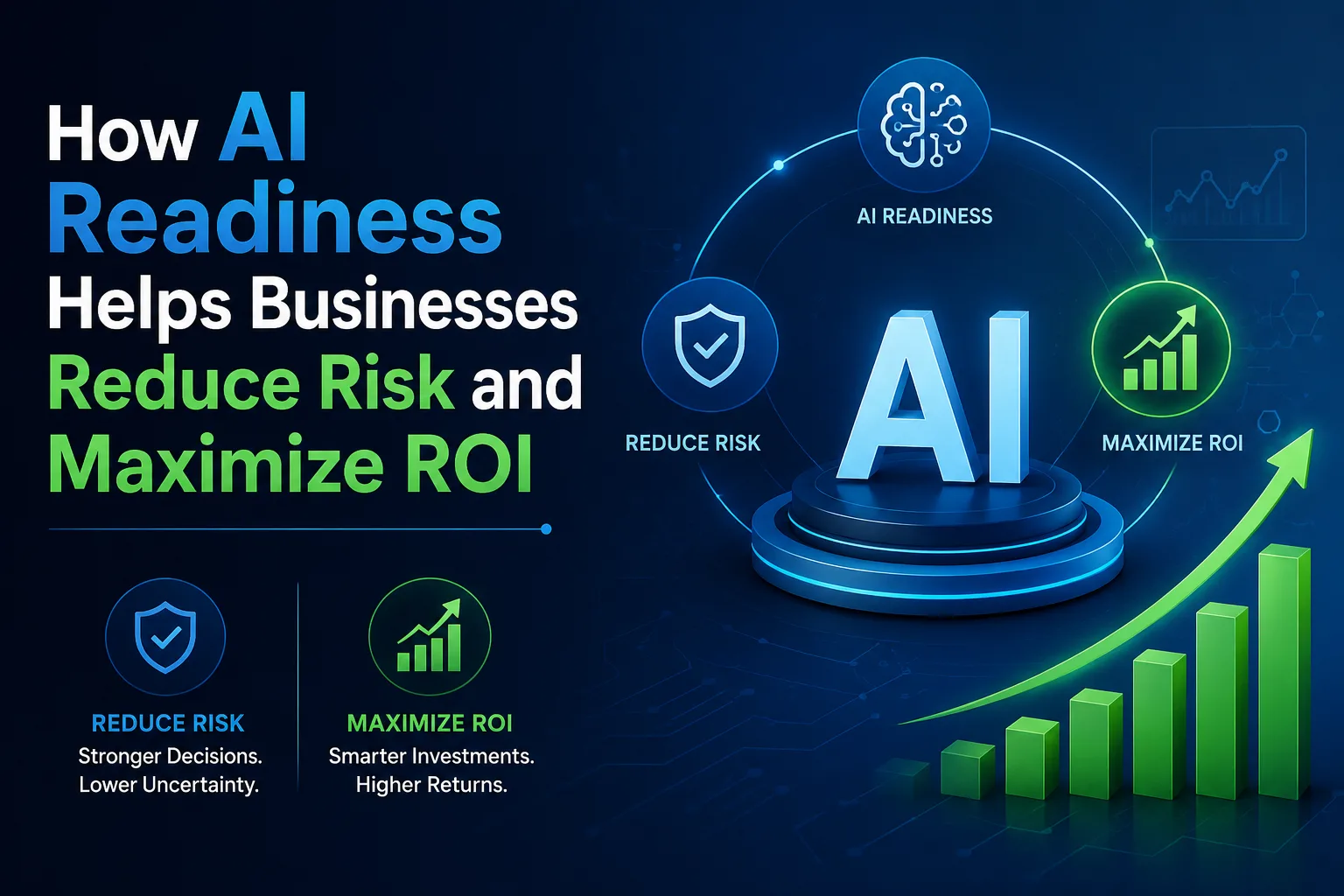
AI readiness helps businesses identify problems before they become expensive mistakes. It lowers technical, operational, financial, and security risks by preparing every part of the organization.
Without preparation, businesses may face challenges such as:
- Poor quality data
- AI models producing inaccurate results
- Employee resistance
- Budget overruns
- Compliance issues
- Cybersecurity threats
According to industry research from McKinsey, organizations that combine technology with proper business processes and skilled employees are significantly more likely to generate value from AI initiatives.
A manufacturing company, for example, wanted to automate quality inspections. During an AI readiness assessment, the team discovered that product images were inconsistent and incomplete. Instead of launching immediately, they improved data collection first. The final AI system became much more accurate, saving both time and money.
How does AI readiness improve return on investment?
AI readiness improves ROI by helping businesses invest in the right projects, reduce costly errors, and achieve faster adoption across teams.
Every successful AI project starts with clear business goals.
Instead of asking,
"Which AI tool should we buy?"
Successful companies ask,
"What business problem are we solving?"
This simple shift helps organizations focus on measurable outcomes.
Examples include:
- Reducing customer service response time.
- Improving forecasting accuracy.
- Automating repetitive office tasks.
- Detecting fraud faster.
- Improving employee productivity.
When goals are clearly defined, every AI investment becomes easier to measure.
What role does an AI readiness assessment play?
An AI readiness assessment evaluates whether your business has the right foundation to adopt AI successfully.
It looks at several important areas, including:
Business Area Why It Matters
Data quality AI depends on accurate information
Technology Existing systems must support AI
Employee skills Teams need confidence using AI
Business strategy AI should support company goals
Security Sensitive information must stay protected
Governance Clear policies reduce long term risk
This assessment helps leaders understand where improvements are needed before implementation begins.
Why is an AI readiness audit important?
An AI readiness audit provides a detailed review of your organization's current capabilities and identifies gaps that may prevent successful AI adoption.
Unlike a simple checklist, an audit provides practical recommendations for improvement.
An effective AI readiness audit often reviews:
- Current infrastructure
- Existing workflows
- Data governance
- Compliance requirements
- AI project priorities
- Team readiness
- Risk management
Many businesses discover hidden issues during the audit that would have been expensive if found after deployment.
How do AI cybersecurity and governance protect AI projects?
Strong AI Cybersecurity keeps AI systems secure by protecting sensitive business data and reducing cyber risks.
AI systems often process customer information, financial records, and confidential company data. Without proper protection, businesses become vulnerable to cyber attacks.
Good security practices include:
- Data encryption
- Access controls
- Continuous monitoring
- Secure cloud environments
- Regular security testing
Organizations should also create governance policies that define how AI is developed, monitored, and updated over time.
Security is not something added later. It should be part of the planning process from the beginning.
Why do employees need AI Based Training?
AI Based Training prepares employees to work confidently with AI tools and increases adoption across the organization.
Technology alone does not create success. People do.
Employees who understand AI are more likely to trust it and use it correctly.
Training can include:
- Understanding AI basics
- Responsible AI practices
- Data privacy awareness
- Workflow automation
- Using AI tools effectively
Well trained employees help businesses achieve faster adoption and better results from every AI investment.
How do AI Consulting and Automation support business growth?
Experienced AI Consulting helps businesses choose the right strategy while Automation improves efficiency by reducing repetitive work.
Not every company needs the same AI solution.
Professional consultants help organizations:
- Prioritize AI opportunities.
- Select suitable technologies.
- Build realistic implementation plans.
- Reduce project risks.
- Measure business outcomes.
At the same time, Automation allows employees to spend less time on repetitive tasks and more time solving important business problems.
When combined with AI and ML, automation becomes even more powerful because systems can continuously learn and improve.
How do AI and ML create long term value?
AI and ML enable businesses to make smarter decisions, improve efficiency, and adapt to changing market conditions.
Machine learning allows systems to improve over time by learning from new data.
Businesses use AI and ML for:
- Demand forecasting
- Predictive maintenance
- Customer recommendations
- Fraud detection
- Intelligent document processing
The greatest value comes when these solutions are built on a strong foundation rather than rushed implementation.
Common mistakes businesses should avoid
Many AI projects struggle because organizations skip important preparation steps.
Avoid these common mistakes:
- Starting without clear business goals.
- Ignoring data quality.
- Underestimating security needs.
- Skipping employee training.
- Expecting immediate results.
- Measuring technology instead of business outcomes.
Avoiding these mistakes greatly improves the chances of long term success.
Frequently Asked Questions
What is AI readiness?
AI readiness is the process of preparing your people, technology, data, and business strategy for successful AI adoption.
How long does an AI readiness assessment take?
An AI readiness assessment can take anywhere from a few days to several weeks, depending on the size and complexity of the organization.
Is an AI readiness audit necessary for small businesses?
Yes. Even small businesses benefit from an AI readiness audit because it helps avoid unnecessary spending and identifies the most valuable AI opportunities.
Why is AI Based Training important?
AI Based Training helps employees understand AI tools, improves adoption, and reduces mistakes during implementation.
Can AI improve ROI without proper planning?
AI can deliver value, but businesses are far more likely to maximize returns when preparation, security, governance, and strategy come first.
Conclusion
Artificial intelligence offers exciting opportunities, but success rarely happens by chance. Businesses that invest time in planning, security, employee development, and clear business goals are better prepared to reduce risk and achieve measurable returns.
Whether through an AI readiness assessment, an AI readiness audit, stronger AI Cybersecurity, expert AI Consulting, Automation, AI Based Training, or advanced AI and ML solutions, preparation always creates a stronger foundation for growth.
If your organization is planning its AI journey, Rubixe can help you evaluate your current capabilities and build a practical roadmap that supports sustainable business success.