AI-powered lead generation helps in two places: finding the buyers who are already showing interest, and converting them before that interest fades. This article explains how both halves work, what the research says, how it compares with older methods, and how to roll it out without wasting budget.
Most companies don't have a lead problem. They have a follow-through problem.
Traffic arrives, ads run, content gets published. Then a visitor reads your pricing page at 9 p.m., has one question, finds nobody to ask, and leaves. Nothing in your reports tells you that happened. The lead was there for a few minutes, and then it wasn't.
That gap is what AI-powered lead generation is trying to close. And it's not a niche idea anymore. Salesforce's 2026 State of Sales research found that 87% of sales organizations already use some form of AI for tasks like prospecting, forecasting, lead scoring, and drafting emails, and 54% of sellers say they've used AI agents. The report is summarized on Salesforce's news site for anyone who wants the details.

So the interesting question isn't whether to use it. It's where it actually helps, and where it doesn't. That's what we'll walk through here.
What is AI-powered lead generation?
AI-powered lead generation is the use of artificial intelligence to find potential customers, talk with them, judge how likely they are to buy, and pass the best ones to a sales team. It covers everything from spotting interest on your website to scoring a lead and following up.
It helps to separate it from two older ideas. Traditional lead generation relies on forms, cold outreach and people doing the sorting by hand. Automated lead generation adds software to the repetitive jobs, like sending a confirmation email after a form is filled in, but it follows fixed rules. AI lead generation goes further because it reads language, adapts to what a person says, and makes judgment calls, such as "this visitor sounds ready to buy."
In practice, you'll see this packaged as AI lead generation software. Some products focus on prospecting and data enrichment. Others focus on your own website and the people already visiting it. Many of the best AI-powered lead generation tools combine several of these jobs, which is why it pays to know what each job is before you shop.
How does AI-powered lead generation help you find more customers?
"Finding" sounds like outbound work, and it can be. But for most businesses, the richest source of new leads is the traffic they already have. Here are the three ways AI helps on the finding side.
It spots intent you would otherwise miss
A page view on its own isn't very meaningful. A sequence of views is. Someone who opens your pricing page, then your integrations page, then returns two days later is behaving very differently from someone who read one blog post. AI can weigh those signals together and flag the visitors who look like buyers.
This is where the approach earns its keep. Instead of a report that says "400 people visited," your team sees "these five visitors showed strong interest." Platforms in this space, including the one our team builds at Corvexa, treat that kind of AI-powered lead generation as a way to turn quiet website traffic into conversations.
It makes prospecting faster
Outbound teams use AI to research accounts, find contact details, and draft first messages. Salesforce's research found that 55% of sales professionals are already using AI for prospecting, and 92% of sellers with AI agents said it benefits their prospecting work. Those are self-reported numbers from sales teams, so treat them as a sign of direction rather than proof of results. But the pattern is clear: the dull research work is being handed to software.
It helps you focus on fit, not volume
Most sales teams drown in names. The real constraint isn't how many leads you have; it's how many you can give proper attention to. AI can score leads on fit (industry, company size, the problem they describe) so people spend their time on the best ones first. That's the core of qualified lead generation: fewer leads in the pipeline, but better ones.
How does it help you convert more of them?
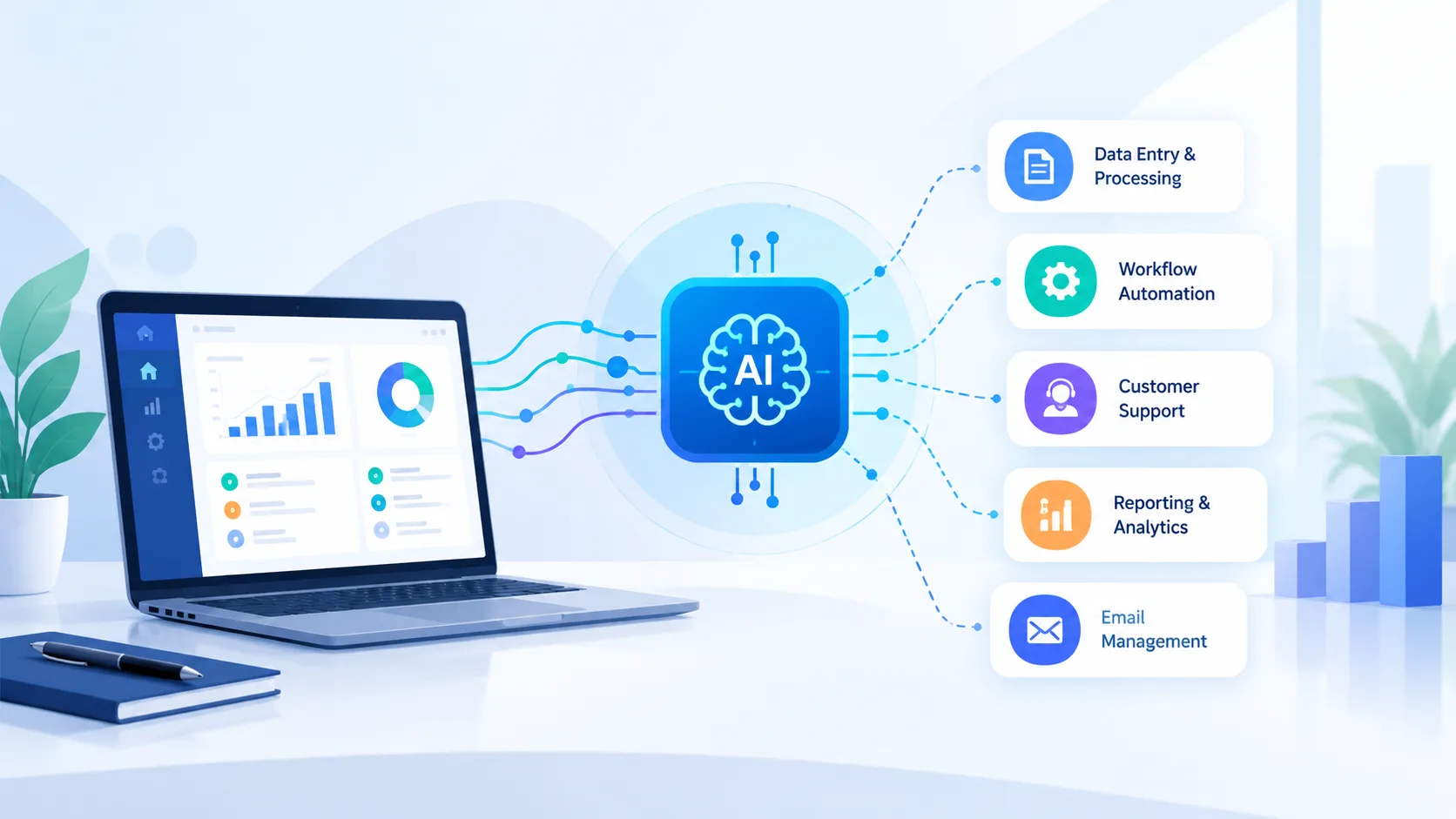
Finding a lead is only half the story. The other half is not losing them. The conversion side has four jobs, and the diagram below shows how they connect to the finding side.

Engage visitors while they are still on the page
Speed matters more than most teams think. In a well-known Harvard Business Review study, only 37% of companies answered a web-generated lead within an hour, and 23% never answered at all. The same research found that firms who made contact within an hour were nearly seven times as likely to qualify the lead as firms who waited one more hour. The study is in Harvard Business Review online.

This is the clearest use case for AI chatbots for lead generation. A chatbot can greet a visitor, answer a question from your own content, and ask a couple of useful questions, all in seconds. For website visitor conversion, that immediacy is the whole advantage. A form asks someone to wait. A good chat doesn't.
Qualify leads without a manual review
Not every conversation deserves a sales call. Lead qualification automation reads what a visitor says, compares it with your ideal customer profile, and attaches a score. High-scoring leads go straight to a person. Lower ones go into a slower path.
If you want to see how one vendor approaches it, there's a short overview of AI-powered lead qualification on the Corvexa site. Whichever tool you choose, the principle is the same: define what a good lead looks like first, then let the software apply that definition consistently.
Nurture the ones who aren't ready yet
Plenty of good leads aren't ready to buy today. Older Forrester research found that companies that excel at nurturing produce 50% more sales-ready leads at 33% lower cost, as repeated in HubSpot's roundup of lead nurturing statistics online. The data is dated, so don't treat the exact figures as current benchmarks. The direction still holds: staying useful to a lead over time beats dropping them after one chat.
This is where lead nurturing automation comes in. It sends the right follow-up at the right moment, for example, a short recap email, a relevant case study, and a low-pressure invitation to talk. Here's what an example path could look like for a medium-score lead.

Hand off to sales with context
The last step is where many systems quietly fail. A lead that lands in the wrong place, with no context, gets ignored. This is why integrations matter. Your tool should send each qualified lead, with its chat history and score, into the CRM, calendar or team chat your people already use. You can see an example of how this looks in the list of chatbot integrations Corvexa supports.
It also matters more than it sounds. The Salesforce report found that 51% of sales leaders using AI agree that disconnected systems are slowing down their AI initiatives, as reported by CX Today in its coverage. In other words, the best AI in the world struggles if it can't see your data or pass its results along. AI-powered sales automation only works as well as the systems behind it.
How does AI-powered lead generation compare with older methods?
A quick comparison makes the differences easier to see. The table below sets three approaches side by side.
StageTraditionalAutomated (rule-based)AI-poweredFinding leadsForms, events, cold listsForms plus email triggersReads behavior and intent on your site and in your dataFirst responseHours or daysInstant, but a fixed scriptInstant and tailored to the questionQualificationA rep decidesSimple form rulesScores fit and urgency from the conversationNurturingManual, often forgottenFixed drip emailsAdapts timing and content to what the lead didReportingSpreadsheetsBasic dashboardsShows which signals and sources lead to meetings
AI doesn't beat the others at everything. A simple contact form is still fine for a low-volume business, and fixed email sequences work well when your buyers are predictable. AI pays off most when visitors ask varied questions and timing really matters.
How do you roll it out without wasting budget?
You don't need to rebuild your whole sales process. A sensible rollout is small and measurable.
Start with the leak, not the tool
Look at where leads disappear today. Is it slow replies? A pricing page with no way to ask questions? A big pile of leads nobody follows up? The answer tells you which job to automate first.
Define "qualified" in writing
Write down what makes a lead worth a sales call: industry, company size, the problem they have, and the signals that show urgency. Without this, no AI tool can do qualified lead generation properly, because it has nothing to measure against.
Feed it good information
Chat and nurture tools are only as good as the content behind them. Gather your key pages, product sheets, pricing and common questions, and remove anything outdated. An AI that confidently repeats last year's pricing does more harm than no AI at all.
Connect it to your CRM and your team
Decide where leads should land and who owns them. Set instant alerts for high scores, and make sure a person can take over a conversation when it matters.
Launch on one page, then review weekly
Pick a high-intent page, such as pricing or demo, and switch the tool on there first. For the first month, read a sample of conversations every week, fix weak answers, and adjust your scoring.
How do you measure whether it's working?
Watch a short list of numbers rather than a giant dashboard. Track your visitor-to-lead rate, the share of leads scored as qualified, how long a lead waits for a first reply, how many qualified leads become meetings, and how many meetings become customers.
Small improvements add up. Say your site gets 5,000 visitors a month and converts at the 2.9% median rate reported by Callbox from Ruler Analytics data. That's about 145 leads. If better engagement lifts the rate by half a percentage point, you'd gain roughly 25 extra leads a month from the same traffic. This is arithmetic, not a forecast, and your actual results will depend on your traffic, offer and industry.
What should you watch out for?
This technology isn't risk-free, and a good article should say so.
Data quality. If your CRM is messy or your website content is stale, the AI will inherit those problems. The Salesforce finding about disconnected systems points the same way.
Over-automation. Some visitors want a person. If a chatbot loops or can't answer, it damages trust. Always give people an easy route to a human.
Privacy and consent. Rules such as GDPR in Europe affect how you collect and use personal data. Tell visitors they're talking to an AI, ask only for what you need, and check the rules where you operate. This is general guidance, not legal advice.
Biased scoring. Scoring rules can quietly favor some kinds of companies. Review the leads you ranked low from time to time and ask whether that was fair.
Conclusion
AI-powered lead generation works best when you think of it as one loop: find the people showing interest, convert them quickly, nurture the ones who aren't ready, and learn from the results. The tools differ, but that loop doesn't.
If you're starting out, keep it simple. Pick one lead, define a good lead, connect your CRM, and measure one number for 30 days. The companies that get value from this technology usually aren't the ones with the biggest budgets. They're the ones that reply fast, stay useful, and keep checking the results.
Frequently asked questions
What is AI-powered lead generation?
It's the use of artificial intelligence to find potential customers, engage them, score how likely they are to buy, and hand the best ones to sales. It covers website chat, prospecting, qualification and follow-up.
How is AI lead generation different from automated lead generation?
Automated lead generation follows fixed rules, such as sending an email when a form is submitted. AI lead generation reads language and behavior, adapts its responses, and makes judgments about which leads are worth pursuing.
What are the main types of AI lead generation software?
Common types include website chatbots and AI sales agents, prospecting and data enrichment tools, visitor intelligence platforms, and nurture and email automation. Many products combine two or more of these.
Do AI chatbots for lead generation replace salespeople?
No. They handle the first conversation, basic questions and after-hours coverage. People still build relationships and close deals, and a good setup lets a person take over a chat at any moment.
How long does it take to see results?
Many tools can be installed in minutes with a code snippet, but tuning answers and scoring usually takes a few weeks. Judge the results after at least 30 days, using one clear metric.
Is AI-powered lead generation suitable for small businesses?
Often yes, especially if your site gets steady traffic and visitors ask varied questions. If you only get a few visitors, a simple form with fast personal replies may be enough.