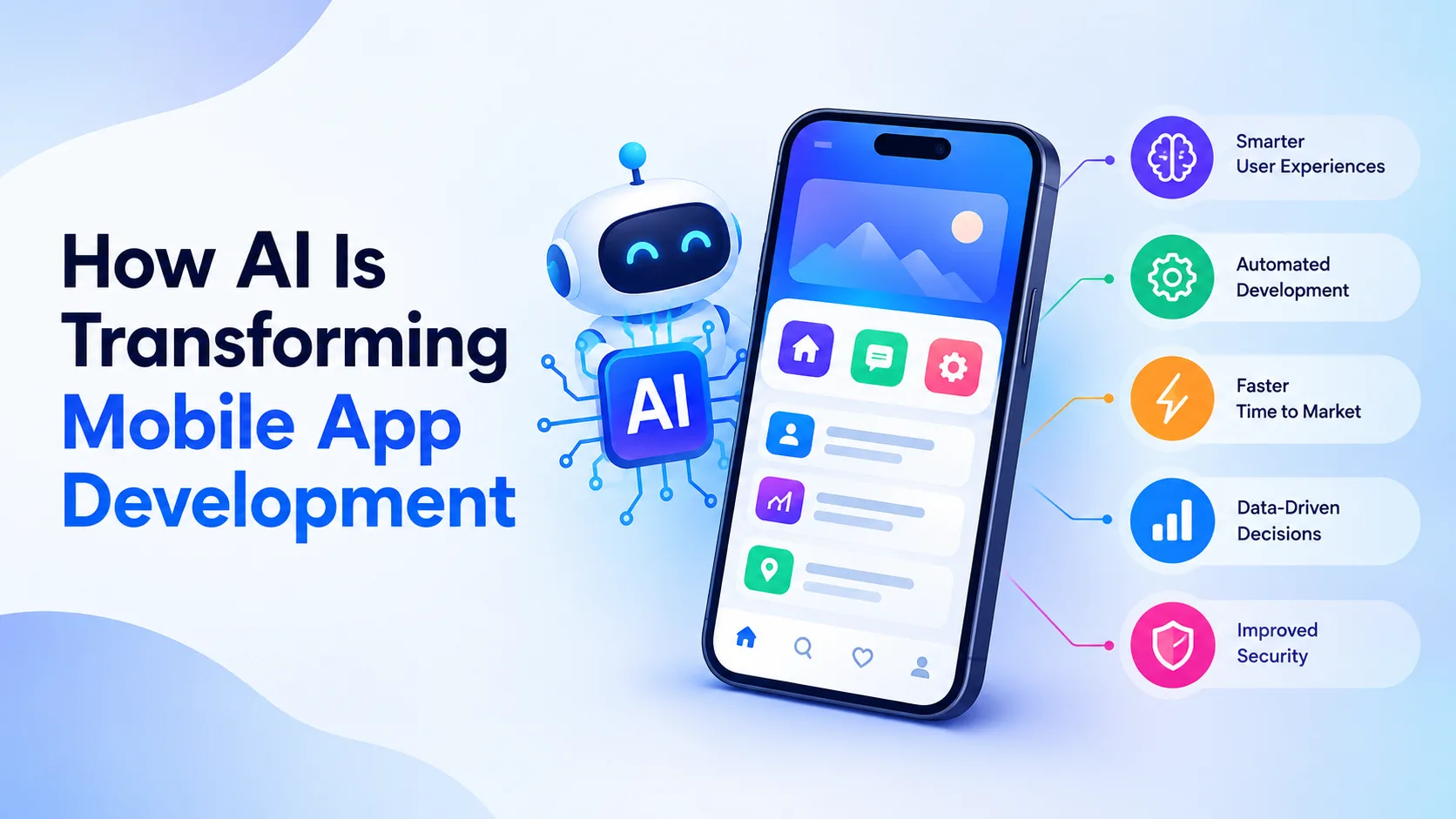
Artificial intelligence is moving beyond basic chatbots and recommendation engines. Today, AI is becoming an important part of how digital products are planned, developed, and experienced. Businesses are increasingly using artificial intelligence and machine learning to automate processes, understand customers, improve decision-making, and create smarter digital experiences..
One of the most interesting ways artificial intelligence can be implemented is a combination of it with mobile application development. Modern mobile apps can utilize AI technologies for analyzing user behavior, processing data, automating actions, making personalized recommendations and communicating with the user via natural language and voice.
In case of creating intelligent digital products, Custom AI & Machine Learning Services can assist in turning an idea into a scalable mobile application.
Latest AI Developments Are Changing Mobile Applications
AI research and development have been shifting towards the creation of intelligent systems capable of comprehending user intent and performing actions instead of giving responses. Agentic AI is a term used to describe such approach in which the system can plan actions, use various tools, and even carry out several actions at once.
New advancements of major technology vendors bring AI even closer to mobile platforms since developers now get access to advanced AI models, on-device AI solutions, and development tools that help code, test, debug, and design apps.
This development is transforming the place AI can occupy in mobile applications because instead of implementing some chatbot as a supplementary tool, companies can implement AI technology into the main functionality of the application.
An AI mobile app can perceive user needs, analyze data, automate actions and workflows, and deliver personalized experience.
How AI Is Used to Build Modern Mobile Applications
AI solutions can be introduced in different phases of mobile application development process, starting with coding and ending with its features.
1. AI-Assisted Mobile App Development
Tools powered by AI could help developers to write code, create components of application, identify errors, develop test scenarios, and improve code.
Such approach might eliminate routine development activities and allow development teams to concentrate on application architecture, security, user experience, and business needs.
AI assistance in mobile development does not mean replacement of experienced developers. It could become an additional layer for developers that could help them work effectively.
For companies, this could result in accelerated development process while focusing on quality and scalability.
2. AI-Powered Personalization
Every mobile application user is individual in terms of preferences and behavior. Using machine learning, applications could offer more personalized experience for users.
For instance, ecommerce mobile application could analyze:
- Purchases history
- Searches
- User browsing
- Frequently viewed products
- Preferences
Based on this information, the application can recommend products that are more relevant to each customer.
The same approach can be used in entertainment, education, fitness, travel, and financial applications.
Personalization can make an application feel more relevant while helping businesses improve engagement and customer retention.
3. AI Chatbots and Virtual Assistants
AI-powered conversational assistants are becoming an important feature in modern mobile applications.
Instead of navigating through several menus, users can interact with an application using natural language.
For example, a customer could ask:
- “Where is my order?”
- “Show me products under ₹2,000.”
- “Book my appointment for tomorrow.”
- “What are today's available offers?”
- “Help me find the right subscription.”
An AI system can understand the user's request and connect it with the appropriate application functionality.
With more advanced AI agents, mobile applications can move beyond answering questions toward helping users complete tasks.
4. On-Device AI for Faster Mobile Experiences
Another important development is the growth of on-device AI.
Traditionally, many AI features depend on cloud-based processing. However, improvements in mobile hardware and smaller AI models are making it increasingly possible to perform certain AI tasks directly on supported devices.
On-device AI can provide benefits such as:
- Faster responses
- Lower latency
- Reduced dependency on internet connectivity
- Better privacy for certain use cases
- Support for selected offline AI features
For instance, the mobile app could leverage an AI model that resides in the user’s smartphone to perform activities such as text summarization, image processing, speech recognition, and intelligent suggestions.
It is especially handy for scenarios where the application requires fast operations, needs some form of privacy and offline functionality.
5. AI Voice Features in Mobile Apps
As AI systems gain better understanding of human languages, voice-based interactions will become more natural.
The AI voice capabilities in mobile applications may allow customers to interact with mobile apps without going through the entire app navigation.
The businesses can leverage AI voice capabilities in the following cases:
- Voice search
- Customer service
- Booking appointments
- Monitoring orders
- Controlling smart devices
- Bank assistance
- Productivity services
For instance, a smart home application may enable users to instruct the system, “Switch on the bedroom lights,” and the AI system may understand the instruction and take actions accordingly.
6. AI-Powered Image and Video Processing
Using computer vision and machine learning, it is possible to create applications that can interpret visual information.
Through machine learning, mobile applications will be able to analyze the images and videos to recognize objects, documents, products, patterns and other types of visual information.
In an ecommerce application, a user can take a picture of a product and the application will provide him with similar products visually. In a logistics application, computer vision would be used to analyze the delivery documents. In a manufacturing application, machine learning will be used to identify product defects.
The examples provided above show how machine learning can be incorporated into the basic function of an application instead of being just another feature in an application.
7. Predictive Analytics in Mobile Applications
Machine learning will also assist in forecasting the future through predictive analysis using the available data.
For instance:
- In retail applications, customers' demands can be predicted.
- In transportation applications, prediction of the demand and optimization of routes is possible.
- In financial applications, unusual transactions can be identified.
- In education applications, learning patterns can be determined.
- In business applications, customers' behavior can be predicted.
How Custom AI & Machine Learning Services Help Businesses
Each company has its own unique customers, workflows, data, and tech requirements. A standard AI solution may fail to offer adequate functionality.
In custom AI development, businesses can tailor intelligent capabilities according to their needs.
The process of developing an AI system usually includes:
Business Analysis → AI Strategy → Data Preparation → Model Selection → Mobile App Development → AI Integration → Testing → Deployment → Continuous Optimization
According to the project requirements, developers can integrate mobile technologies with machine learning models, AI APIs, cloud, databases, analytics platforms, and AI on-device.
Thus, businesses can get AI functionality that matches their application rather than trying to build their business around a certain AI solution.
AI + Mobile Apps: What Businesses Can Build
Combining AI and mobile technologies gives businesses many possibilities within various industries.
Ecommerce
AI can be used for providing personalized product suggestions, intelligent search, virtual assistants, customer service, and demand forecasting.
Healthcare
An AI-powered mobile app can be used for managing appointments, conversational assistance, image analysis, and other uses based on the specific application and privacy regulations.
Banking and Fintech
Machine learning can be implemented for detecting frauds, providing assistance, personalized financial advice, transaction analysis, and risk monitoring.
Logistics
AI will assist in optimizing routes, calculating expected arrival time, forecasting demand, and managing fleets.
Education
AI-enabled learning applications will be able to create customized educational content, generate quiz questions, offer tutoring, and analyze patterns of learning.
Real Estate
AI will help users find appropriate real estate properties, analyze preferences, offer intelligent searches, and engage with intelligent property assistants.
The Future of AI-Powered Mobile Applications
The future of mobile applications is all about intelligent interactions that can comprehend the context of the user's intention.
Users will not need to launch an application, go through several menus, and perform each task on their own.
Instead, the process will become more intelligent, as users will be able to communicate with applications via natural language and speech.
For businesses, this means redesigning current applications to take advantage of automation.
An ecommerce app would be able to identify what products a customer needs automatically. A travel app would assist in organizing the entire trip. A business app would sum up the most crucial information and suggest the subsequent actions.
These opportunities would keep growing as more capable and easy-to-implement AI models appear in the future.
Benefits of AI-Powered Mobile Applications
Implementing AI in mobile apps can bring a number of benefits both for businesses and their users.
Improved Customer Experience
AI would enable the creation of conversational, personal, and proactive applications.
Business Automation
Many tasks that are repeated daily could be automated.
Better Decision-Making
Machine learning would help to analyze a big amount of data and gain insights and forecasts.
Personalized Experiences
AI would tailor content and suggestions based on user's activity.
Increased Productivity
Features provided by AI would assist employees to perform tasks faster and get information needed.
Scalable Digital Solutions
Well-thought architecture of AI would enable a company to add intelligent features to their applications as they grow.
Build Smarter Mobile Applications with AI
AI is changing how mobile applications are designed, developed, and experienced. From AI-powered personalization and voice assistants to intelligent automation, predictive analytics, computer vision, and on-device AI, businesses can now create mobile experiences that are smarter and more responsive.
If you are looking to develop a mobile application with AI capabilities, our team can help turn your idea into a practical and scalable solution. We develop mobile applications involving AI and machine learning, integrating features such as AI chatbots, recommendation engines, voice assistants, predictive analytics, computer vision, intelligent automation, and personalized user experiences.
Whether you are planning a new AI-powered mobile app or want to add AI capabilities to an existing application, our Custom AI & Machine Learning Services can help you choose the right technology and build an application around your business goals.