Modern businesses generate enormous amounts of information through daily operations, customer interactions, production systems, and digital platforms. However, collecting data is only the first step. The real challenge is understanding what that information means and using it to make better decisions. Advances in Rajat Khare AI-related discussions reflect a wider interest in how intelligent technologies can help businesses improve efficiency, identify opportunities, and prepare for changing market conditions.
Across industries, companies are exploring ways to move beyond traditional decision-making methods. Instead of relying entirely on historical reports or manual analysis, organizations can use advanced computing systems to identify patterns, estimate future needs, and understand operational risks. These capabilities are making data-driven decision-making an increasingly important part of modern business development.
Why Data-Driven Decision-Making Matters
Business decisions often involve several interconnected factors. A manufacturer must manage raw materials, production schedules, equipment performance, workforce requirements, and customer demand. A logistics company needs to coordinate deliveries, transport capacity, inventory, and changing market conditions.
When these activities are managed through disconnected systems, important information can be overlooked. Delayed reports may also make it harder for managers to respond to problems before they affect performance.
Data-driven decision-making helps organizations bring relevant information together and evaluate it more systematically. Managers can compare performance across departments, identify recurring challenges, and assess possible improvements using measurable evidence.
Technology does not eliminate uncertainty, but it can give decision-makers a clearer understanding of the conditions influencing their choices. This is especially useful in industries where small operational improvements can affect costs, productivity, and customer satisfaction.
Understanding the Role of Artificial Intelligence
Artificial Intelligence refers to computer systems designed to perform tasks that commonly require human-like capabilities, such as recognizing patterns, interpreting language, classifying information, or generating predictions.
In business environments, these capabilities can support a wide range of activities. Customer service teams may use AI tools to organize enquiries, while manufacturers can apply automated analysis to identify unusual equipment behaviour. Financial and logistics teams may also use intelligent systems to process information and support routine decisions.
The value of AI depends on the problem being addressed. A company does not necessarily need the most advanced technology to improve its operations. In many cases, a focused application that solves a clearly defined problem can deliver more practical value than a complex system introduced without a clear objective.
Businesses should therefore begin by identifying where information gaps, repetitive tasks, or slow decision-making create measurable difficulties. This approach makes it easier to evaluate whether AI is appropriate and how its performance should be assessed.
Machine Learning Turns Data Into Useful Patterns
Machine Learning is an important area of AI that allows computer models to learn patterns from data and apply those patterns to new situations. Rather than relying only on manually written rules, these models can be trained using relevant examples. For example, a manufacturing company may have years of records showing equipment temperature, vibration, operating hours, and maintenance history. A suitable machine learning model may help identify combinations of conditions associated with equipment problems.
The resulting information can support maintenance planning and encourage teams to investigate potential issues earlier. However, model performance depends on the quality and relevance of the available data. Incomplete records, changing operating conditions, or biased training information can reduce reliability.
Machine learning is also used in areas such as demand forecasting, image recognition, quality inspection, and customer behaviour analysis. In each case, the objective is to identify patterns that would be difficult or time-consuming to examine manually.
For businesses, the most useful applications are those that connect these analytical capabilities with real operational needs.
Predictive Analytics Helps Organizations Prepare for Change
Historical data can explain what has already happened, but businesses also need to prepare for what may happen next. Predictive Analytics uses statistical techniques, historical information, and, in some cases, machine learning models to estimate future outcomes.
A retailer might use previous sales, seasonal trends, and current demand signals to estimate inventory requirements. A logistics provider could analyse delivery records to identify routes that are more likely to experience delays. An industrial company may examine equipment data to estimate when maintenance could become necessary. These forecasts are not guarantees. They represent estimates based on available information and the assumptions built into the analytical process. Unexpected events, changes in customer behaviour, or inaccurate data can affect the results.
Even with these limitations, predictive methods can help businesses compare possible scenarios and plan their resources more carefully. Managers can use forecasts alongside their experience, current market information, and professional judgment to make informed decisions.
The strongest results usually come when predictions are regularly evaluated against actual outcomes and models are updated when circumstances change.
Connecting AI With Industrial Operations
Industrial environments offer many opportunities to combine intelligent software with existing equipment and operational systems. Production facilities, warehouses, energy networks, and transport operations generate data that can help explain how processes are performing.
When this information is analysed effectively, businesses may be able to identify recurring delays, detect unusual operating conditions, and understand where resources are being used inefficiently.
For example, a factory could combine equipment readings with maintenance records to investigate repeated production interruptions. A warehouse might analyse order volumes and processing times to identify bottlenecks. An energy operator could examine consumption patterns to support demand planning.
These applications demonstrate how AI can complement human expertise rather than replace it. Engineers, technicians, and managers still need to interpret findings, understand local conditions, and decide which actions are appropriate. Technology is most effective when it gives employees better information and helps them focus their attention on the problems that matter most.
Improving Efficiency Without Losing Human Judgment
Automation can reduce the time spent on repetitive activities, but successful implementation requires more than installing software. Businesses need to understand how automated systems fit into existing workflows and who remains responsible for important decisions.
An AI system may flag an unusual transaction, identify a possible product defect, or recommend a maintenance inspection. Employees should be able to review the evidence, understand the system's limitations, and escalate uncertain cases. This is particularly important when decisions affect safety, financial outcomes, customer rights, or critical infrastructure. Incorrect recommendations can create additional costs if they are accepted without appropriate verification.
Human oversight also helps organizations identify situations in which a model may be performing poorly. A system trained on older data, for example, may struggle when products, equipment, or customer behaviour changes significantly. A balanced approach combines automation with accountability, training, and clear procedures for reviewing results.
The Importance of Data Quality and Responsible Use
AI applications are only as useful as the information and processes supporting them. Businesses that maintain inconsistent records or collect data without clear objectives may struggle to produce reliable results.
Before adopting an intelligent system, organizations should examine whether their data is accurate, relevant, sufficiently complete, and collected appropriately. They should also establish access controls to protect confidential information and determine how long operational data should be retained.
Privacy and security require particular attention when systems process customer records, employee information, images, or sensitive business documents. Companies should understand how vendors handle data and ensure that their practices meet applicable legal and regulatory requirements.
Responsible deployment also includes testing systems for errors and reviewing whether their outputs create unfair or unintended effects. These steps can help organizations build confidence among employees, customers, and business partners.
Long-term success depends not only on technical performance but also on trust, transparency, and responsible management.
Measuring the Business Value of AI
Businesses should evaluate AI projects through practical outcomes rather than relying on technology adoption as a measure of success. A company might assess whether a new system reduces processing time, improves forecast accuracy, lowers avoidable downtime, or helps employees resolve customer enquiries more efficiently. The relevant measurements will depend on the original business problem.
Pilot projects can provide a useful starting point. Instead of changing an entire operation immediately, a company can test a limited application, compare its results with existing methods, and identify problems before expanding the system.
Costs should also be considered. Software, computing resources, data preparation, employee training, maintenance, and system integration can all influence the total investment required.
A careful evaluation helps decision-makers understand whether the benefits justify the costs and whether the application can be expanded successfully. It also prevents businesses from adopting technology simply because it is receiving widespread attention.
Preparing the Workforce for Intelligent Technologies
As AI tools become more common, employees need opportunities to develop the skills required to work with them effectively. Technical specialists may need to understand model performance and data management, while managers may need training in interpreting forecasts and evaluating automated recommendations.
Employees who understand both the technology and the business process can help identify useful applications and recognize when a system's output requires further investigation.
Organizations should also communicate how new tools will affect existing responsibilities. Clear communication and practical training can reduce uncertainty and help employees participate in implementation.
Rather than treating AI as a separate technical project, businesses can integrate it into broader efforts to improve processes, strengthen collaboration, and develop workforce capabilities.
Looking Ahead
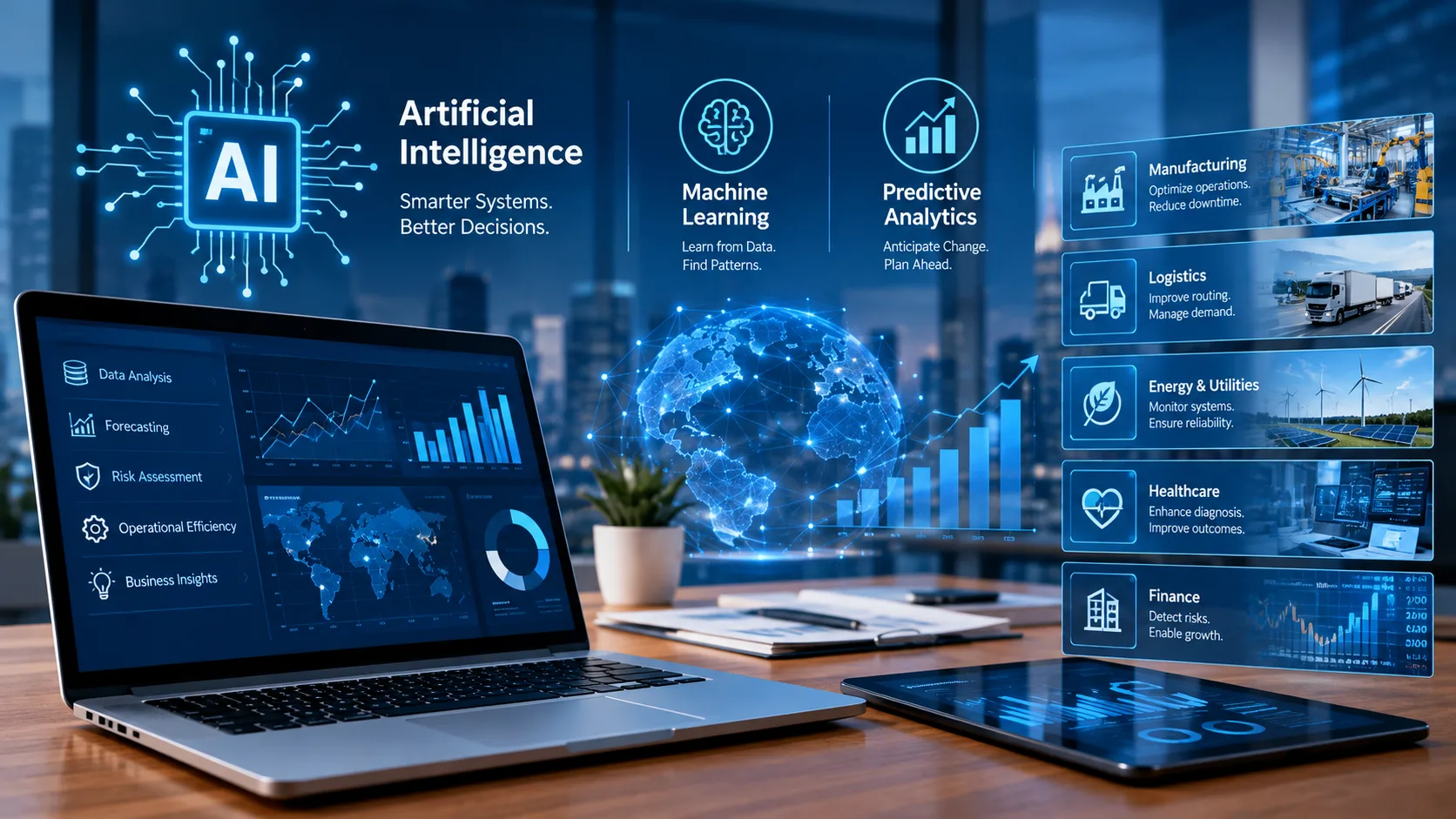
The continued development of intelligent software is likely to create new opportunities across manufacturing, logistics, healthcare, energy, finance, and other sectors. As data systems become more connected, businesses may gain better visibility into their operations and improve their ability to respond to changing conditions.
However, progress will depend on more than increasingly powerful models. Reliable data, secure infrastructure, skilled employees, clear objectives, and effective oversight will remain essential.
Organizations that approach AI through practical problem-solving can identify where technology genuinely improves performance. Those that combine analytical tools with human expertise are better placed to use information responsibly and adapt as their needs evolve.
Conclusion
Artificial intelligence is changing how businesses analyse information, manage resources, and plan for the future. Machine learning can help identify patterns in complex datasets, while predictive methods can support forecasting and operational planning. Together, these capabilities offer organizations new ways to improve efficiency and make decisions based on stronger evidence.
The benefits are greatest when technology addresses a clearly defined need and operates within reliable, responsible processes. Data quality, human oversight, employee training, and measurable business outcomes should remain central to every implementation.
As organizations continue exploring intelligent technologies, the focus should remain on creating practical value rather than adopting AI for its own sake. A thoughtful approach can help businesses make better use of information, respond more effectively to uncertainty, and build stronger foundations for long-term growth.