Education is changing quickly. Students today are not limited to textbooks, classrooms, and fixed learning schedules. They use online courses, learning apps, digital classrooms, and interactive tools to learn at their own pace. As technology continues to evolve, artificial intelligence is becoming an important part of this transformation.
AI Development for Education Platform is helping schools, universities, EdTech companies, and training organizations build smarter learning experiences. Instead of providing the same content to every student, AI-powered platforms can understand individual learning patterns and deliver more personalized support.
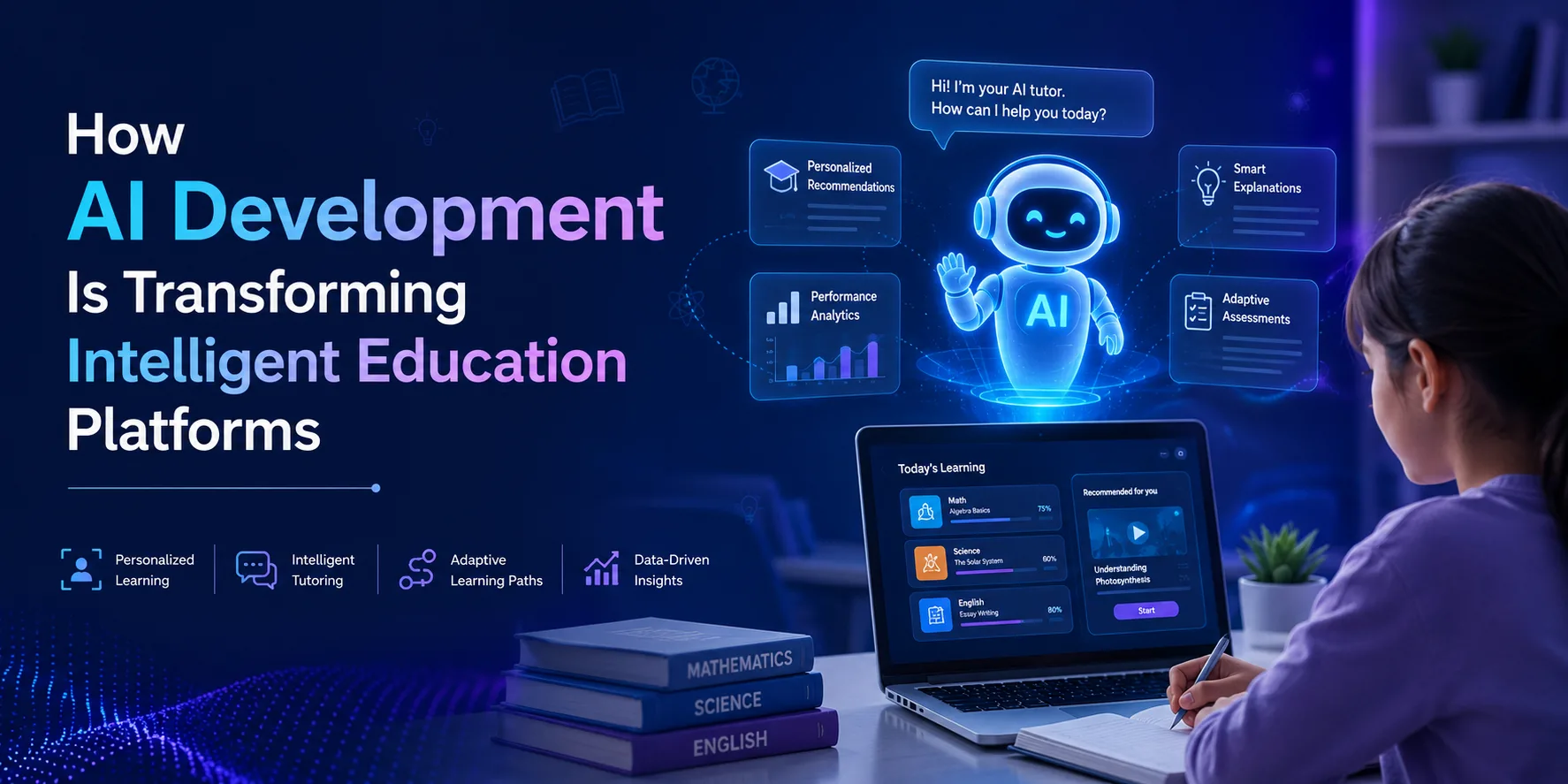
From adaptive learning and AI tutoring to intelligent assessments and learning analytics, AI is making education platforms more responsive, engaging, and efficient.
What Is an Intelligent Education Platform?
An intelligent education platform is a digital learning system that uses technologies such as artificial intelligence, machine learning, natural language processing, and data analytics to improve the learning experience.
Traditional education platforms usually provide a fixed set of courses, videos, assignments, and tests. Intelligent platforms can go a step further. They can analyze how students interact with learning materials and use that information to make recommendations or provide additional support.
For example, if a student repeatedly struggles with a particular mathematics topic, an AI-powered platform can identify the problem and recommend easier explanations, practice exercises, videos, or additional learning resources.
This makes the learning experience more personalized instead of treating every learner in exactly the same way.
How AI Development Is Changing Education Platforms
AI is not simply adding another feature to an education app. It is changing how educational platforms understand students, deliver content, and support teachers.
Here are some of the most important ways AI is transforming intelligent education platforms.
1. Personalized Learning Experiences
Every student learns differently. Some students understand concepts quickly, while others need additional explanations and practice.
AI can analyze student behavior, performance, learning speed, quiz results, and content preferences. Based on these insights, an intelligent education platform can create a more personalized learning journey.
For example, the platform might:
- Recommend relevant courses or lessons
- Adjust the difficulty of learning materials
- Suggest additional practice
- Identify topics that need improvement
- Provide personalized study plans
- Recommend learning resources based on student progress
This approach is often referred to as personalized learning or adaptive learning.
With effective AI Development for Education Platform solutions, personalization can become an ongoing process rather than a one-time recommendation.
2. AI-Powered Virtual Tutors
Students often need help outside traditional classroom hours. Teachers may not always be available to answer every question immediately.
AI-powered virtual tutors can provide students with on-demand assistance. Using natural language processing and generative AI, these systems can understand questions and provide explanations in conversational language.
An AI tutor can help students:
- Understand difficult concepts
- Answer questions
- Practice problems
- Explain mistakes
- Summarize learning material
- Generate practice questions
- Provide step-by-step guidance
The goal should not be to replace teachers. Instead, AI tutoring can provide additional support and allow teachers to spend more time on areas where human interaction is most valuable.
3. Intelligent Assessments
Assessments are an important part of education, but traditional testing methods do not always provide a complete picture of student understanding.
AI can make assessments more intelligent by analyzing responses and identifying patterns in student performance.
An AI-powered assessment system can recommend questions based on a student's current skill level. If a student performs well, the platform can gradually increase the difficulty. If the student struggles, it can provide easier questions or additional practice.
This creates a more dynamic assessment experience.
AI can also help identify knowledge gaps and provide educators with useful information about where students need additional support.
4. Automated Grading and Feedback
Teachers spend a considerable amount of time evaluating assignments, quizzes, and other learning activities.
AI-powered grading tools can automate parts of this process. They can evaluate objective answers quickly and, depending on the system and subject, assist with evaluating written responses using predefined criteria.
More importantly, AI can provide faster feedback.
Instead of waiting several days to receive results, students can receive immediate guidance about their mistakes and suggestions for improvement.
This does not mean every educational assessment should be completely automated. Human review remains important, particularly for complex or high-stakes assessments.
5. Learning Analytics for Better Decisions
Modern education platforms generate large amounts of data. This can include attendance, course completion, quiz scores, time spent on lessons, engagement levels, and learning progress.
Without intelligent analysis, much of this data may remain unused.
AI-powered learning analytics can turn this information into useful insights.
Educators and administrators can use these insights to understand:
- Which subjects students are struggling with
- Which courses have low engagement
- Which students may need additional support
- How learners are progressing
- Which learning materials are performing well
- Where students are dropping out of a course
These insights can support data-driven decision-making across educational organizations.
6. AI Chatbots for Student Support
Educational institutions receive many repetitive questions about courses, schedules, assignments, admissions, fees, policies, and learning resources.
AI chatbots can handle many routine questions through conversational interfaces.
A chatbot integrated into an education platform can provide support 24/7 and direct students toward relevant information.
For example, a student could ask:
"What assignments do I need to complete this week?"
The platform could retrieve the student's relevant course information and provide an answer.
When designed correctly, educational chatbots can reduce the workload on administrative teams while giving students faster access to information.
7. Improved Student Engagement
Keeping students engaged is one of the biggest challenges in digital education.
AI can analyze engagement patterns and help platforms understand when learners are becoming less active.
An intelligent platform could recommend shorter lessons, quizzes, revision activities, or interactive content based on a student's behavior.
Gamification can also be combined with AI to create personalized challenges, progress goals, badges, and learning recommendations.
The objective is not simply to keep students clicking. The real goal is to encourage meaningful learning and consistent progress.
8. AI-Generated Educational Content
Generative AI is creating new possibilities for educational content creation.
AI systems can assist educators and content teams with creating:
- Lesson outlines
- Practice questions
- Quizzes
- Study guides
- Summaries
- Flashcards
- Explanations
- Course descriptions
- Learning activities
However, AI-generated content should be reviewed carefully. Educational material needs to be accurate, appropriate for the learner's level, and aligned with the curriculum.
A strong education platform combines AI-generated assistance with expert human oversight.
9. Early Identification of Learning Challenges
One of the most valuable applications of AI in education is identifying students who may need additional support.
By analyzing changes in performance, engagement, attendance, and learning behavior, AI models can identify patterns that may require attention.
For example, a sudden decline in quiz performance combined with reduced platform activity could indicate that a student is struggling.
Educators can then investigate the situation and provide appropriate support.
AI should support this process rather than make sensitive decisions about students without human involvement.
10. Voice and Natural Language Interaction
Voice technology can make digital education more accessible and interactive.
Students can ask questions verbally, practice pronunciation, or interact with educational applications through natural language.
For language-learning platforms, AI can also support conversational practice and provide feedback on pronunciation and communication skills.
As speech recognition and natural language processing continue to improve, voice-based learning experiences are likely to become more common.
Benefits of AI Development for Education Platform
Organizations investing in AI-powered education platforms can gain several benefits.
Better Personalization
AI enables platforms to provide learning recommendations based on individual student needs rather than relying entirely on a fixed learning path.
Greater Efficiency
Automation can reduce repetitive administrative and educational tasks, allowing teachers and staff to focus on higher-value activities.
Faster Feedback
Students can receive feedback and learning recommendations much faster than with traditional manual processes.
Improved Student Support
AI tutors and chatbots can provide assistance beyond regular classroom hours.
Data-Driven Education
Learning analytics can help educators make better decisions using real-time and historical learning data.
Scalable Learning
AI-powered systems can support large numbers of learners while still providing a degree of individualized assistance.
Technologies Used in Intelligent Education Platforms
Successful AI Development for Education Platform projects can combine several technologies depending on the platform's objectives.
Common technologies include:
- Machine Learning: Used to analyze learning patterns and make predictions.
- Natural Language Processing: Helps systems understand and respond to human language.
- Generative AI: Supports content creation, tutoring, summarization, and conversational learning.
- Computer Vision: Can support applications involving images, documents, handwriting, or visual learning materials.
- Recommendation Engines: Suggest relevant courses, lessons, and learning resources.
- Learning Analytics: Converts educational data into actionable insights.
- Cloud Computing: Provides scalable infrastructure for AI-powered applications.
- AI Agents: Can perform multi-step tasks such as answering questions, retrieving learning resources, and assisting with educational workflows.
The technology stack should be selected based on the specific educational use case rather than simply adding AI for the sake of using AI.
Challenges of Building AI-Powered Education Platforms
Although AI offers significant opportunities, developing an intelligent education platform also comes with challenges.
Data Privacy
Education platforms handle sensitive student information. Organizations need strong security, access controls, data governance, and privacy practices.
Accuracy
AI systems can sometimes generate incorrect or misleading information. Educational platforms need appropriate testing, validation, monitoring, and human oversight.
Bias
AI models can reflect biases present in their training data. Developers need to consider fairness and evaluate systems across different groups of learners.
Teacher and Human Oversight
AI should support educators rather than remove the human element from education. Teachers remain essential for mentorship, context, motivation, and complex decision-making.
Integration
AI features may need to work with existing learning management systems, student information systems, content repositories, assessment tools, and other educational software.
The Future of Intelligent Education Platforms
The future of education is likely to become increasingly personalized and AI-assisted.
Instead of simply providing a digital library of courses, future platforms may act more like intelligent learning environments. They could understand a student's goals, track progress, identify learning gaps, recommend resources, and provide assistance throughout the learning journey.
AI agents may also become more capable of handling multi-step educational tasks. For example, an intelligent learning assistant could help a student create a study plan, find relevant course material, generate practice exercises, track progress, and adjust recommendations based on performance.
At the same time, successful education technology will need to maintain a strong balance between automation and human interaction.
The most effective platforms will not necessarily be the ones with the most AI features. They will be the ones that use AI thoughtfully to solve genuine problems for students, teachers, and educational organizations.
Conclusion
AI is changing education platforms from simple digital content systems into intelligent learning environments.
Through personalized learning, adaptive learning, AI tutoring, intelligent assessments, automated feedback, learning analytics, educational chatbots, and generative AI, education platforms can deliver more responsive and engaging experiences.
For schools, universities, EdTech companies, and corporate training providers, AI Development for Education Platform can provide a foundation for building scalable and intelligent learning solutions.
The key is to focus on real educational outcomes. AI should make learning more accessible, personalized, efficient, and supportive while keeping educators and learners at the center of the experience.