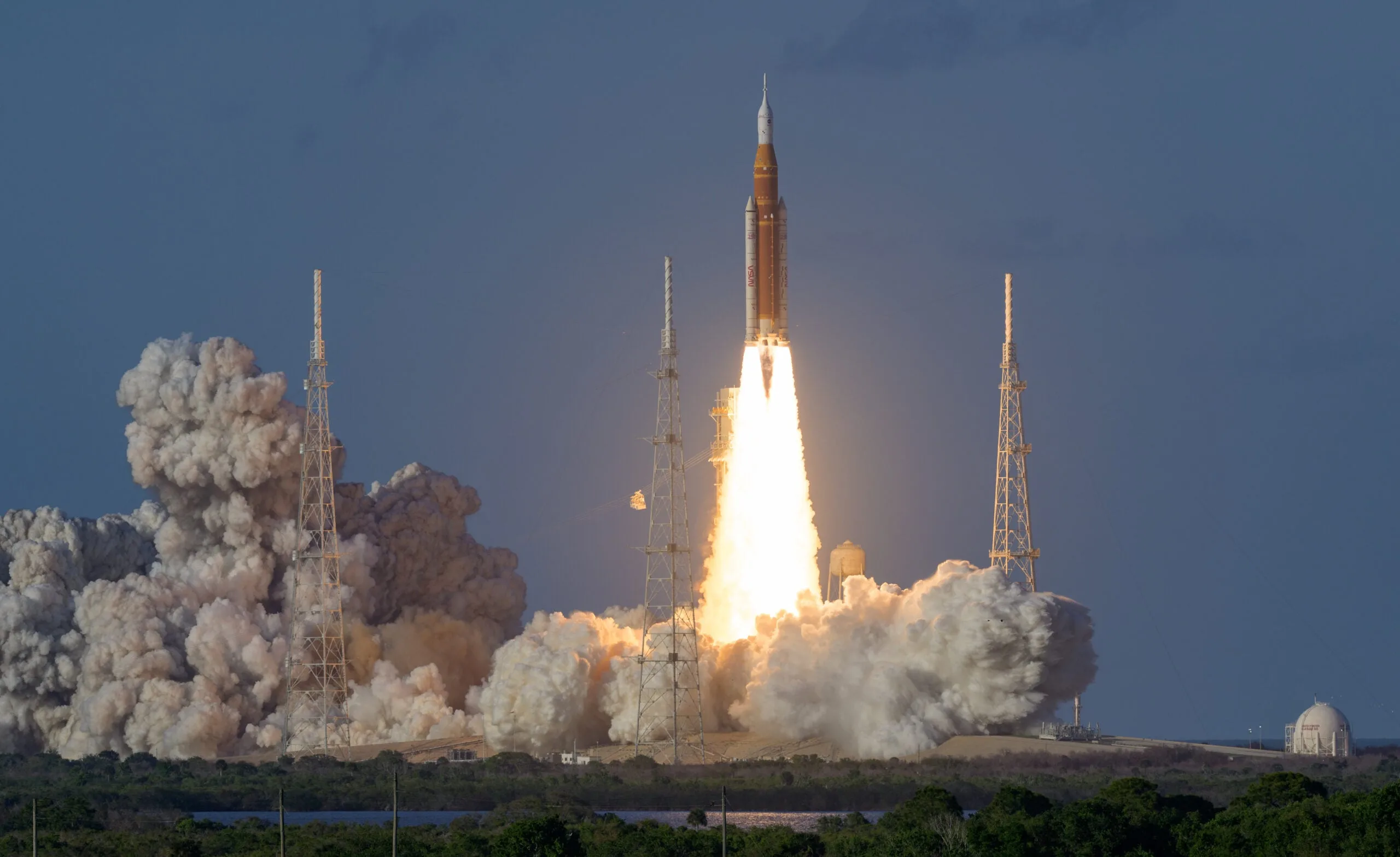
World Space Week is being observed from October 4 to October 10, 2026, and this year's theme is “Rocket Revolution.” The theme focuses on how quickly rocket technology, space missions, and access to orbit have changed in recent years.
Google's Doodle is giving the celebration an especially visual touch. Instead of simply displaying a rocket illustration, the company is using spectacular astronomical imagery to remind people of what space exploration is ultimately about: looking farther, learning more, and understanding the universe around us.
What Is the World Space Week 2026 Doodle?
Google's World Space Week 2026 celebration includes a series of space-themed Doodles. One of the featured Doodles, launched on October 6, showcases the Rosebud Nebula, a fascinating region of space photographed by NASA's James Webb Space Telescope.
The Rosebud Nebula is located around 3,300 light-years from Earth and contains more than 130 young stars. Its clouds of gas and dust create a shape that resembles a rosebud, while the surrounding material gives the region its striking pink appearance.
Google describes the Doodle as a celebration of the technology behind modern astrophotography. That is an interesting connection because telescopes such as Webb allow scientists and the public to see distant cosmic objects in extraordinary detail.
Google's Doodle collection has also continued the celebration with another space image. On October 8, the company featured the Carina Nebula as part of World Space Week 2026.
Rather than being just another decorative change to Google's homepage, these Doodles help bring complicated topics in astronomy and space science to a much wider audience.
Why Is This Year's Theme Called "Rocket Revolution"?
The phrase “Rocket Revolution” reflects how dramatically spaceflight has changed.
For decades, space missions were largely associated with national space agencies and extremely expensive government programs. Today, the space industry includes government agencies, private companies, universities, startups, researchers, and international organizations.
One of the biggest changes has been the development of reusable rocket technology. Instead of treating every rocket as a single-use vehicle, engineers have developed systems that can return important rocket components for future missions.
This has the potential to reduce launch costs and make access to space more practical for a wider range of organizations.
The change is not happening in just one area. Satellites, communications systems, Earth observation, scientific research, navigation, and commercial spaceflight are all becoming increasingly connected to developments in launch technology.
That is why the term “rocket revolution” is broader than simply building bigger or faster rockets. It represents a change in how humanity approaches access to space.
From Sputnik to Today's Space Industry
World Space Week has a strong connection to the history of space exploration.
The celebration begins on October 4, the anniversary of the launch of Sputnik 1 in 1957. Sputnik became the first artificial satellite to orbit Earth and marked one of the defining moments at the beginning of the Space Age.
The week concludes on October 10, which commemorates the entry into force of the Outer Space Treaty in 1967. The treaty established important principles concerning the exploration and use of outer space.
Looking back at the history of spaceflight makes the current “Rocket Revolution” especially interesting.
The technology of the late 1950s was focused on proving that humans could send an object into orbit. Today, spacecraft routinely support communications, navigation, weather monitoring, scientific research, Earth observation, and many other activities.
The distance between those two eras is enormous.
The Role of Private Companies
Another major part of today's space revolution is the growing involvement of private companies.
Commercial space organizations are developing rockets, spacecraft, satellite systems, and other technologies that were once largely controlled by governments.
This has created a more competitive space industry and encouraged companies to look for ways to make launches more efficient.
Reusable launch systems are particularly important because rockets represent a significant portion of the cost and complexity of getting equipment into orbit. If parts of a launch vehicle can be recovered and flown again, the economics of spaceflight can change considerably.
The result is a space industry that is becoming more active and more diverse.
For ordinary people, that may mean that space missions are no longer something that happens only a few times a year. Launches, satellite deployments, scientific missions, and commercial projects are increasingly becoming regular parts of the news.
Why Google's Doodle Matters
At first glance, a Google Doodle may seem like a small event. After all, it is simply a temporary change to the company's search homepage.
But the reach of Google's homepage gives these illustrations a unique ability to introduce people to subjects they might not normally search for.
Someone looking up an everyday question could suddenly see an image of a distant nebula. That person might become curious about what a nebula is, how stars are formed, or how a telescope can photograph objects thousands of light-years away.
That kind of curiosity is one of the most valuable aspects of science communication.
Google has used Doodles for years to highlight important people, cultural events, holidays, scientific discoveries, and historical milestones. Its official Doodle archive describes Doodles as celebrations covering subjects such as culture, places, holidays, sports, and more.
The World Space Week Doodles fit naturally into that tradition.
The Beauty Behind the Science
One of the most appealing parts of the 2026 celebration is the imagery itself.
Space can sometimes feel like an abstract subject filled with huge numbers, complicated physics, and difficult concepts. Images from modern telescopes make those ideas easier to appreciate.
The Rosebud Nebula, for example, is not simply a colorful object in a photograph. It is a huge region of gas and dust associated with young stars. The light we see from such a distant object has traveled for thousands of years before reaching Earth.
That means when we look at the Rosebud Nebula, we are also looking into the past.
The same idea applies to many astronomical observations. Telescopes are not just cameras pointed at the night sky. They are scientific tools that allow researchers to study objects across enormous distances and learn about how stars, galaxies, and other cosmic structures develop.
What the "Rocket Revolution" Could Mean for the Future
The changes taking place in spaceflight could have an impact far beyond today's launches.
Lower launch costs and more capable rockets could make it easier to place scientific instruments in orbit. More satellites could improve communication and Earth observation. New missions could help scientists study the Moon, Mars, asteroids, and the deeper reaches of the solar system.
At the same time, the rapid growth of space activity creates new challenges.
More spacecraft in orbit means that governments and companies must pay greater attention to space traffic, satellite coordination, and orbital debris. The future of space exploration will therefore involve not only building new technology but also finding responsible ways to manage the increasingly busy environment around Earth.
That balance will be important as more countries and companies become involved in space.
A Celebration of Curiosity
Google's World Space Week 2026 Doodle is ultimately more than a colorful change to its homepage. It is a reminder of how far space exploration has come and how much remains to be discovered.
The “Rocket Revolution” theme looks toward the future, while World Space Week itself connects that future to the history of spaceflight.
From Sputnik's first trip around Earth to reusable rockets and powerful space telescopes, the story of space exploration has always been driven by curiosity.
Google's decision to highlight the celebration through stunning astronomical imagery brings that story to millions of people in a simple and accessible way.
Whether someone is already fascinated by rockets or simply stops to admire a colorful nebula on Google's homepage, the message is much the same: there is still a lot to discover beyond Earth.
As World Space Week 2026 continues, the combination of rocket technology, astronomy, scientific research, and public curiosity shows why space remains one of humanity's most exciting frontiers.