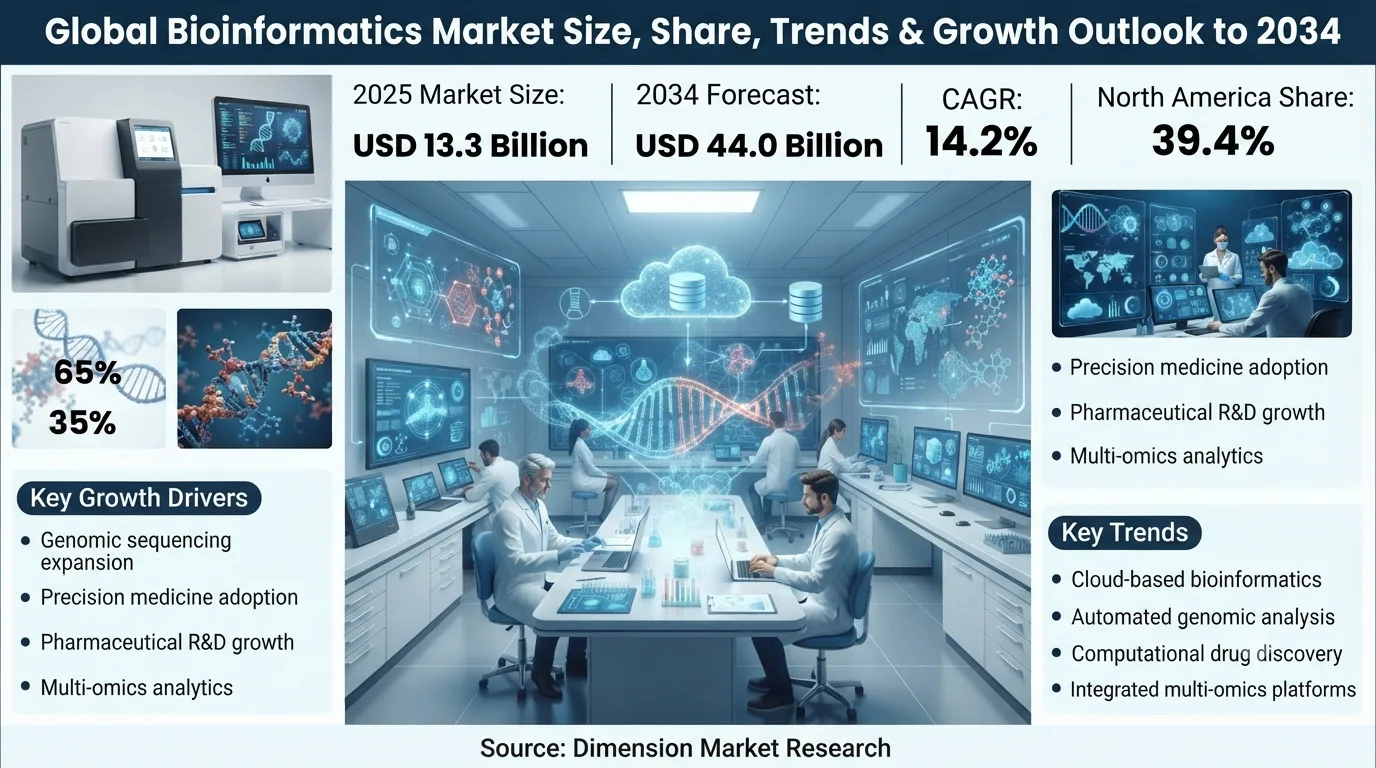
The Global Bioinformatics Market is entering a period of strong expansion as genomics, precision medicine, drug discovery, molecular diagnostics, and biological data analysis become increasingly dependent on advanced computational platforms. The market is projected to reach USD 13.3 billion in 2025 and expand to USD 44.0 billion by 2034, registering a CAGR of 14.2%. Increasing volumes of genomic and proteomic information are creating demand for software, analytical tools, databases, cloud infrastructure, and specialized services capable of transforming complex biological datasets into actionable scientific insights.
Bioinformatics combines biology, computer science, mathematics, statistics, and data engineering to manage and interpret biological information. Its applications have expanded considerably with the adoption of next-generation sequencing, biomarker identification, personalized therapeutics, gene-based research, molecular modeling, and advanced diagnostics. Pharmaceutical and biotechnology organizations increasingly use bioinformatics to accelerate target identification, optimize clinical research, understand disease pathways, and improve drug development productivity.
The market is also benefiting from declining sequencing costs, expanding genomic research programs, improvements in computing capabilities, and growing availability of biological databases. Laboratories are producing increasingly complex datasets that require scalable analytical environments. This is encouraging healthcare organizations, academic institutes, pharmaceutical developers, agricultural biotechnology companies, and research laboratories to strengthen their bioinformatics capabilities.
📄 Looking for Specific Data? Get a Free Customized Sample:
https://dimensionmarketresearch.com/request-sample/bioinformatics-market/
Bioinformatics Market Overview
Bioinformatics has evolved from a specialized academic discipline into an essential component of modern life sciences. Biological research increasingly depends on computational analysis to identify patterns across genomic sequences, proteins, molecular structures, clinical information, and other forms of biomedical data.
Organizations are adopting bioinformatics platforms to shorten research cycles while managing increasingly large datasets. Genome sequencing projects can generate enormous quantities of information, making manual analysis impractical. Modern platforms automate sequence alignment, annotation, molecular analysis, variant identification, visualization, and biological interpretation.
The expansion of precision medicine is particularly important for market development. Personalized treatment approaches require researchers and clinicians to understand genetic differences among patients. Bioinformatics enables the identification of mutations, biomarkers, and molecular pathways that may influence treatment response.
Key market indicators include:
- 2025 market value: USD 13.3 billion
- 2034 projected value: USD 44.0 billion
- 2025 to 2034 CAGR: 14.2%
- Genomics remains a major application area
- Drug development creates significant analytical demand
- Cloud platforms are improving research scalability
- Precision medicine supports long-term adoption
Key Findings of the Bioinformatics Market
The market is characterized by strong demand for analytical technologies capable of processing increasingly complex life science data. Pharmaceutical innovation, genome sequencing, computational biology, and molecular diagnostics are emerging as major areas of investment.
Important findings include:
- Biological datasets are increasing rapidly
- Sequencing adoption is expanding research opportunities
- Drug discovery is becoming more computational
- Cloud infrastructure supports large-scale analysis
- Biomarker discovery is increasing platform demand
- Precision medicine strengthens genomic analytics adoption
- North America maintains significant market leadership
- Integrated software platforms are gaining importance
The ability to integrate information from genomics, transcriptomics, proteomics, metabolomics, and clinical datasets is becoming an important competitive capability. Organizations increasingly prefer interconnected platforms rather than isolated analytical tools.
Bioinformatics Market Dynamics
Growth Drivers
One of the strongest drivers of the Bioinformatics Market is the rapid expansion of genomic sequencing. Sequencing technologies are becoming more accessible to research institutions, diagnostic laboratories, pharmaceutical companies, and healthcare organizations. Increasing sequencing volumes directly raise demand for storage, processing, interpretation, and visualization technologies.
The growing importance of precision medicine represents another major growth catalyst. Instead of relying exclusively on standardized treatments, healthcare research is increasingly focused on therapeutic strategies designed around individual genetic profiles. Bioinformatics helps researchers interpret genetic variations and connect molecular characteristics with disease development and treatment outcomes.
Drug discovery is also becoming increasingly data-intensive. Computational biology enables researchers to screen potential compounds, study biological pathways, identify therapeutic targets, evaluate proteins, and prioritize promising candidates before extensive laboratory testing.
Major growth drivers include:
- Rising adoption of next-generation sequencing
- Increasing precision medicine research
- Growing genomic and proteomic datasets
- Expansion of pharmaceutical R&D
- Higher demand for biomarker discovery
- Greater use of computational drug discovery
- Improved availability of cloud computing
- Increasing biological database development
Market Challenges
Despite strong growth prospects, the market faces several challenges. Biological datasets can be highly complex, requiring specialized expertise in both life sciences and advanced computational analysis. Organizations may struggle to recruit professionals capable of working across these disciplines.
Data standardization also remains difficult. Biological information is generated using different technologies, formats, laboratory protocols, and analytical methods. Integrating these datasets while maintaining consistency and accuracy can create significant operational challenges.
Another concern involves infrastructure requirements. Large genomic projects require substantial computing capacity and storage. Cloud technology is reducing some infrastructure barriers, although security, privacy, interoperability, and governance requirements remain important considerations.
Key challenges include:
- Shortage of specialized bioinformatics professionals
- Complex biological data integration
- High computational infrastructure requirements
- Difficulties maintaining consistent data quality
- Interoperability limitations between platforms
- Data privacy and security considerations
- Requirement for continuous software updates
- Validation requirements for clinical applications
Major Bioinformatics Market Trends
Expansion of Multi-Omics Analysis
Research organizations are moving beyond isolated genomic analysis toward multi-omics approaches combining genomics, transcriptomics, proteomics, metabolomics, and related biological information.
Multi-omics integration can provide a broader understanding of disease mechanisms by showing how genetic information interacts with proteins, metabolic pathways, and cellular processes. Bioinformatics platforms capable of integrating these datasets are therefore becoming increasingly valuable.
Growing Adoption of Cloud-Based Bioinformatics
Cloud computing is changing how laboratories manage biological information. Instead of maintaining extensive local computing infrastructure, organizations can access scalable processing and storage resources based on project requirements.
Cloud platforms can facilitate collaboration between geographically distributed research teams while improving access to large datasets and analytical workflows.
- Cloud systems support scalable biological analysis
- Remote collaboration is becoming easier
- Computing resources can expand with project demand
- Centralized platforms improve workflow management
Increasing Automation of Biological Analysis
Automation is becoming important as sequencing output expands. Modern platforms can automate repetitive analytical processes including sequence alignment, annotation, quality control, variant detection, and workflow management.
Automation helps reduce processing time while allowing researchers to focus on scientific interpretation rather than routine computational tasks.
Growing Role of Advanced Computational Analytics
Advanced computational models are increasingly being incorporated into life science workflows to identify complex relationships within large datasets. These approaches can help classify biological information, identify potential biomarkers, analyze molecular interactions, and prioritize drug development opportunities.
Market Segmentation Overview
The Bioinformatics Market can be evaluated across products and services, applications, sectors, and end users. Each segment reflects a different part of the biological data analysis ecosystem.
By Product and Service
Bioinformatics platforms generally include knowledge management tools, analytical software, computational platforms, databases, and professional services.
Software solutions are increasingly important because laboratories need user-friendly environments capable of performing sophisticated biological analysis without requiring researchers to develop every computational workflow independently.
Key categories include:
- Bioinformatics platforms
- Knowledge management tools
- Analytical software
- Biological databases
- Data management solutions
- Sequencing analysis tools
- Professional services
- Consulting and implementation services
By Application
Genomics represents a major application because sequencing generates significant volumes of information requiring computational processing. Proteomics, transcriptomics, metabolomics, molecular medicine, and drug discovery also create substantial demand.
Major applications include:
- Genomics
- Proteomics
- Transcriptomics
- Metabolomics
- Drug discovery
- Molecular medicine
- Precision medicine
- Gene sequencing
- Agricultural biotechnology
By End User
Demand comes from organizations involved in biological research, medicine, therapeutics, and biotechnology development.
Pharmaceutical companies increasingly use bioinformatics throughout research pipelines, from target identification and molecular screening to biomarker development and clinical research.
Key end users include:
- Pharmaceutical companies
- Biotechnology companies
- Academic institutions
- Research organizations
- Diagnostic laboratories
- Healthcare organizations
- Agricultural biotechnology companies
- Contract research organizations
Competitive Landscape
The competitive landscape is increasingly focused on integrated platforms, scalable analytical capabilities, workflow automation, interoperability, and specialized scientific applications. Companies are strengthening their portfolios through software development, cloud integration, database expansion, strategic partnerships, and research collaborations.
Competition is moving beyond basic sequence analysis toward platforms capable of integrating multiple biological data types. Customers increasingly seek systems that support genomic analysis, visualization, workflow management, data storage, and biological interpretation through a unified environment.
Competitive priorities include:
- Development of integrated analytical platforms
- Expansion of cloud-based capabilities
- Support for multi-omics research
- Improved workflow automation
- Faster processing of sequencing datasets
- Greater interoperability between applications
- Enhanced visualization capabilities
- Expansion into precision medicine workflows
Service providers are also becoming important as organizations seek assistance with implementation, data analysis, workflow design, database management, and specialized computational research.
📄 Purchase the report for comprehensive details:
https://dimensionmarketresearch.com/checkout/bioinformatics-market/
Regional Analysis
North America Bioinformatics Market
North America is projected to lead the bioinformatics industry with 39.4% of the market share by the end of 2024. The region's leadership is supported by a strong biotechnology and pharmaceutical ecosystem, advanced research infrastructure, high adoption of sequencing technologies, and substantial investment in biomedical innovation.
The presence of sophisticated academic research environments and technology-driven life science organizations also supports demand for computational biology platforms. Pharmaceutical companies increasingly incorporate bioinformatics into drug discovery, genomic research, clinical development, and biomarker identification.
Key regional strengths include:
- 2024 market share: 39.4%
- Strong biotechnology research ecosystem
- Advanced pharmaceutical R&D infrastructure
- High adoption of genomic technologies
- Extensive biomedical research capabilities
- Growing precision medicine activities
Europe Bioinformatics Market
Europe represents an important market supported by biomedical research, pharmaceutical development, genomic initiatives, and increasing use of molecular diagnostics. Research collaboration between universities, hospitals, biotechnology companies, and pharmaceutical organizations continues to support adoption.
The region is also experiencing growing interest in personalized medicine and population genomics, creating additional demand for analytical platforms capable of processing complex genomic information.
Asia Pacific Bioinformatics Market
Asia Pacific presents significant long-term growth potential as genomic sequencing, biotechnology investment, pharmaceutical research, and healthcare modernization expand across major economies.
Increasing research capabilities and improving computational infrastructure are creating opportunities for bioinformatics software and services. Growth in genetic testing, biotechnology startups, clinical research, and precision medicine initiatives may further strengthen regional adoption.
Future Market Outlook
The Bioinformatics Market is positioned for sustained expansion through 2034 as biological research becomes increasingly digital and data-intensive. Moving from USD 13.3 billion in 2025 to USD 44.0 billion by 2034 reflects the growing importance of computational technologies across pharmaceutical development, genomics, molecular diagnostics, and life science research.
Future bioinformatics platforms are expected to become more integrated, scalable, automated, and accessible. Researchers will increasingly require systems capable of connecting genomic information with other biological and clinical datasets.
Multi-omics analysis could become particularly important because complex diseases cannot always be understood through genetic information alone. Combining multiple molecular layers may enable researchers to develop deeper insights into biological mechanisms and therapeutic responses.
Future market opportunities include:
- Integrated multi-omics platforms
- Personalized therapeutic development
- Computational drug discovery
- Population-scale genomic research
- Cloud-based research ecosystems
- Molecular diagnostic applications
- Automated genomic interpretation
- Advanced biomarker identification
FAQs
What is the Bioinformatics Market?
The Bioinformatics Market includes software, platforms, databases, computational technologies, and services used to collect, organize, analyze, and interpret biological information. Applications include genomics, proteomics, drug discovery, molecular medicine, precision medicine, and biomedical research.
How large will the Bioinformatics Market be in 2034?
The market is projected to reach USD 44.0 billion by 2034, increasing from an expected USD 13.3 billion in 2025 at a CAGR of 14.2%.
What is driving growth in the Bioinformatics Market?
Major growth drivers include increasing genomic sequencing, expanding precision medicine research, pharmaceutical R&D, biomarker discovery, multi-omics analysis, and rising demand for computational drug development.
Which region leads the Bioinformatics Market?
North America is projected to hold 39.4% of the market share by the end of 2024, supported by its biotechnology industry, pharmaceutical research base, advanced infrastructure, and widespread use of genomic technologies.
What are the major applications of bioinformatics?
Major applications include genomics, proteomics, transcriptomics, metabolomics, molecular medicine, drug discovery, biomarker identification, precision medicine, and agricultural biotechnology.
Summary of Key Insights
The Global Bioinformatics Market is becoming a critical component of modern biological research as healthcare, biotechnology, pharmaceutical, and academic organizations generate increasingly large volumes of molecular information. The market is projected to expand from USD 13.3 billion in 2025 to USD 44.0 billion by 2034, reflecting a strong 14.2% CAGR.
Genomics, precision medicine, drug discovery, multi-omics research, and cloud-based analytical environments are expected to remain major growth areas. North America maintains a leading position with a projected 39.4% market share by the end of 2024, supported by its mature biotechnology and pharmaceutical ecosystem.
Key takeaways include:
- Market revenue could reach USD 44.0 billion by 2034
- The projected 2025 to 2034 CAGR is 14.2%
- Genomic sequencing remains a major demand catalyst
- Precision medicine is expanding analytical requirements
- Multi-omics research is creating new opportunities
- Cloud platforms improve scalability and collaboration
- Drug discovery increasingly relies on computational tools
- North America remains a major regional market
As biological research continues shifting toward data-intensive workflows, bioinformatics will become increasingly essential for transforming complex molecular information into useful scientific and clinical insights. The combination of expanding genomic datasets, advanced computational infrastructure, automated analytical workflows, and personalized medicine is expected to sustain the market's strong long-term growth trajectory.
Related Reports:
Bioinformatics Services Market- https://dimensionmarketresearch.com/report/bioinformatics-services-market/