Introduction
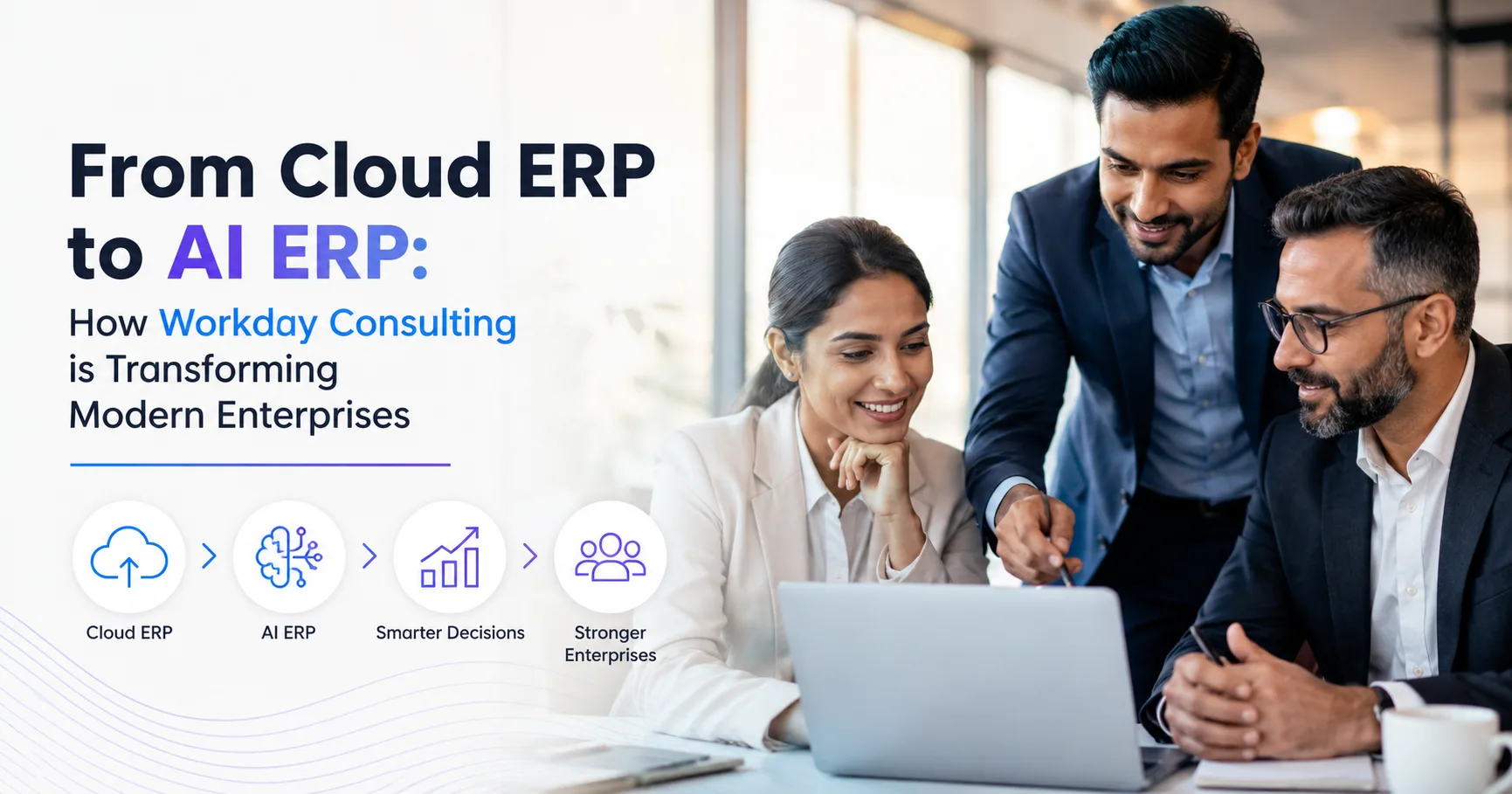
The enterprise technology landscape is undergoing a major shift, moving beyond traditional cloud-based systems toward more intelligent and adaptive platforms. What once started as Cloud ERP, focused on standardizing business processes and improving accessibility, has now evolved into a new phase, AI ERP, where systems are designed to learn, predict, and support real-time decision-making.
This transition is not just a technological upgrade; it represents a fundamental change in how modern organizations operate. Enterprises today are no longer satisfied with systems that only record transactions. They expect platforms that can analyze data, generate insights, and drive strategic outcomes.
This is where Workday Consulting plays a critical role in enabling transformation. As enterprises adopt more advanced ERP capabilities, consulting expertise becomes essential to align technology with business objectives, ensure smooth implementation, and unlock the full potential of AI-driven systems.
In this context, the shift from Cloud ERP to AI ERP is redefining how enterprises approach digital transformation, making intelligence and automation central to business growth.
Evolution of Workday in the Enterprise ERP Landscape
With the growth of international enterprises and complex business processes, the demand for unified, scalable systems has led to the development of Cloud ERP systems. A popular example of such an ERP is Workday. Workday provides an ideal solution for managing the core functions of an enterprise, including Human Capital Management and Financial Management, offering agility, real-time visibility, and increased operational efficiency.
Over time, businesses began to realize that Workday was more than just a transactional ERP solution; it was also an integral part of their overall enterprise ERP implementation strategy. By integrating Workday with other enterprise systems, businesses were able to eliminate silos between Financial Management and Human Capital Management, streamline reporting, and speed up decision-making across multiple departments.
Even though Cloud ERP solutions provided scalable and accessible solutions, many businesses still did not have the predictive capabilities, intelligent automation, and dynamic decision-making capabilities they needed from their ERP solution.
These limitations created a need for specialized Workday Consulting Services. Enterprises needed expert help in configuring, integrating, and optimizing Workday to meet their specific business models. Thus, consulting became an essential component in ensuring the successful technical implementation of Workday and supporting enterprises in the pursuit of achieving a successful digital transformation.
Rise of AI in ERP Systems
The next major shift in enterprise technology is being driven by the rapid adoption of AI in ERP systems. Unlike traditional ERP platforms that primarily focus on recording and processing business transactions, AI-enabled ERP systems are designed to interpret data, predict outcomes, and recommend actions in real time.
For modern enterprises, this evolution is redefining what ERP can deliver. AI in ERP introduces capabilities such as predictive analytics, intelligent forecasting, anomaly detection, and automated decision support. These advancements allow organizations to move from reactive operations to proactive and even predictive business management.
In areas like finance and HR, AI is already transforming how enterprises operate. Financial teams can anticipate cash flow trends more accurately, while HR teams can improve workforce planning through predictive insights into hiring, attrition, and performance. This shift significantly enhances operational efficiency and strategic decision-making across the organization.
As enterprises adopt more intelligent systems, ERP platforms are gradually evolving from being “systems of record” to becoming “systems of intelligence.” This change marks a critical milestone in the broader journey of enterprise digital transformation, where data is no longer just stored but actively used to drive business outcomes.
Within this evolving landscape, Workday plays a key role by embedding AI-driven capabilities into its ecosystem, enabling enterprises to unlock deeper insights and improve decision-making at scale.
Role of Workday Consulting in AI-Driven Transformation
As enterprises transition from Cloud ERP to AI ERP, the role of consulting becomes central to ensuring that technology investments translate into measurable business outcomes. While platforms like Workday provide the foundation for intelligent enterprise operations, the real value is unlocked through effective strategy, configuration, and implementation led by experienced consulting partners.
Workday Consulting acts as the bridge between enterprise goals and system capabilities. Large organizations often operate with complex structures, multiple legacy systems, and diverse operational processes. Without a structured consulting approach, even advanced ERP platforms can fall short of delivering their full potential.
A key aspect of Workday Consulting Services is aligning system architecture with business strategy. This includes defining data models, designing workflows, and ensuring seamless integration with existing enterprise ecosystems. Beyond implementation, consultants also play a critical role in optimizing processes to improve efficiency and scalability across departments.
With the increasing adoption of AI in ERP, consulting has expanded beyond traditional implementation support. Enterprises now require guidance on embedding AI-driven capabilities such as predictive analytics, intelligent automation, and real-time decision support into their Workday environments. This makes consulting a strategic function rather than just a technical service.
In the context of enterprise digital transformation, Workday Consulting ensures that organizations not only deploy technology successfully but also evolve their operating models to become more agile, data-driven, and future-ready. This combination of strategy, execution, and optimization is what enables enterprises to fully realize the value of AI-powered ERP systems.
Business Impact: From Cloud ERP to AI ERP
The shift from Cloud ERP to AI ERP is not just a technological upgrade; it delivers measurable business impact across enterprise operations. Organizations adopting AI-driven ERP systems are experiencing a significant improvement in how they manage data, make decisions, and execute core business processes.
One of the most immediate benefits is enhanced decision-making speed and accuracy. With AI in ERP, enterprises can analyze large volumes of data in real time, identify patterns, and generate actionable insights without manual intervention. This allows leadership teams to respond faster to market changes and internal operational shifts.
Another key impact is operational efficiency. Automation powered by AI reduces repetitive manual tasks across finance, HR, and supply chain functions. This not only improves productivity but also minimizes errors and frees up teams to focus on higher-value strategic work.
Enterprise ERP solutions powered by AI also improve forecasting and planning capabilities. Organizations can better predict financial performance, workforce needs, and demand fluctuations, enabling more proactive and informed business planning.
In addition, the integration of AI into ERP systems strengthens overall enterprise agility. Businesses become more adaptable to change, whether it involves scaling operations, entering new markets, or responding to regulatory requirements.
With the support of Workday Consulting, enterprises are able to maximize these benefits by ensuring that AI capabilities are properly configured, integrated, and aligned with business objectives. This results in a more connected, intelligent, and future-ready enterprise ecosystem.
Conclusion: Future of Enterprise Digital Transformation
The transformation of Cloud ERP to AI ERP is the most critical evolution for how modern enterprises carry out their operations, competition, and growth. What started as a move towards centralized, cloud-based systems has evolved into an era of enterprise operations being focused on intelligence, automation, and the ability to make decisions based on real-time data.
As enterprises continue down their path of enterprise digital transformation, the focus is now beyond system modernization. Enterprises are looking for platforms that provide continuous learning and adaptation to support strategic decision-making at scale. AI-driven ERP systems will become a key enabler of long-term resilience and growth.
Throughout the transformation journey, Workday Consulting will continue to play an important role as an enabling partner by aligning technology capability with business strategy to help enterprises leverage the full value of AI within their ERP solution while maintaining scalability, governance, and operational efficiencies.
With the ongoing evolution of the enterprise landscape, Workday, AI, and strategic consulting will together be key drivers of the creation of intelligent, future-ready organizations that can deliver sustained innovation and competitive advantage.