
Artificial Intelligence is changing how software is built and how organisations use information. From systems that recognise images to applications that help people analyse data, AI is becoming part of many technology products.
For students who have completed Class 12, the field can seem exciting but also confusing. There are many courses, programming languages and AI tools to explore. A clear learning plan can make the journey more manageable.
Start with the Fundamentals, Not the Hype
Students often encounter AI through chatbots or generative AI applications. These tools are useful for exploring the field, but building AI systems requires a deeper understanding of computing.
Start with programming fundamentals. Learn how variables, loops, functions and data structures work. Python is a practical language for beginners because it is widely used in data science and machine learning.
Alongside programming, strengthen your mathematics. Probability and statistics help explain data and model predictions, while linear algebra becomes useful when studying more advanced machine learning methods.
Choose a Degree That Supports Your Goals
There is no single undergraduate degree that suits every future AI engineer. Depending on eligibility and interests, students may consider Computer Science Engineering, AI and Machine Learning, AI and Data Science, or relevant science and computer applications degrees.
Compare the curriculum instead of relying only on course titles. Look for programming, algorithms, databases, mathematics, machine learning, practical laboratories and project work.
Students researching options in India can use this guide as a starting point: https://mhcognition.com/blogs/ai-ml-degree-in-india
Admission rules differ across institutions. Check the official requirements for subject combinations, minimum marks and entrance examinations before applying.
Learn by Building Small Projects
Projects turn abstract concepts into practical experience. Beginners can start with a dataset and create a simple analysis that identifies patterns. Later, they can build a basic classification model or recommendation prototype.
A useful project should answer a clear question. What problem are you solving? What data do you need? How will you measure the result? What are the limitations?
Students should also learn to explain their work. A well-documented project can show how they think, make decisions and respond when a model does not perform as expected.
Explore AI Beyond Chatbots
Artificial Intelligence includes more than text-based applications. Computer vision focuses on understanding images and video, while natural language processing works with human language. AI can also support robotics by helping systems interpret sensor information and respond to their environment.
Students interested in machines and automation can explore the relationship between AI and robotics: https://mhcognition.com/blogs/how-ai-is-transforming-robotics
Exploring different areas can help students identify what they enjoy before choosing a specialisation.
Build Responsible Technology Habits
Technical ability is only one part of AI development. Students should consider data privacy, bias, accuracy, security and how an AI system may affect people. They should also learn to verify outputs rather than assuming a model is always correct.
When working on projects, use suitable datasets, respect licences and explain the limitations of the results.
Turn Learning into a Long-Term Plan
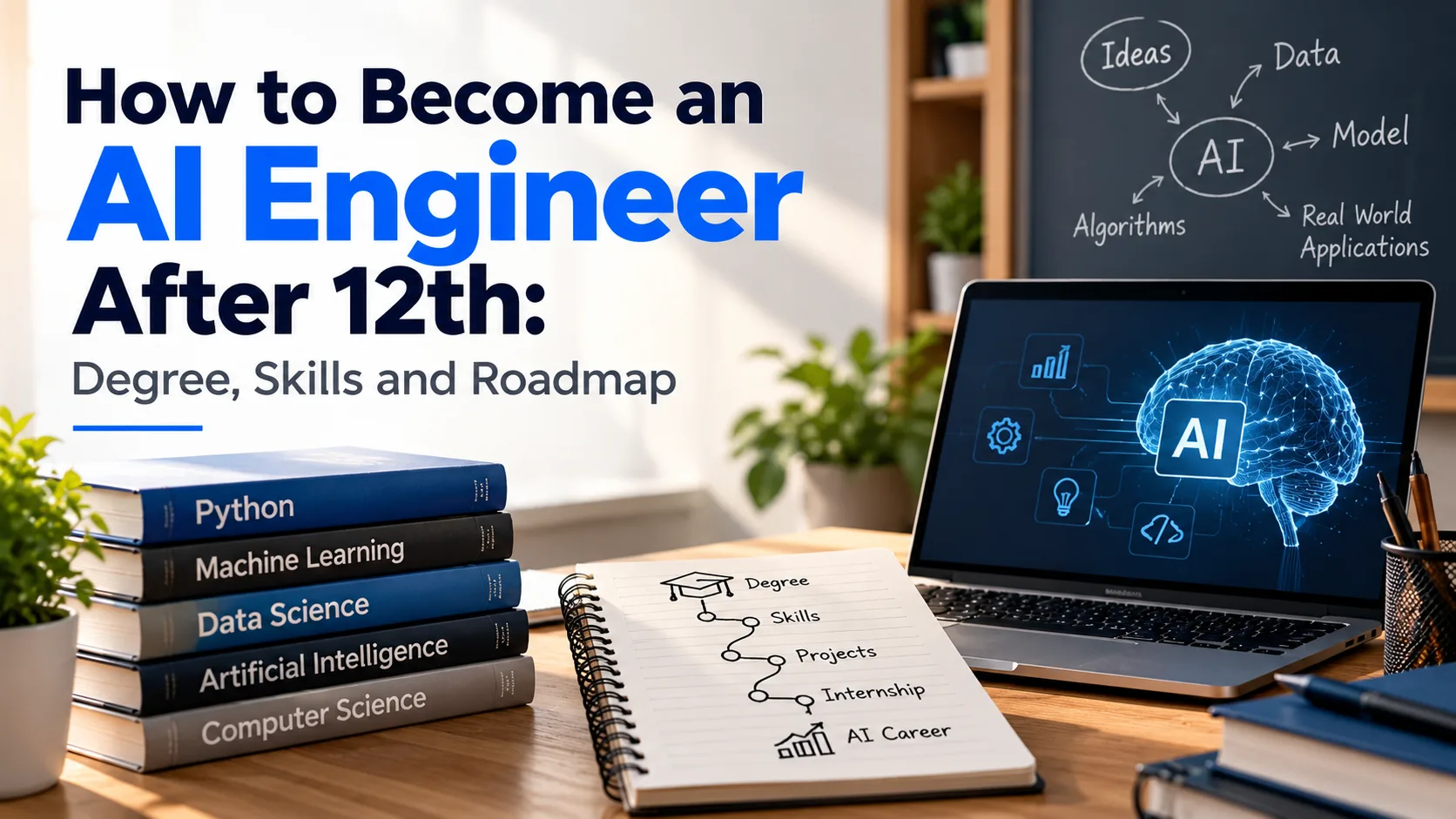
A practical roadmap can begin with Python and mathematics, move into data analysis and machine learning, and progress towards larger projects and internships. The pace will differ for every student.
Students can also explore different AI-related careers and the skills they require: https://mhcognition.com/blogs/ai-careers-in-india
The journey from Class 12 to AI engineering is not about learning every new tool immediately. It is about developing strong fundamentals, practising regularly and gradually building the ability to solve meaningful problems.
Further reading: https://mhcognition.com/blogs/how-to-become-ai-engineer-after-12th