Aluminum tubing serves as the foundational component of thermal exchange, automotive, and precision machinery industries, with extruded aluminum tube and drawn aluminum tube standing as two core forming technologies that determine dimensional precision, surface quality and service lifespan. Many procurement and design engineers confuse the two processes and misselect materials, leading to product leakage, poor brazing performance or excessive production costs. This article systematically breaks down their manufacturing workflows, performance gaps and applicable scenarios, also linking seamless aluminum tube variants to clarify technical boundaries.
Extrusion acts as the primary shaping step for nearly all hollow aluminum profiles. The production of extruded aluminum tube begins with heating solid or hollow aluminum billets to 400–500°C, then forcing the softened metal through custom steel dies under thousands of tons of hydraulic pressure. Two extrusion branches exist: structural extruded tubes with invisible porthole welds, and seamless extruded tubes formed with a mandrel piercing hollow billets. Extrusion excels at complex cross-sections including square, rectangular, flat oval and peanut-shaped tubes, supporting outer diameters from 8mm to 150mm and wall thickness ranging 0.5–20mm. Its main drawbacks lie in loose dimensional tolerances (±0.1mm or higher for standard products), slightly rough inner and outer surfaces, and inconsistent wall uniformity after hot forming. For low-demand structural frames, architectural railings and general heat exchanger frameworks, standard extruded tubes deliver cost advantages with high single-line output.
Drawn aluminum tube is a secondary cold working refinement built upon extruded seamless blanks, also named cold drawn precision tube. After hot extrusion, semi-finished seamless aluminum tube is pulled through series of precision dies and mandrels at room temperature, generating plastic deformation that refines metal grain structures and compresses wall thickness evenly. CHAL’s drawing production line implements multi-pass cold drawing, followed by annealing, zinc anti-corrosion spraying and degreasing finishing, enabling tolerance control within ±0.02mm and mirror-grade smooth surfaces without polishing. Unlike raw extruded tubes, drawn variants cover ultra-thin walls as thin as 0.1mm and special internal structures such as internal grooved tubes, capillaries and peanut tubes designed for air conditioning evaporators. Cold working boosts tensile strength and bending ductility, eliminating cracking risks during tube expansion and brazing—critical for household and commercial HVAC heat exchangers.
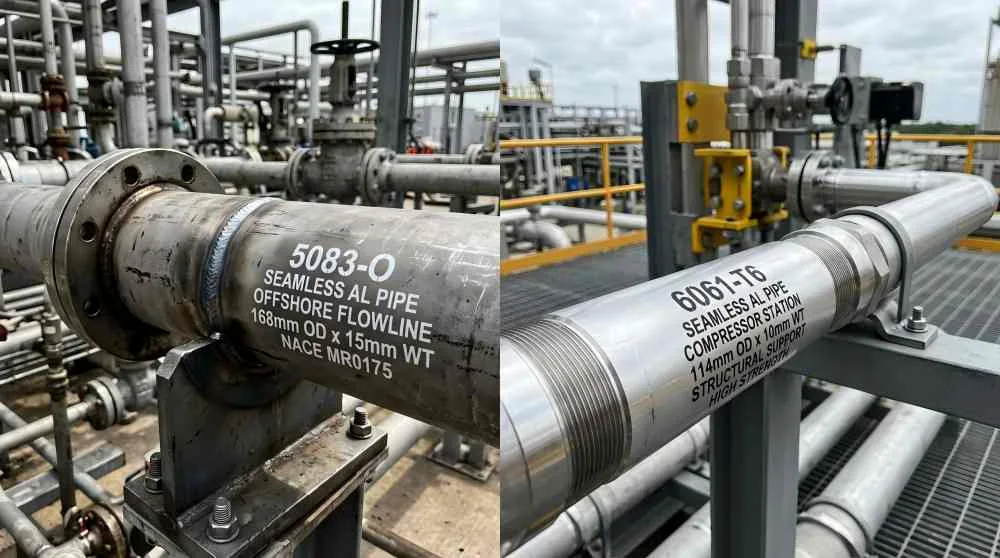
Seamless aluminum tube bridges the two technologies, divided into extruded seamless blanks and finished drawn seamless tubes. Raw extruded seamless tubes offer medium precision for general pressure vessels, while post-drawn seamless tubes meet high-pressure fluid transmission standards for auto AC pipelines and solar thermal systems. Cost comparison reveals extruded tubes carry lower unit pricing for bulk standard profiles, yet drawn tubes reduce post-processing rejection rates by over 35% for precision thermal parts, offsetting extra drawing labor expenses.
For design reference: Choose extruded aluminum tube if you need complex custom cross-sections and loose tolerance allowances. Select drawn aluminum tube when ultra-precise sizing, thin walls or high heat transfer consistency are required, and opt for drawn seamless aluminum tube for high-pressure refrigeration and automotive cooling circuits. CHAL’s integrated production lines cover full extrusion and cold drawing workflows, delivering customized tempers (O, T6, H14) and surface treatments including anodizing and zinc coating for both tube types.