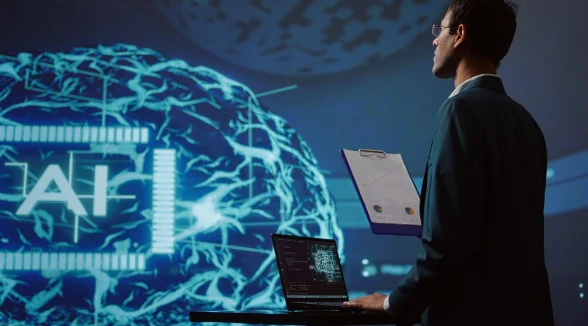
Cognitive UX (User Experience) goes beyond buttons, visuals, and interactions — it’s about designing experiences that align with how the human brain thinks, reacts, and learns. As technology inches closer to the mind itself, cognitive UX experts are now working at the intersection of AI, neuroscience, and design psychology to make brain-controlled systems intuitive and natural.
Take, for instance, the rise of brain-computer interfaces (BCIs). Companies like Cognixion are creating systems where users can control devices like the Apple Vision Pro with their thoughts — no surgery required. This breakthrough highlights how cognitive UX experts are helping bridge neural signals and digital interfaces, making thought-driven computing a reality.
👉 Explore how this innovation is unfolding in this detailed analysis by Valueans.
How Are AI Development Services Empowering Cognitive UX?
To design for the brain, UX professionals increasingly depend on AI Development Services that analyze behavioral data, predict user intent, and optimize feedback loops.
AI enables interfaces to “learn” from the user — adapting gestures, gaze patterns, and even brainwave signals into smooth interactions. With the help of machine learning models, cognitive UX designers can simulate emotional responses, anticipate fatigue, and create systems that respond empathetically.
These adaptive capabilities are made possible by advanced AI models trained on biosignals, such as EEG (electroencephalogram) and EMG (electromyogram) data. As a result, AI is not just assisting design — it’s co-designing experiences that feel as natural as thought itself.
If your enterprise is exploring this frontier, you can learn more about the technologies behind it through AI Development Services by Valueans, which focus on integrating AI with next-generation cognitive systems.
Why Do Cognitive UX Experts Matter for Neural Control Interfaces?
Cognitive UX designers play a unique role: they translate neuroscience and user behavior into accessible, human-centered interfaces. Their work ensures that when a user thinks “select,” “move,” or “scroll,” the system responds instantly and intuitively.
Without cognitive UX:
- Neural devices would feel slow and inconsistent.
- AI-driven predictions could misread human intent.
- Users might struggle with mental overload or fatigue.
With it:
- Brain signals are mapped to familiar digital gestures.
- AI-driven predictions adjust interfaces in real time.
- Users experience seamless, fatigue-free control.
In short, cognitive UX is the empathy layer of AI-powered interaction — ensuring technology adapts to the brain, not the other way around.
What Role Does an AI Development Company Play in Building Cognitive Interfaces?
An AI Development Company doesn’t just build algorithms; it builds intelligence into every interaction. These companies partner with UX researchers and neuroscientists to design adaptive systems capable of interpreting complex neural and behavioral inputs.
Here’s how a top-tier AI Development Company contributes to cognitive UX projects:
- Data Modeling: Creating AI models that interpret neural data with accuracy.
- Behavioral Simulation: Testing how users will react before real-world deployment.
- Cross-Disciplinary Integration: Bringing together AI engineers, designers, and neuro-experts to build cohesive systems.
- Ethical Oversight: Ensuring brain data remains private and secure.
By combining AI engineering with UX psychology, these companies create technologies that can understand how people think, not just what they do.
How Are Custom AI Solutions Shaping the Future of Human-Computer Interaction?
Custom AI Solutions are at the heart of this evolution. Off-the-shelf models can’t process the nuanced, real-time data coming from neural inputs. Instead, companies are building tailored AI models trained on individual brain patterns, emotions, and context.
For example:
- Emotion recognition algorithms help systems respond when users show signs of frustration.
- Personalized learning systems adapt to each user’s cognitive style.
- Signal interpretation engines translate raw EEG data into specific actions.
These Custom AI Solutions help craft interfaces that are deeply personal and context-aware — a vital step toward true mind-machine harmony.
What Makes Generative AI Development Services Critical for Cognitive UX?
The next leap in cognitive UX comes from Generative AI Development Services, which enable interfaces to imagine, generate, and redesign experiences in real time.
Generative AI can:
- Create adaptive interface layouts based on user mood or attention span.
- Generate personalized prompts or visuals for neural feedback.
- Simulate cognitive load and reduce mental strain dynamically.
For instance, a BCI-powered AR headset could change visual complexity based on user fatigue, thanks to a generative AI engine predicting optimal sensory balance. This ability to evolve dynamically is transforming how designers think about experience — from static design to living, thinking interfaces.
What Challenges Do Cognitive UX Experts Face in Neural Design?
While the potential is vast, cognitive UX experts face real challenges:
- Data Sensitivity: Brain data is deeply personal — protecting it is paramount.
- Signal Variability: Neural patterns differ between users and even from moment to moment.
- Cognitive Fatigue: Mental control requires new ergonomic and psychological principles.
- AI Bias: Models can misinterpret neural data without diverse training sets.
- Ethical Responsibility: Designers must ensure inclusivity and transparency in thought-based systems.
The key lies in balancing innovation with ethics, ensuring that mind-controlled experiences remain empowering, not invasive.
How Will AI and Cognitive UX Redefine the Future of Design?
In the coming years, AI and cognitive UX will merge into a new design discipline — one where interfaces are co-created with the human mind. Instead of adapting to technology, humans will see technology adapting to them in real time.
We’ll witness:
- Interfaces that anticipate intent before any action.
- Wearables that translate thought into seamless commands.
- AI copilots that learn from cognitive feedback loops.
From healthcare and education to entertainment and accessibility, AI-driven cognitive UX will redefine how humans express themselves through technology.
Summary: The Mind-First Future of User Experience
Cognitive UX experts are the architects of a new human-technology relationship, powered by AI Development Services and Custom AI Solutions. They design not just for screens but for the mind itself — ensuring interfaces are empathetic, intuitive, and deeply human.
As Generative AI Development Services evolve, interfaces will become even more adaptive, reshaping industries from neurogaming to assistive tech. And behind every neural command or seamless interaction, there will be a cognitive UX expert ensuring the experience feels effortless, safe, and truly connected.