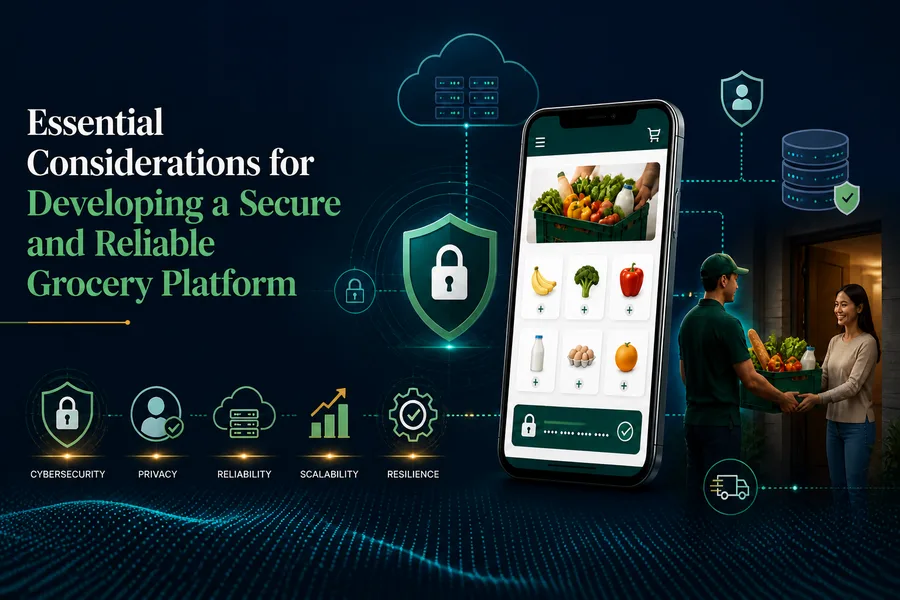
Customer confidence is an important factor in the success of any digital grocery business. People expect their personal information, payment details, and shopping activities to remain protected whenever they place an order. Investing in grocery delivery app development services gives retailers an opportunity to create secure and dependable digital shopping environments. Selecting a knowledgeable grocery app development company is equally important because security, application performance, and operational reliability must be considered throughout the development lifecycle rather than added just before launch.
Understanding the Security Requirements
A grocery application handles several categories of sensitive and business-critical information. These may include customer names, phone numbers, delivery addresses, order histories, payment references, and vendor details.
Unauthorized access to this information can damage customer confidence and create financial or legal consequences.
Businesses should begin by identifying what information their platform collects, why it is required, and which employees or systems need access to it.
Data collection should remain limited to legitimate business requirements. Clear privacy notices and appropriate consent mechanisms help customers understand how their information is handled.
Secure Authentication and Access Control
Authentication ensures that users can access their accounts through approved methods. Depending on application requirements, businesses may implement password-based login, one-time passwords, or additional verification methods.
Administrative access requires particular attention. Store employees, delivery partners, vendors, and platform administrators should not automatically receive identical permissions.
Role-based access control allows businesses to define which actions each user can perform.
For example, a delivery partner may need access to assigned delivery information but should not be able to modify product pricing or vendor settlement records.
Secure session management, appropriate password practices, and protection against repeated unauthorized login attempts can further improve account security.
Protecting Payment Transactions
Payment processing is one of the most important parts of an online grocery platform.
Customers may use cards, UPI, digital wallets, or other locally supported payment methods. Businesses should integrate trusted payment providers and follow applicable payment security requirements.
Where possible, payment processing should be handled by certified gateway providers rather than storing sensitive card information directly within the grocery application.
The platform should also manage transaction states carefully. Payment confirmation, failed transactions, refunds, and order cancellations must remain synchronized.
A clear payment history helps customers understand their transactions and gives administrators the information needed to investigate disputes.
Ensuring Data Protection
Encryption helps protect information while it moves between application components and when it is stored.
Businesses should use secure communication protocols and appropriate encryption mechanisms for sensitive records.
Database permissions should be configured carefully, and production systems should not expose unnecessary information to application users or external services.
Regular backups are also important. A tested recovery process helps businesses restore essential information following accidental deletion, system failure, or other incidents.
Companies should define how long different types of information are retained and follow relevant privacy laws and contractual requirements.
Maintaining Application Performance
Reliability involves more than security. Customers also expect grocery applications to load quickly and process orders without interruptions.
Slow product searches, checkout failures, and inaccurate inventory updates can discourage customers from completing purchases.
Developers can improve performance through database optimization, caching, efficient API design, cloud infrastructure, and appropriate load testing.
Applications should be tested under different conditions, including increased user activity and large promotional campaigns.
Monitoring tools can help technical teams identify performance problems and investigate errors before they significantly affect customers.
Testing Before and After Launch
Quality assurance should cover the complete shopping journey.
Testing activities should include:
- Registration, login, and account management.
- Product searches and category navigation.
- Cart calculations and discount application.
- Payment processing and refund workflows.
- Inventory synchronization.
- Order confirmation and cancellation.
- Delivery assignment and location tracking.
- Administrative permissions and access controls.
- Performance across different devices and network conditions.
Security testing should also evaluate common vulnerabilities and potential weaknesses in APIs, authentication, and data handling.
After deployment, regular maintenance is necessary. Software updates, dependency reviews, security monitoring, and bug fixes help maintain platform reliability as technologies and business requirements change.
Preparing the Platform for Business Expansion
A grocery application may begin with one store and later expand into a multi-vendor or multi-city operation.
The architecture should support additional locations, growing product catalogs, increased order volumes, and new integrations without requiring unnecessary redevelopment.
Modular systems, well-documented APIs, and scalable infrastructure can make future improvements easier.
Businesses should also consider how new features will affect security. Adding vendor accounts, delivery partners, and external integrations introduces additional access points that must be managed appropriately.
Why the Development Process Matters
A structured development process helps businesses identify risks and technical requirements early.
Comfygen follows a project approach that includes business analysis, requirement gathering, UI/UX design, application development, quality assurance, deployment, and ongoing maintenance.
Its grocery application solutions can include customer-facing mobile apps, vendor management panels, delivery partner applications, and centralized administrative dashboards.
The company also works with integrations involving payment gateways, mapping services, and retail management systems. Security, scalability, and maintainability remain important considerations when selecting the appropriate technical architecture.
Conclusion
Developing a secure grocery platform requires continuous attention to authentication, payment processing, data protection, performance, and quality assurance. Businesses should evaluate these areas before launch and continue reviewing them as the platform grows. A dependable application protects customer confidence while helping retailers manage their operations effectively. By combining careful planning, appropriate technology, and ongoing maintenance, grocery businesses can create digital services that remain reliable as customer expectations and market demands evolve.