
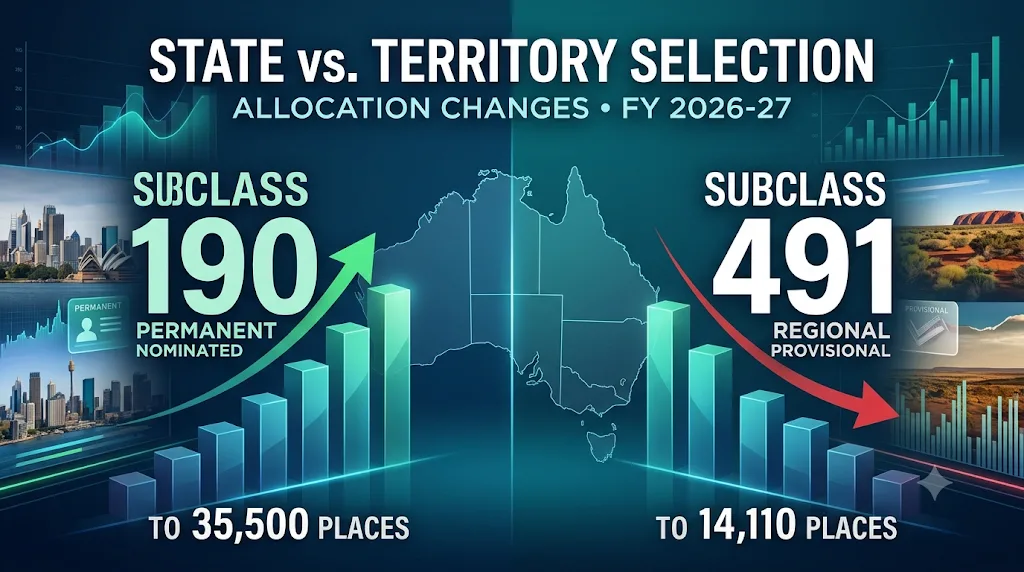
Choosing between an Australian state or territory for skilled migration has always required careful calculation, but the 2026–27 financial year has fundamentally shifted the strategic landscape. While Australia’s overall Permanent Migration Program planning level remains steady at 185,000 places, the internal redistribution across skilled visa streams has dramatically altered the odds for Subclass 190 (Skilled Nominated) and Subclass 491 (Skilled Work Regional) applicants.
For prospective migrants—whether applying onshore or offshore—understanding these national allocation shifts alongside individual state and territory settings is critical to securing an invitation. Consulting an experienced visa consultant in Australia can also help clarify how these rapidly evolving state criteria align with your specific occupation and points profile.
The Macro Shift: Permanent 190 Up, Regional 491 Slashed
The most defining feature of the 2026–27 skilled migration program is the sharp divergence between permanent state nomination and provisional regional pathways.
Visa Stream2025–26 Places2026–27 PlacesNet ChangeState & Territory Nominated (Subclass 190)33,00035,500+2,500 (+7.6%)Regional (Subclass 491 & 494)33,00014,110-18,890 (-57.2%)At the federal level, the Subclass 190 planning level increased to 35,500 places, signalling a preference for direct permanent residency pathways aligned with immediate labour needs. Conversely, the combined Regional stream plummeted by over 57% to just 14,110 places—the lowest regional allocation in recent program years. For applicants who previously relied on the 15-point boost offered by a Subclass 491 nomination to compensate for lower core points, competition has become fierce, making jurisdiction selection more consequential than ever.
Major States: Tightening Regional Gates and Selective 190s
Australia’s larger states have responded to the federal recalibration by heavily favouring Subclass 190 nominations while restricting or pausing Subclass 491 pathways.
- New South Wales (NSW): NSW opened its Subclass 190 program in October 2026, selecting candidates directly from SkillSelect Expressions of Interest (EOIs). However, NSW closed its Subclass 491 direct pathways after allocating available places, effectively removing itself as an immediate option for regional provisional seekers.
- Victoria: Victoria confirmed an initial 2026–27 allocation of 900 places for its Subclass 190 program—a steep drop from the 2,700 places it held in the prior year—requiring a fresh Registration of Interest (ROI) through Live in Melbourne. Meanwhile, its Subclass 491 program remains on hold pending final allocation numbers. Victoria continues to target onshore Victorian residents and offshore candidates in priority sectors like healthcare, social assistance, education, and construction.
- Western Australia (WA) and South Australia (SA): Both states remain vital for offshore and onshore applicants alike, though with distinct mechanisms. WA continues to invite directly from SkillSelect without a separate ROI portal, having already issued early 2026–27 nominations across both 190 and 491 streams while awaiting full annual criteria updates. SA reopened cautiously in late October 2026, restricting initial onshore ROIs to local workers whose visas expire by 31 January 2027, while continuing to invite offshore candidates directly via SkillSelect.
- Queensland: Operating on a later timeline, Queensland remained closed through early November 2026 while awaiting final federal confirmation before launching its 2026–27 onshore and offshore nomination criteria.
Smaller States and Territories: Early Movers and Rapid Closures
Historically, smaller jurisdictions—Tasmania, the Australian Capital Territory (ACT), and the Northern Territory (NT)—have served as strategic havens for applicants seeking regional points or flexible occupation lists. In 2026–27, their contrasting approaches highlight the trade-offs between early application and strict residency ties.
- Tasmania: Tasmania was the first jurisdiction to open in August 2026, confirming 2,050 total places (1,250 for Subclass 190 and 800 for Subclass 491). Tasmania’s updated priority attribute system heavily rewards applicants already living and working in the state, leaving offshore applicants largely reliant on securing a genuine Tasmanian job offer.
- Northern Territory (NT): Opening in August 2026, the NT experienced overwhelming demand and rapidly reached capacity. The territory closed all Subclass 190 and offshore streams to new applications, accepting onshore Subclass 491 applications strictly by exception for local graduates or residents facing qualifying visa or age deadlines before 30 September 2027.
- Australian Capital Territory (ACT): Because the entire ACT is classified as a regional area for migration purposes, it remains uniquely positioned to offer both Subclass 190 and 491 pathways via its Canberra Matrix ranking system. However, its October 2026 invitation round focused exclusively on Subclass 190 nominations—including overseas candidates in critical skill occupations—holding back 491 invitations until federal allocations are fully confirmed.
Strategic Takeaways for 2026–27 Applicants
Navigating the 2026–27 program year requires abandoning outdated assumptions about regional migration. With Subclass 491 allocations cut by more than half nationwide, states are rationing regional nominations almost exclusively for onshore residents, local graduates, or offshore candidates holding verified regional job offers.
Meanwhile, the expansion of the Subclass 190 quota to 35,500 places creates stronger opportunities for high-scoring candidates—particularly those in healthcare, construction, engineering, and education—to bypass provisional regional visas altogether. Onshore applicants should anchor themselves early to a jurisdiction where they meet local employment criteria, while offshore candidates must focus on states actively drawing from SkillSelect—such as South Australia, Victoria, and the ACT—rather than waiting on closed or oversubscribed territory programs. Before locking in your Expression of Interest strategy, speaking with a registered visa consultant in Australia can ensure you target the jurisdiction with the strongest realistic pathway to permanent residency.