Organizations are increasingly adopting distributed data architectures to overcome data silos, simplify data access, and support modern analytics and AI initiatives. Enterprise Data Fabric is emerging as a strategic approach for organizations seeking to integrate, govern, and deliver trusted data across complex IT environments, including on-premises infrastructure, cloud platforms, and edge environments.
Click here for more information : https://qksgroup.com/market-research/spark-matrix-enterprise-data-fabric-q2-2026-10462
What Is Enterprise Data Fabric?
An Enterprise Data Fabric is a unified, distributed data-management architecture that connects heterogeneous data sources and environments through a logical layer of data services, active metadata, governance, and orchestration. It enables organizations to discover, integrate, manage, and access data consistently while reducing the complexity associated with fragmented data ecosystems.
According to Principal Analyst at QKS Group, “An Enterprise Data Fabric is a unified, distributed data-management architecture that integrates, governs, and delivers data across heterogeneous sources, platforms, and environments, on-premises, cloud, and edge, through a single, logical layer of data services, active metadata, and orchestration.”
By providing context-rich and secure access to trusted data, Enterprise Data Fabric solutions help organizations accelerate data analytics, artificial intelligence (AI), business intelligence, and operational workloads.
Enterprise Data Fabric Market Trends
The Enterprise Data Fabric market is evolving rapidly as organizations prioritize data accessibility, governance, and interoperability. Key trends shaping the market include:
- AI-driven data management: AI and machine learning are increasingly being used to automate data discovery, classification, quality management, and metadata enrichment.
- Active metadata management: Organizations are leveraging metadata to understand data relationships, lineage, context, and usage across distributed environments.
- Hybrid and multi-cloud adoption: Enterprises require consistent data access and governance across multiple cloud providers and on-premises systems.
- Automated data integration: Data fabric platforms are helping reduce manual integration efforts through intelligent orchestration and automation.
- Data governance and security: Centralized policies, lineage, access controls, and compliance capabilities are becoming essential for trusted enterprise data.
- AI-ready data infrastructure: Enterprises are investing in data architectures that can provide reliable, contextual, and governed data for generative AI and advanced analytics.
QKS Group Enterprise Data Fabric Market Research
QKS Group's Enterprise Data Fabric market research provides a comprehensive assessment of the global market, covering emerging technology trends, market dynamics, competitive developments, and future market outlook. The research provides technology vendors with strategic insights to understand market opportunities and strengthen their growth strategies.
Download Sample Report : https://qksgroup.com/download-sample-form/spark-matrix-enterprise-data-fabric-q2-2026-10462
For enterprises and technology buyers, the research enables a structured assessment of vendor capabilities, competitive differentiation, and market positioning.
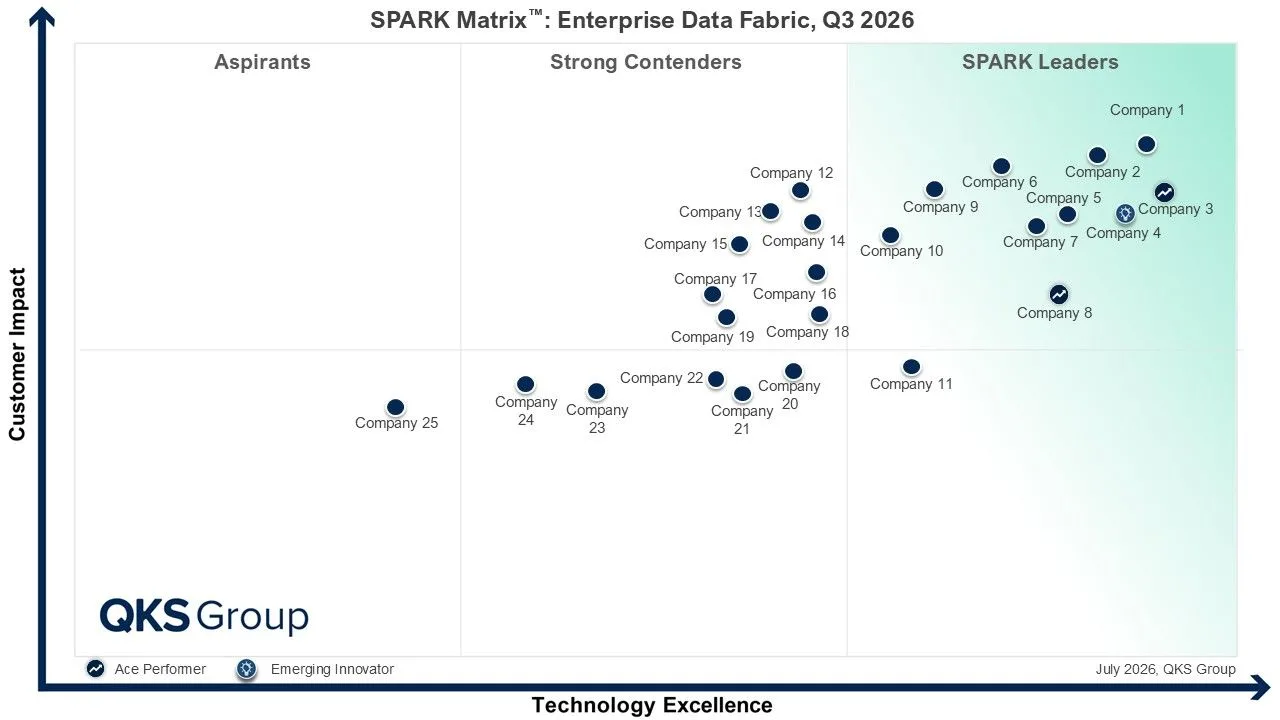
The research also features a detailed competitive analysis and vendor evaluation using QKS Group's proprietary SPARK Matrix™ analysis. The SPARK Matrix™ evaluates and positions leading Enterprise Data Fabric vendors based on their technological capabilities and competitive impact in the global market.
Enterprise Data Fabric Vendors
The SPARK Matrix™ analysis includes leading vendors such as Ab Initio Software, AWS, Cloudera, Confluent, Denodo, Fivetran, Google, IBM, InterSystems, K2view, Matillion, Microsoft, NetApp, Oracle, Palantir Technologies, Pentaho, Precisely, Qlik, Salesforce (Informatica), SAP, SAS, Solix Technologies, Stardog, Teradata, and TIBCO.
The vendor assessment helps organizations understand how different providers address data integration, governance, metadata management, data accessibility, interoperability, and support for analytics and AI workloads.
Future Outlook for Enterprise Data Fabric
As enterprises continue to operate across increasingly distributed data environments, the demand for flexible and intelligent data architectures is expected to grow. Enterprise Data Fabric can play an important role in creating a connected data ecosystem where information can be securely discovered, governed, and delivered across business and technology environments.
The convergence of AI, active metadata, automation, data governance, and hybrid cloud infrastructure is expected to further enhance Enterprise Data Fabric capabilities. Organizations that establish a trusted and interconnected data foundation can improve data-driven decision-making while accelerating analytics and AI adoption.
QKS Group's research provides organizations with the market intelligence needed to evaluate evolving Enterprise Data Fabric technologies, understand competitive dynamics, and identify vendors aligned with their data transformation objectives.