Opening the Web3 Gateway: A New Digital Dawn
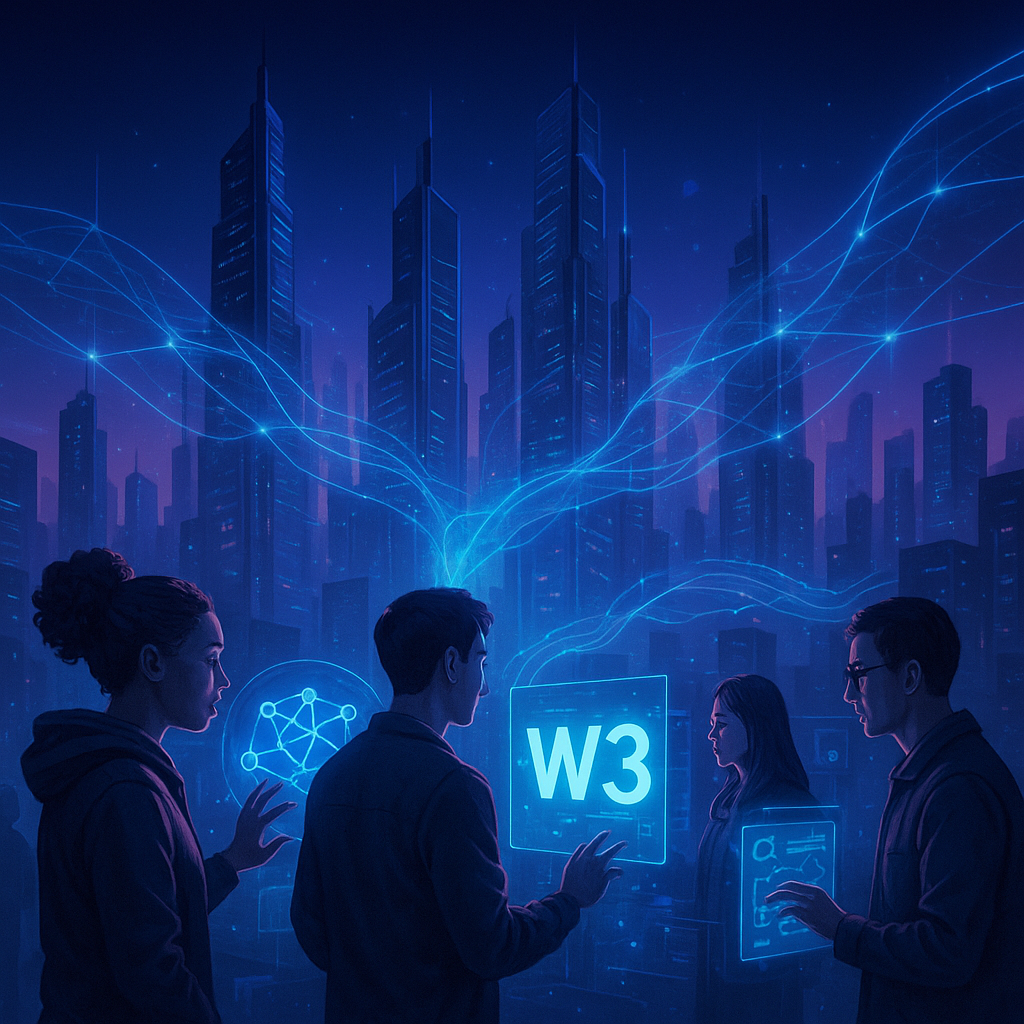
On a brisk morning in early 2026, the bustling virtual city of DecentraCity, hosted on one of the leading Web3 platforms, saw an unprecedented event. Over 50,000 users simultaneously participated in a decentralized governance vote that reshaped the platform’s core protocol, all without a single centralized authority overseeing the process. This scene, once unthinkable, is now emblematic of Web3’s transformative power. What began as a niche concept has morphed into a force challenging how we perceive ownership, trust, and interaction online.
Web3, the envisioned next iteration of the internet, leverages blockchain technology to create a decentralized digital ecosystem where users, not corporations, hold sway. Unlike Web2’s centralized platforms, Web3 offers peer-to-peer interactions, tokenized ownership, and transparent governance models. As of mid-2026, the ecosystem supports billions in locked value and hosts thriving communities that govern themselves autonomously.
“Web3 is less about technology and more about redefining digital society. It’s a societal shift where control returns to the users.” — Dr. Leila Morgan, Blockchain Sociologist
This article unpacks the origins, evolution, and current state of Web3, examines its recent breakthroughs, and projects its trajectory in reshaping digital reality.
From Web1 to Web3: The Evolution of the Internet’s Architecture
To appreciate Web3’s significance, one must trace the internet’s journey. The Web1 era (1990s to early 2000s) was the “read-only” internet — static pages with minimal user interaction. Web2, which dominated the 2000s and early 2020s, introduced dynamic content, social media, and user-generated platforms. Yet, it centralized control in the hands of a few tech giants, raising concerns about data privacy, surveillance, and monopolistic practices.
Web3 emerged as a response to these power imbalances. It is grounded in blockchain, the decentralized ledger technology introduced by Bitcoin in 2009. Early experiments with Ethereum’s smart contracts in the mid-2010s expanded blockchain’s utility beyond currency to programmable digital agreements, setting the stage for decentralized applications (dApps). Over the past decade, these innovations matured into a multi-layered ecosystem encompassing decentralized finance (DeFi), non-fungible tokens (NFTs), decentralized autonomous organizations (DAOs), and more.
The transition to Web3 also echoes a philosophical shift: from corporate ownership of digital identity and assets to user sovereignty. This shift addresses fundamental challenges of Web2, such as data breaches and opaque algorithms. Instead, Web3 champions transparency, interoperability, and community governance.
“The internet’s future isn’t controlled by a handful of servers and corporations. It’s distributed across millions of nodes, run by its users.” — Vitalik Buterin, Ethereum Co-founder
Dissecting Web3’s Core: Technology, Economics, and Governance
Web3 is more than a buzzword; it’s a complex ecosystem built on three intertwined pillars — technological infrastructure, token economics, and decentralized governance.
Technological Infrastructure
At its core, Web3 relies on blockchain networks like Ethereum, Solana, and newer Layer 2 protocols that solve scalability and cost issues. These blockchains enable smart contracts — self-executing agreements with code-enforced terms. Decentralized storage solutions such as IPFS and Arweave replace traditional centralized servers, ensuring data permanence and censorship resistance.
Interoperability protocols have advanced significantly by 2026, allowing seamless asset and data movement across chains. Cross-chain bridges and Layer 0 networks enhance composability, enabling developers to build multifaceted dApps that tap into multiple blockchains simultaneously.
Token Economics
Tokens, both fungible and non-fungible, are the economic lifeblood of Web3. They represent ownership, utility, and governance rights within decentralized ecosystems. The rise of utility tokens facilitates access to services, while governance tokens empower holders to vote on protocol changes.
As of 2026, DeFi platforms manage assets exceeding $1.4 trillion globally, according to industry estimates. Tokenized real-world assets, such as fractionalized real estate and art, have also gained traction, bridging physical and digital economies.
Decentralized Governance
DAOs exemplify Web3’s governance innovation. These member-owned organizations operate transparently via smart contracts, making decisions through collective voting. In 2026, DAOs govern everything from investment funds and social communities to software development projects.
- Decentralized Identity: Self-sovereign identity systems allow users to control their personal data without intermediaries.
- Permissionless Innovation: Anyone can create dApps or launch projects without gatekeepers.
- Incentive Alignment: Token-based rewards align user and developer interests.
Despite these advances, challenges around scalability, user experience, and regulatory clarity persist.
Web3 in 2026: Breakthroughs and Roadblocks
The past two years have witnessed a significant maturation of Web3 technologies. Blockchain protocols have improved throughput, reducing energy consumption by over 90% compared to early PoW chains, as reported by multiple environmental assessments. Major corporations have integrated decentralized identity solutions, signaling mainstream acceptance.
New paradigms such as Web3 social media platforms have attracted millions seeking ownership of their content and data. Platforms like SocialVerse and CommuniChain enable users to monetize interactions without intermediaries, challenging traditional giants.
However, the ecosystem still grapples with hurdles:
- Regulatory Uncertainty: Governments worldwide are debating frameworks that balance innovation with consumer protection. The US SEC and EU regulators have introduced tentative guidelines for token classification, but ambiguity remains.
- Usability Barriers: Despite progress, onboarding non-technical users remains tough, with wallet management and transaction fees posing friction.
- Security Risks: Smart contract exploits and rug pulls continue to surface, undermining user trust.
Nevertheless, the sector’s resilience and innovation pace are accelerating. Layer 2 solutions and zero-knowledge proofs are making transactions faster and cheaper, while AI integration enhances decentralized app functionalities.
For a detailed exploration of Web3’s ongoing resurgence, see this analysis.
Voices from the Frontlines: Industry Experts Reflect on Web3’s Impact
Leading figures in crypto and blockchain offer nuanced views on Web3’s trajectory.
“Web3’s promise lies in democratizing digital ownership but delivering on that promise requires solving complex social and technical puzzles.” — Anjali Rao, CEO of MetaLedger
Rao’s company recently launched a decentralized marketplace enabling artists worldwide to tokenize and sell their work without intermediaries, exemplifying Web3’s creative empowerment.
Meanwhile, Dr. Ethan Clarke, a cybersecurity expert, warns, “Decentralization introduces new attack vectors. The ecosystem must prioritize robust security standards and user education.” Clarke’s concerns are echoed by many in light of recent exploits that cost billions.
On the regulatory front, former EU digital policy advisor Sofia Mendes notes, “Regulation shouldn’t stifle innovation but must protect consumers and ensure transparency. Collaborative frameworks involving stakeholders are essential.”
These perspectives underscore Web3’s evolving nature — a blend of promise and pragmatism.
Additional insights on how Web3 is reshaping digital trust and ownership can be found here.
Looking Ahead: What to Watch in Web3’s Expanding Universe
The future of Web3 is poised for dynamic expansion, shaped by technological breakthroughs, regulatory developments, and user adoption patterns.
Key trends to monitor include:
- Integration with AI: Combining Web3’s decentralized infrastructure with AI will enable smarter, autonomous dApps and DAO decision-making.
- Mass Adoption of Decentralized Identity: Self-sovereign identities could become standard, transforming privacy and security paradigms.
- Tokenization of Everything: From real estate to intellectual property, more assets will be fractionalized and tradable on blockchain.
- Interoperability Standards: Unified protocols will ease cross-chain interactions, fueling a more cohesive ecosystem.
- Regulatory Clarity and Collaboration: As governments adopt clearer stances, compliance-friendly innovations will flourish.
However, adopting Web3 widely depends on overcoming user experience challenges and ensuring equitable access. Education and intuitive tools will be crucial to demystify the technology for mainstream users.
Ultimately, Web3 represents not just a technological upgrade but a philosophical reimagining of digital life — one that empowers individuals and communities over centralized entities.
For a comprehensive exploration of Web3’s new paradigms shaping digital reality, readers can refer to this feature.
In summary, Web3 stands at the crossroads of innovation and adoption. Its decentralized architecture challenges entrenched digital hierarchies, promising a future where users reclaim control over data, assets, and governance. As 2026 unfolds, the ecosystem’s growth, coupled with growing regulatory frameworks and technological refinements, will determine whether Web3 fulfills its revolutionary potential or remains a niche experiment.