The cryptocurrency industry is entering a new phase of maturity. What was once driven primarily by retail investors has evolved into a global financial ecosystem powered by institutional participation, regulatory advancements, tokenized assets, artificial intelligence, and decentralized technologies. As a result, cryptocurrency exchanges are no longer just trading platforms—they are becoming comprehensive digital financial ecosystems.
For startups, fintech companies, and enterprises planning to launch a cryptocurrency exchange, simply offering spot trading is no longer enough. Users now expect seamless experiences, institutional-grade security, multi-chain support, advanced trading tools, and regulatory compliance. Businesses that fail to keep pace with these expectations risk falling behind in an increasingly competitive market.
Understanding the latest cryptocurrency exchange trends can help businesses build future-ready platforms that attract users, improve operational efficiency, and create sustainable revenue streams. Here are the top trends shaping cryptocurrency exchange development in 2026.
1. AI-Powered Exchanges Are Becoming the New Standard
Artificial Intelligence is revolutionizing every aspect of cryptocurrency exchanges. Beyond simple automation, AI is enabling platforms to provide smarter, faster, and more secure trading experiences.
Modern exchanges use AI for:
- Fraud detection and risk analysis
- Automated customer support through AI agents
- Personalized trading recommendations
- Market surveillance
- Predictive analytics
- Portfolio optimization
- Smart compliance monitoring
AI-powered exchanges can analyze millions of data points in real time, helping businesses improve security while delivering better experiences to traders.
2. Institutional Investors Are Driving Platform Evolution
Institutional participation has significantly changed the expectations placed on cryptocurrency exchanges.
Professional investors demand:
- High-performance trading infrastructure
- Institutional-grade custody
- Advanced reporting
- Deep liquidity
- Regulatory compliance
- Robust security controls
To meet these requirements, exchanges are investing in scalable architectures and enterprise-grade infrastructure capable of handling large transaction volumes with minimal latency.
3. Stablecoins Are Becoming Core Trading Assets
Stablecoins are no longer used only for trading convenience. They have become essential for settlements, treasury management, cross-border payments, and decentralized finance.
Modern exchanges increasingly support:
- USDT
- USDC
- FDUSD
- DAI
- Region-specific stablecoins
Integrating stablecoins improves liquidity, reduces volatility during transactions, and enables faster settlements for both retail and institutional users.
4. Tokenized Real-World Assets (RWAs) Are Expanding Trading Opportunities
One of the fastest-growing trends is the rise of tokenized real-world assets.
Businesses are increasingly tokenizing:
- Real estate
- Government bonds
- Commodities
- Precious metals
- Private equity
- Carbon credits
- Luxury collectibles
Cryptocurrency exchanges that support RWA trading are expanding beyond digital assets and positioning themselves as next-generation financial marketplaces.
5. Hybrid Exchange Models Are Gaining Popularity
The traditional divide between centralized exchanges (CEXs) and decentralized exchanges (DEXs) is narrowing.
Hybrid exchanges combine the strengths of both models by offering:
- High-speed centralized order matching
- Non-custodial wallet support
- Enhanced transparency
- Better security
- Improved user control
This approach provides the efficiency of centralized trading while preserving many of the benefits of decentralized finance.
6. Cross-Chain Trading Is Becoming Essential
Users no longer operate within a single blockchain ecosystem.
Modern exchanges now support assets across:
- Ethereum
- Solana
- BNB Chain
- Polygon
- Avalanche
- Arbitrum
- Base
- Optimism
Cross-chain compatibility allows users to trade assets seamlessly across multiple blockchain networks while improving liquidity and asset availability.
7. Security Is Becoming a Business Differentiator
Security is no longer just a technical requirement—it has become one of the strongest factors influencing user trust.
Leading exchanges invest heavily in:
- Multi-signature wallets
- Cold storage
- Hardware Security Modules (HSMs)
- AI-powered fraud detection
- Behavioral analytics
- Multi-factor authentication
- Zero-trust security architecture
- Continuous penetration testing
Businesses that prioritize security strengthen their reputation and improve customer retention.
8. Compliance Is Becoming a Competitive Advantage
Global cryptocurrency regulations continue to evolve.
Successful exchanges are implementing:
- KYC verification
- AML compliance
- Transaction monitoring
- Travel Rule support
- Identity verification
Audit reporting
Rather than slowing innovation, strong compliance frameworks are helping exchanges attract institutional investors and expand into regulated markets.
9. Superior User Experience Is Driving Growth
Competition among exchanges means users have more choices than ever.
Modern platforms are focusing on:
- Faster onboarding
- Intuitive interfaces
- Mobile-first design
- Real-time portfolio tracking
- Advanced charting
- One-click trading
Personalized dashboards
A seamless user experience encourages higher trading activity and long-term customer loyalty.
10. White Label Exchange Solutions Are Accelerating Market Entry
Developing a cryptocurrency exchange from scratch can require significant time, technical expertise, and investment.
Many businesses are choosing White Label Cryptocurrency Exchange Solutions because they offer:
- Faster deployment
- Lower development costs
- Proven architecture
- Complete branding customization
- Enterprise-grade security
Continuous technical support
White label platforms allow startups and enterprises to enter the market quickly while maintaining flexibility for future growth.
Emerging Technologies Shaping the Future
Beyond current trends, several emerging technologies are expected to redefine cryptocurrency exchanges over the next few years.
These include:
AI Agents
AI agents capable of automating customer support, compliance, trading assistance, and operational workflows.
Embedded Finance
Integration of cryptocurrency trading directly into banking, fintech, and payment applications.
Decentralized Identity (DID)
Giving users greater control over digital identity while improving privacy and regulatory compliance.
Tokenized Securities
Expansion of blockchain-based trading beyond cryptocurrencies into regulated financial assets.
Predictive Analytics
AI-driven market intelligence helping traders identify opportunities and manage risks more effectively.
Businesses that embrace these innovations early will be better positioned to compete in the evolving digital asset ecosystem.
Key Considerations Before Building a Cryptocurrency Exchange
Before launching an exchange, businesses should evaluate several strategic factors:
- Target audience and market niche
- Regulatory requirements
- Security architecture
- Liquidity strategy
- Multi-chain compatibility
- Scalability
- AI integration
- Mobile accessibility
- Long-term maintenance and support
Careful planning reduces operational risks and improves the chances of long-term success.
Why Maticz Technologies?
Launching a successful cryptocurrency exchange requires expertise in blockchain technology, cybersecurity, compliance, and scalable software architecture.
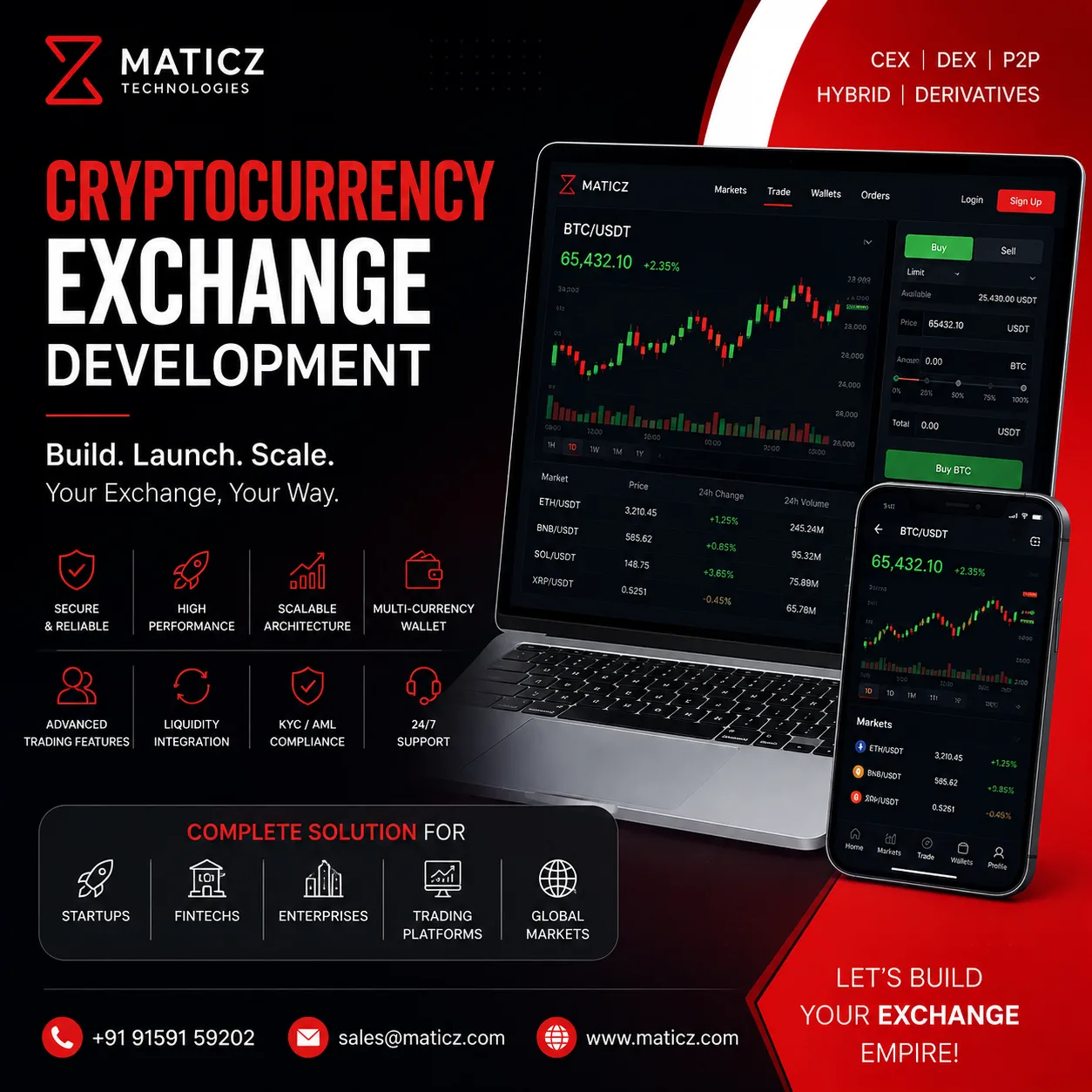
Maticz Technologies is a leading Cryptocurrency Exchange Development Company delivering secure, scalable, and enterprise-grade exchange solutions for startups, fintech companies, and global enterprises. Our services include Centralized (CEX), Decentralized (DEX), Hybrid, P2P, and White Label Cryptocurrency Exchange Development, powered by high-performance matching engines, liquidity integration, AI-powered security, multi-currency wallet support, KYC/AML compliance, and advanced trading features.
From consultation and architecture design to deployment and post-launch support, our team helps businesses build future-ready cryptocurrency exchanges that are designed for performance, compliance, and sustainable growth.
Conclusion
The cryptocurrency exchange landscape in 2026 is being shaped by technological innovation, regulatory maturity, and evolving user expectations. Artificial intelligence, institutional adoption, stablecoins, tokenized real-world assets, hybrid exchange models, cross-chain interoperability, and enterprise-grade security are no longer emerging concepts—they are becoming industry standards.
Businesses planning to enter the digital asset market must build platforms that are secure, scalable, compliant, and capable of adapting to future innovations. By understanding these trends and partnering with an experienced cryptocurrency exchange development company, organizations can create exchanges that not only meet today's demands but also remain competitive in the rapidly evolving world of digital finance.