In today’s data-driven business environment, organizations depend on accurate, reliable, and trustworthy data to support analytics, operations, compliance, and artificial intelligence initiatives. As data volumes and sources continue to expand, Data Quality and Observability Tools are becoming essential for organizations seeking greater visibility into data health, faster issue resolution, and improved confidence in business-critical information.
Click here for more information : https://qksgroup.com/market-research/spark-matrix-data-quality-and-observability-tools-q4-2025-9879
QKS Group’s Data Quality and Observability Tools market research provides a comprehensive analysis of the global market, covering emerging technology trends, market dynamics, competitive developments, and future market outlook. The study delivers strategic insights for technology vendors to understand the evolving competitive landscape, strengthen growth strategies, and identify new market opportunities. It also helps enterprises evaluate vendor capabilities, competitive differentiation, and market positioning.
Data Quality and Observability Tools Market Overview
Data quality and observability have become strategic priorities as enterprises increasingly rely on data for real-time decision-making, digital transformation, and AI-driven applications. Poor-quality, incomplete, inconsistent, or outdated data can negatively impact operational efficiency, analytics accuracy, regulatory compliance, and customer experiences.
Modern data quality and observability platforms address these challenges by providing capabilities across the data lifecycle. These solutions help organizations monitor data pipelines, identify anomalies, validate schemas, track data lineage, profile datasets, and continuously assess data quality.
The growing adoption of cloud data platforms, data lakes, data warehouses, generative AI, and advanced analytics is further increasing demand for automated and continuous data quality monitoring. Organizations are therefore moving beyond traditional data cleansing toward proactive data observability and intelligent data quality management.
Key Capabilities of Data Quality and Observability Platforms
Leading platforms typically provide a combination of capabilities designed to improve enterprise data reliability, including:
- Automated data profiling and discovery
- Data cleansing and validation
- Anomaly and data drift detection
- Schema validation and monitoring
- Data lineage and impact analysis
- Continuous data quality monitoring
- Data pipeline and freshness monitoring
- Metadata and governance capabilities
- Data issue detection and remediation
- Alerts and real-time data health visibility
These capabilities enable enterprises to identify data problems earlier, reduce operational risks, support compliance initiatives, and improve trust in analytics and AI outcomes.
SPARK Matrix™ Analysis of Data Quality and Observability Tools
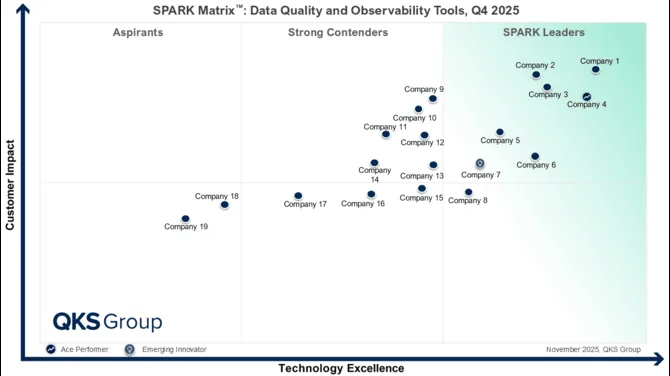
QKS Group’s research includes a detailed competitive assessment using its proprietary SPARK Matrix™ analysis. The SPARK Matrix evaluates and positions leading Data Quality and Observability Tools vendors based on their capabilities and competitive impact in the global market.
Click here for analyst briefing : https://qksgroup.com/analyst-briefing?analystId=70&reportId=9879
The research analyzes vendors including Ataccama, Ab Initio Software, ChainSys, Collibra, DQLabs, Experian, IBM, Informatica, Innovative Systems, Irion, Monte Carlo, Oracle, Precisely, Qlik, Redpoint Global, SAP, SAS, Syniti by Capgemini, and TIBCO Software.
The SPARK Matrix provides technology buyers with a structured framework for comparing vendors, understanding competitive differentiation, and identifying solutions aligned with their data quality and observability requirements.
Future Outlook of the Data Quality and Observability Market
The future of the Data Quality and Observability Tools market will be shaped by increasing data complexity, hybrid and multi-cloud environments, real-time analytics, and the rapid adoption of AI. Organizations will increasingly require automated approaches that can detect data issues proactively and provide actionable insights into the health of enterprise data.
AI-powered anomaly detection, intelligent data monitoring, automated remediation, and deeper integration with data governance and metadata management platforms are expected to become increasingly important. As enterprises scale AI initiatives, ensuring high-quality and trustworthy data will remain critical to achieving reliable business and AI outcomes.
Expert Perspective
According to Principal Analyst at QKS Group, “A Data Quality and Observability platform is a comprehensive solution designed to ensure the accuracy, reliability, and trustworthiness of enterprise data across its lifecycle, from ingestion and integration to analytics, reporting, and AI-driven decision-making.”
He further highlights that these platforms help organizations improve data visibility through capabilities such as automated data profiling, data cleansing, anomaly detection, schema validation, lineage tracking, and continuous monitoring. By providing greater visibility into data health and governance, organizations can reduce business risk, accelerate compliance, improve operational efficiency, and maximize the value of data-driven and AI initiatives.
Conclusion
The Data Quality and Observability Tools market is evolving as enterprises recognize that trusted data is fundamental to successful analytics, digital transformation, and AI adoption. QKS Group’s market research and SPARK Matrix™ analysis provide technology vendors and enterprise buyers with valuable insights into market trends, competitive positioning, vendor capabilities, and future opportunities.
Organizations evaluating data quality and observability solutions can leverage this research to understand the competitive landscape and make informed technology investment decisions.