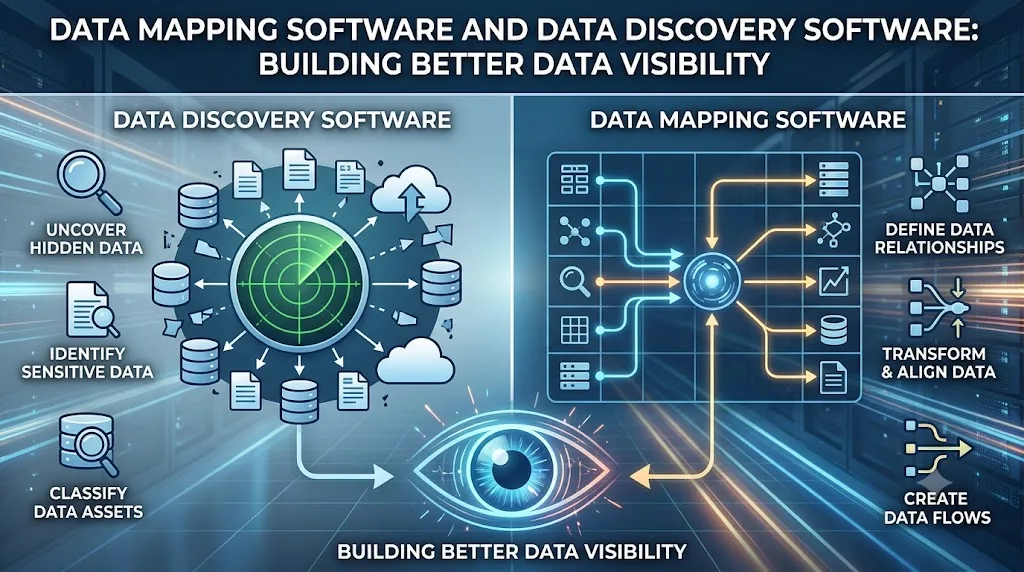
Organizations today collect and process personal and business information across websites, applications, cloud platforms, databases, and third-party systems. As data environments become more complex, understanding where information is stored and how it moves through an organization has become an important part of privacy and data governance.
Using data mapping software can help businesses create a structured view of their data ecosystem, while data discovery software can help identify and understand sensitive information across different systems.
What Is Data Mapping Software?
Data mapping software helps organizations document relationships between data sources, systems, processing activities, and destinations. It can provide a visual or structured representation of how information flows throughout an organization.
For example, a business may collect customer information through a website, transfer it to a CRM, share selected information with service providers, and store it in cloud infrastructure. Mapping these relationships manually can become difficult as the number of systems increases.
Automated data mapping can help privacy and IT teams maintain more accurate information about data flows and processing activities.
What Is Data Discovery Software?
Data discovery software is designed to help organizations locate and identify data across different repositories. Depending on the solution, it may identify personal, sensitive, or business-critical information within databases, applications, documents, cloud environments, and other connected sources.
Data discovery is particularly useful for organizations that need to understand what information they possess before implementing broader privacy and governance processes.
By discovering relevant data assets, organizations can better identify potential privacy risks, understand processing activities, and establish appropriate controls.
Connecting Data Discovery and Data Mapping
Data discovery and data mapping work together. Discovery helps organizations find and classify relevant information, while mapping helps them understand how that information moves between systems.
Consiva AI provides privacy management capabilities designed to help organizations improve visibility across their data-processing environment. A centralized approach can help privacy, compliance, IT, and security teams work with more consistent information.
For organizations managing large amounts of personal data, combining automated discovery with structured mapping can reduce reliance on spreadsheets and disconnected documentation.
Key Benefits
Implementing data mapping and discovery technologies can provide several benefits:
- Improved visibility into organizational data
- Identification of personal and sensitive information
- Better understanding of data flows
- More structured privacy documentation
- Reduced manual data inventory work
- Improved compliance and audit preparation
- Better collaboration between privacy and IT teams
Consiva AI can help businesses organize privacy-related information and establish more systematic processes for managing data visibility and compliance activities.
Conclusion
As organizations adopt more cloud applications, SaaS platforms, and connected technologies, maintaining an accurate understanding of data becomes increasingly important. Manual inventories can become outdated quickly, making automation valuable for modern privacy operations.
By using data mapping software and data discovery software, businesses can develop a clearer understanding of where their information resides and how it moves across their technology environment. Consiva AI supports organizations seeking a centralized approach to privacy management and data visibility.
A structured data management strategy can ultimately help businesses improve operational transparency, strengthen governance, and make privacy processes more manageable as their digital environment grows.
FAQs
1. What is data mapping software?
Data mapping software helps organizations document and understand relationships between data sources, systems, processing activities, and destinations.
2. What does data discovery software do?
Data discovery software helps organizations locate and identify relevant information across databases, applications, cloud environments, and other repositories.
3. Why is data mapping important for privacy management?
Data mapping helps organizations understand how personal information moves through different systems, supporting better privacy documentation and governance.
4. Can data discovery be automated?
Yes. Modern data discovery solutions can automate the identification and classification of relevant information across connected data sources.
5. How can businesses improve data visibility?
Businesses can combine data discovery, data mapping, classification, and privacy management processes. Consiva AI can help centralize these activities and provide a more structured approach to managing privacy-related data.