The Conversational AI Platforms (CAIPs) market is rapidly evolving as enterprises move beyond basic chatbots and virtual assistants toward intelligent, context-aware systems capable of reasoning, automation, and autonomous task execution. Organizations across industries are increasingly adopting conversational AI platforms to improve customer experiences, streamline employee interactions, automate business processes, and deliver personalized digital engagement.
Click here for more information : https://qksgroup.com/market-research/spark-matrix-conversational-ai-platforms-q4-2025-10314
QKS Group’s Conversational AI Platforms market research provides a comprehensive analysis of the global market, covering emerging technology trends, market dynamics, competitive developments, and the future outlook. The research helps technology vendors understand evolving market opportunities and strengthen their growth strategies, while enabling enterprises to evaluate vendors based on capabilities, competitive differentiation, and market positioning.
Key Trends Shaping the Conversational AI Platforms Market
One of the most significant developments in the conversational AI market is the transition from traditional dialogue management toward agentic AI and intelligent orchestration. Modern platforms are increasingly designed to understand user intent, maintain contextual awareness, retrieve information from multiple enterprise data sources, and execute actions across business workflows.
Generative AI is further accelerating this transformation. Conversational AI platforms are incorporating large language models (LLMs), retrieval-augmented generation (RAG), knowledge grounding, and generative reasoning to deliver more natural and contextually relevant interactions. These capabilities enable organizations to move from predefined conversational flows toward dynamic, adaptive interactions.
Another important trend is the integration of conversational AI with enterprise applications and workflows. Platforms that can connect with CRM, ITSM, contact center, HR, sales, and other enterprise systems can transform conversations into actionable business outcomes rather than limiting them to information retrieval.
Agentic AI Is Redefining Conversational Experiences
The next generation of conversational AI platforms is increasingly focused on outcome delivery rather than intent recognition. Agentic conversational systems can interpret complex requests, determine the required steps, access relevant information, and initiate structured actions while maintaining context throughout the interaction.
According to Analyst at QKS Group:
“Conversational AI platforms are transitioning from traditional dialogue management to agentic orchestration, where systems not only interpret intent but also analyse context, synthesise information across data sources, and execute structured actions within enterprise workflows.”
This evolution is expected to make conversational AI increasingly relevant across business functions, including customer service, IT support, employee experience, sales, and enterprise operations.
Conversational AI Platforms Vendor Landscape
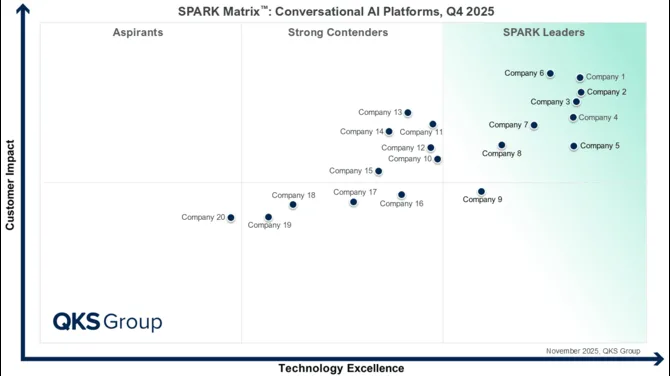
QKS Group’s research provides detailed competitive analysis and vendor evaluation using its proprietary SPARK Matrix™ analysis. The SPARK Matrix evaluates and positions leading Conversational AI Platforms vendors based on their technological capabilities and competitive impact in the global market.
Download Sample Report : https://qksgroup.com/download-sample-form/spark-matrix-conversational-ai-platforms-q4-2025-10314
The evaluated vendors include Avaamo, Boost.ai, Creative Virtual, Druid AI, Google, IBM, Inbenta, Kore.ai, LivePerson, Microsoft, NiCE Cognigy, Omilia, OneReach.ai, Openstream.ai, Parloa, PolyAI, Rasa, SoundHound AI, Sprinklr, and Yellow.ai.
This vendor assessment enables enterprises to compare platform capabilities, understand competitive differentiation, and identify solutions aligned with their conversational AI and digital transformation requirements.
Future Outlook for the Conversational AI Market
The future of Conversational AI Platforms will be shaped by the convergence of generative AI, agentic orchestration, process automation, enterprise integration, and AI governance. As organizations deploy conversational systems across increasingly critical workflows, reliability, security, interoperability, transparency, and governance will become essential factors in vendor selection.
As analyst further highlights, market differentiation will increasingly depend on vendors’ ability to deliver adaptive, dependable, and interoperable conversational systems that can be consistently applied across business functions.
For enterprises evaluating conversational AI solutions, understanding technology maturity, integration capabilities, AI governance, automation potential, and vendor positioning will be critical to maximizing the value of conversational AI investments.
Conclusion
The Conversational AI Platforms market is entering a new phase in which intelligent systems are expected to do more than understand and respond to users. They are increasingly becoming enterprise action engines capable of reasoning, orchestrating workflows, synthesizing information, and delivering measurable outcomes.
QKS Group’s Conversational AI Platforms market research and SPARK Matrix™ analysis provides technology vendors and enterprises with strategic insights into market trends, competitive positioning, vendor capabilities, and the evolving future of conversational AI.