At present, Generative AI is one of the newest ideas in contemporary artificial intelligence (AI). Unlike analytical AI, which focuses on processing information, categorizing it, or predicting some patterns, generative AI creates new content. It can be text, images, audio models, video content, computer code, or anything else that can be generated digitally.
Learn about Generative AI’s most important terms, including large language models (LLMs) and diffusion models. Since both types of technology can produce content, it is essential to differentiate between them and to discover what their true goal is.
Generative AI represents a broad range of AI concepts and techniques responsible for creating new content. Unlike traditional AI that provides insights based on past experience or data, generative AI produces digital content based on previously provided data in a way that allows it to create something that may be completely different from all the previously provided input.
It means that a company can give prompts to a generative AI engine, and it will create new content, ranging from textual material to complex code or audio/video files. Today, generative AI is used almost in all industries where there is a need to create new content, information, or perform some repetitive tasks. For instance, it is applied in healthcare, retail, finance, education, media, manufacturing, and software development.
What Are Large Language Models?
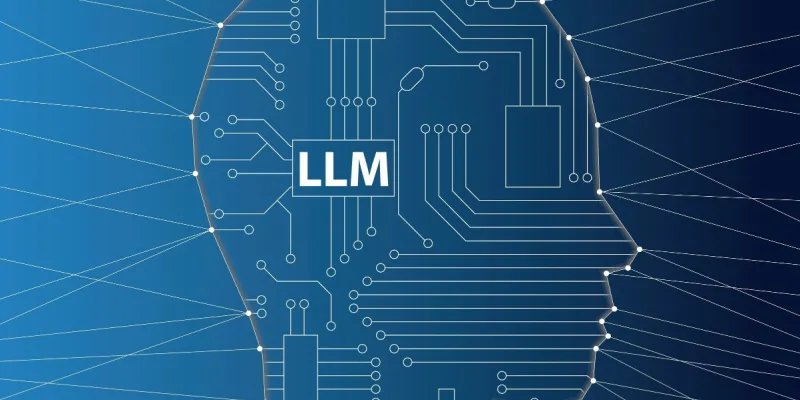
Large language models or LLMs are an important segment of the overall AI field. These deep learning algorithms can understand and generate human languages and are trained on extensive data sets. At present, it is true that the majority of these models are constructed on the transformer paradigm that contributes to the improved learning and analyzing of input-output contextual information.
Among the many capabilities of LLM is text creation, summarization, question-answering, translation, extraction of needed information, code writing, and many other functions.
What is vital about it, each large language model has unique features and can perform better or worse according to the training data, the model's architecture, tuning, context, query, etc.
How Do LLMs Generate Content?
LLM works on a token basis, meaning that it goes through each element, and for each element, it calculates the probability of occurrence in the entire model. This element is known as a token that may consist of several words, phrases, punctuation signs, etc. In case a user provides a certain prompt or query to an LLM, then it uses the context and generates certain content. More specifically, it runs through all the tokens and chooses the most suitable one. The AI model doesn't actually comprehend the given input, but rather performs complicated calculations in order to produce proper output.
While this technology is powerful, it requires caution in using it because of the possibility of producing misleading content. Users should assess the produced outcomes and check them for validity independently. Expert knowledge is essential at all steps of AI usage.
What Are Diffusion Models?
Diffusion models are another powerful concept in the realm of synthetic AI. They are mostly used for generating images but can also create other types of visual content, such as video, animation, art, design prototypes, and more. The underlying principle is relatively straightforward: a model can gradually transform disordered noise into coherent images with the help of special algorithms.
More specifically, diffusion processes can be used for image synthesis, which requires training the model on existing pictures. Then, given a prompt, the AI will produce an image based on its description. In effect, it can be applied to many different use cases, including graphic design, advertising, art creation, product design, and others.
For example, PredisAI can be used for AI-powered video generation, helping users transform ideas and prompts into engaging video content.
LLMs vs. Diffusion Models: Similarities and Differences
Both large language and diffusion models are powerful tools in modern AI. However, they have different purposes, strengths, areas of application, and other characteristics. Understanding their main similarities and differences will help businesses choose the most relevant technology for a particular purpose.
In essence, the key difference is that LLMs focus on language while diffusion models concentrate on visual content. Large language models are ideal for any tasks that involve text, including chatbots, documentation, coding, translation, summarization, and other similar functions. On the other hand, diffusion models are mostly used for generating images or other types of visual media.
LLMs and diffusion models are two distinct but powerful concepts in synthetic AI. The first one provides qualitative text output, while the latter one generates images. Still, both can be used together with other technologies for even greater impact.
Applications of Generative AI
Today, generative AI can be applied in numerous fields, including customer service, software development, retail, healthcare, media, and many others. In particular, companies can use chatbots for answering frequently asked questions or summarizing long messages. At the same time, such synthetic AI applications can help application developers write code, explain the intricacies of a programming language, detect issues, and document the software.
In the retail sector, it can be used for summarizing product descriptions, creating engaging content, and providing product recommendations. Generative AI can help create materials for marketing campaigns, thus supporting the sales function. In healthcare, it can be employed for documentation, information summarization, research assistance, and other administrative In sensitive areas like medicines, it is vital to be careful with the content, checking the obtained information for accuracy.
In the field of media and entertainment, synthetic AI can be applied for story creation, image and video content making, ad design, and other creative activities.
Benefits of Generative AI for Businesses
Generative AI is a powerful instrument that can significantly transform the work of a business. To begin with, it can lessen the number of tedious tasks, therefore, increasing the productivity of employees. To illustrate, LLMs can assist employees in creating text, summing up information, organizing data, and completing other repetitive tasks. In addition, the use of analytics allows companies to introduce the synthetic AI into their existing procedures and enhance them already. This way, firms will be able to make their processes more effective and increase productivity.
Furthermore, AI can assist in generating new ideas and products through searching, testing, mixing, and modifying. It will give businesses the opportunity to introduce unique selling propositions and stay competitive. For example, they can produce intelligent agents, chatbots, and virtual assistants to help people with some tasks.
Challenges of Generative AI
Although generative AI is capable of providing many benefits to companies, there are also some drawbacks that need to be taken into account. The first one is that modern-day generative models are rather inadequate and can cause errors in their responses. The second one is a need for addressing issues of privacy of data as well as intellectual property when using new AI technologies. For example, a company must make sure that all the data used for an AI model is safe as well as results that would not infringe on others' rights.
Moreover, security should also be considered while utilizing synthetic AI. AI application security depends on several factors such as prompt injection, exposure of data, etc. Therefore, companies should be engaged in an integrated approach to AI security.
The prospects of generative AI may be considered as promising. Researchers and developers will definitely keep working on improving current technologies and on inventing something new. In particular, synthetic AI will become more multimodal, that is it will combine human prompts, texts, images, etc.
Moreover, businesses will move toward specialized and focused AI rather than relying on generic models. In other words, companies will look to combine different AI models and services based on their unique needs instead of using one solution for all purposes. All these changes will allow enterprises to leverage the full potential of generative AI and use it as an intelligent assistant in their daily operations.
Conclusion
Generative AI is a strong tool helping businesses improve their processes and ensure sustainable development. Different examples of large language models and diffusion models have already proved to be useful in different areas of life. However, it is crucial to point out that AI should be used together with the human brain and not replace it. By knowing the strengths and weaknesses of such technologies, businessmen are ready to take the best advantage of them.