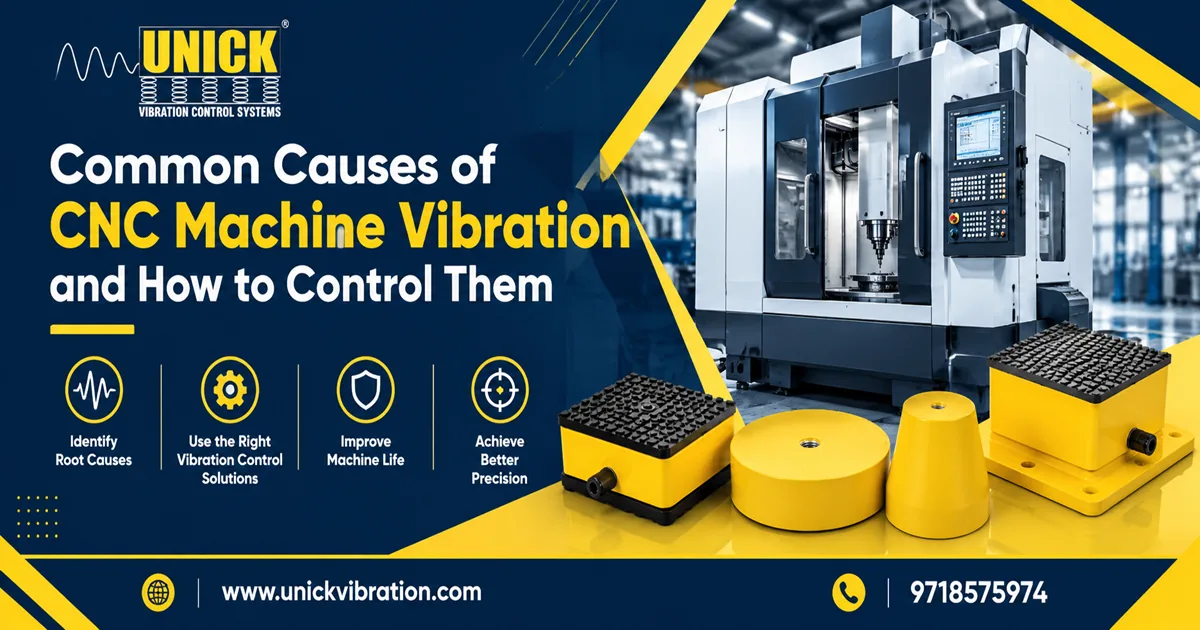
CNC machines are designed to perform precise cutting, milling, turning, and drilling operations. However, even a well-maintained machine can develop vibration due to tool wear, incorrect operating parameters, loose mounting points, or an unstable foundation. If these issues continue, they may affect surface finish, dimensional accuracy, tool life, and overall production quality.
Understanding the source of vibration is the first step towards finding the right solution. In some cases, adjustments to the machine or cutting process are enough. In others, suitable vibration isolation and mounting components can help reduce the transmission of vibration to the surrounding floor and structure.
What Causes Vibration in CNC Machines?
CNC machine vibration can develop from several mechanical and installation-related problems. Identifying the actual cause before selecting a corrective measure can save time and prevent unnecessary equipment changes.
1. Unbalanced Rotating Components
Spindles, cutting tools, and other rotating components can generate vibration when their mass is unevenly distributed. The effect often becomes more noticeable at higher operating speeds.
Regular inspection, proper tool balancing, and maintenance of rotating components can help control this type of vibration. If the problem continues, the spindle and associated components may need a more detailed assessment.
2. Worn Cutting Tools and Incorrect Cutting Parameters
Damaged or worn cutting tools can produce irregular cutting forces. Excessive feed rates, unsuitable spindle speeds, and incorrect cutting depths may also contribute to chatter and vibration during machining.
Operators should check tool condition, workpiece material, tool geometry, and cutting settings before changing the machine's mounting arrangement. Correcting these factors can often improve machining stability.
3. Loose Machine Mountings and Uneven Floors
A CNC machine needs stable support to maintain its intended operating position. Loose fasteners, uneven contact points, or an unsuitable foundation can allow unwanted movement during machining.
In these situations, suitable CNC machine mounting pads and correctly adjusted supports can help establish stable contact with the floor. The machine should also be checked for proper levelling and load distribution.
4. Worn Bearings and Mechanical Misalignment
Damaged spindle bearings, misaligned drive components, and worn mechanical parts can generate vibration even when the machine is operating without a cutting load.
These problems generally require inspection and mechanical correction. Vibration isolation products should not be used as a substitute for repairing defective bearings or correcting misalignment.
5. Resonance and Structural Vibration
Every machine and supporting structure has natural frequencies. When operating forces coincide with these frequencies, vibration can become more pronounced. Nearby machinery may also transmit vibration through a shared floor or structural connection.
An assessment of the vibration source, operating speed, and supporting structure can help determine whether equipment adjustments, structural improvements, or vibration isolation are appropriate.
How Can CNC Machine Vibration Be Controlled?
The correct approach depends on the source and severity of the vibration. A practical inspection should begin with the machine itself before moving on to its mounting system and foundation.
Common corrective measures include:
- Inspecting cutting tools, spindle bearings, and rotating components.
- Checking machine alignment, fasteners, and foundation contact.
- Reviewing spindle speed, feed rate, and cutting depth.
- Verifying machine levelling and the distribution of load across support points.
- Evaluating whether vibration isolation is needed to reduce vibration transmission.
When vibration travels from the machine into the floor, suitable isolation components may help reduce the amount of vibration transferred to the surrounding structure.
How Anti-Vibration Pads Help CNC Machines
Anti-vibration pads are placed beneath suitable machinery supports to help isolate vibration and reduce direct transmission into the floor. Their effectiveness depends on the pad material, thickness, stiffness, load, operating frequency, and installation conditions.
Anti Vibration Pads for CNC Machines
Anti vibration pads for CNC machines can help reduce vibration transmission when the selected material and design are suitable for the machine's operating conditions. They may also help protect floor surfaces and improve the stability of supported equipment when properly installed.
Vibration Isolation Pads for CNC Machines
Vibration isolation pads for CNC machines are used to reduce the transfer of vibration between the machine and its supporting surface. Selection should account for the machine's weight, support-point loads, and the type of vibration that needs to be controlled.
Vibration Damping Pads for CNC Machines
Vibration damping pads for CNC machines can help dissipate vibrational energy through suitable material properties. Damping and isolation are related but different functions, so the correct product depends on whether the main concern is reducing vibration transmission, controlling movement, or addressing resonance.
Anti Vibration Mounts for CNC Machines
Anti vibration mounts for CNC machines provide a mounting interface designed to manage vibration and support the equipment. Depending on the design, they may combine elastic elements with structural components to provide isolation, stability, or both.
CNC Machine Vibration Isolation Mounts
CNC machine vibration isolation mounts are particularly relevant when vibration transmission to the floor or nearby equipment is a concern. Their suitability depends on the vibration frequency, machine load, and required isolation performance.
Which Types of Mounting Solutions Are Used for CNC Machines?
Different CNC installations require different mounting arrangements. A lightweight machine may need a different support system from a heavy CNC lathe or machining centre.
Rubber Mounts for CNC Machines
Rubber mounts for CNC machines use elastomeric material to provide compliant support and help control vibration transmission. Their performance depends on rubber hardness, mount geometry, load, and operating conditions.
They may be suitable for selected machines where compact mounting, vibration control, and stable support are required. However, the correct rubber compound and mount design should be chosen for the actual application.
Anti Vibration Rubber Pads for CNC Machines
Anti vibration rubber pads for CNC machines are used beneath suitable machine supports to provide a resilient interface between the equipment and the floor. They can help reduce vibration transmission and prevent direct metal-to-floor contact.
Before selecting a pad, check its load capacity, resistance to oils or coolants, and suitability for the installation environment. A pad that is too soft or incorrectly loaded may allow excessive movement.
CNC Machine Leveling Pads
CNC machine leveling pads help establish the required machine height and provide adjustable support where the design allows. Correct levelling is important for maintaining machine alignment and distributing weight across the mounting points.
Some leveling pads also incorporate vibration-isolating elements. However, levelling and vibration isolation are separate functions, and the product should be selected to meet both requirements where necessary.
CNC Lathe Anti Vibration Pads
CNC lathe anti vibration pads are selected according to the lathe's weight, operating speed, support arrangement, and cutting conditions. Since turning operations generate changing cutting forces, the mounting system must provide suitable support without allowing excessive movement.
If vibration originates from the spindle, workpiece, or cutting tool, those components should be inspected before relying on pads to address the problem.
CNC Machine Shock Absorbing Pads
CNC machine shock absorbing pads are designed for applications where suitable materials can help absorb or cushion mechanical impacts. They may be useful in selected installations, but shock absorption should not be confused with effective isolation of continuous machine vibration.
The product specification should match the type of load and mechanical disturbance involved.
Anti Vibration Feet for CNC Machines
Anti vibration feet for CNC machines provide support at individual mounting points and may combine height adjustment with vibration-isolating properties. Correct installation helps distribute the machine load across the feet and maintain stable contact with the floor.
The number of feet, their load ratings, and their adjustment range should match the machine manufacturer's recommendations.
CNC Machine Vibration Control Pads
CNC machine vibration control pads are an option for installations where vibration transmission through the support points needs to be reduced. The appropriate pad depends on the machine's static and dynamic loads, operating frequency, and required stability.
For heavier machinery, a properly engineered mount may be more suitable than a simple rubber pad.
CNC Machine Mounting Pads
CNC machine mounting pads provide a supporting interface between machinery and its base or floor. Depending on the product, they may help with load distribution, levelling, vibration isolation, or floor protection.
Before installation, verify the mounting dimensions, allowable load, floor condition, and manufacturer's instructions.
CNC Machine Shock and Vibration Control
Some installations experience both continuous vibration and intermittent mechanical impacts. In these cases, the mounting solution should be selected according to the actual disturbance rather than relying on a general-purpose pad.
Where vibration is severe or the machine requires high precision, a specialist assessment may be needed to determine whether elastomeric mounts, spring-based systems, or another engineered solution is appropriate.
How to Choose the Right Anti-Vibration Mounting Solution
Selecting a suitable mounting product involves more than checking its dimensions or price. The following factors can help narrow down the options.
Machine weight and load distribution: Calculate the load carried by each support point. Uneven loading can affect both stability and isolation performance.
Type of machine: A CNC lathe, milling machine, and machining centre may have different vibration characteristics and support requirements.
Operating speed and vibration frequency: The mount must suit the machine's operating conditions. Incorrect stiffness can reduce isolation performance or increase movement.
Floor and foundation: Check whether the floor is level, structurally suitable, and free from loose or damaged areas.
Environmental conditions: Oils, coolants, temperature, and industrial contaminants may affect the service life of some rubber compounds.
Levelling and maintenance: Confirm whether the machine requires adjustable supports and whether the mounting system allows routine inspection and servicing.
These checks can help identify an appropriate solution while avoiding the assumption that every vibration problem can be resolved with the same type of pad.
How Unick Vibration Supports Industrial Vibration Control
Unick Vibration manufactures industrial vibration-control products for machinery applications. Businesses evaluating CNC machine support and isolation options should consider machine weight, operating conditions, installation requirements, and the source of vibration before choosing a product.
Providing details about the machine type, approximate weight, mounting arrangement, and vibration problem can help narrow down suitable options.
Frequently Asked Questions
Can anti-vibration pads improve CNC machining accuracy?
Suitable pads can help reduce vibration transmission and unwanted movement in appropriate installations. However, machining accuracy also depends on spindle condition, tool quality, machine rigidity, alignment, and operating parameters.
Are rubber pads suitable for every CNC machine?
No. Rubber pads may suit some machines, but heavier equipment or installations with specific vibration frequencies may require engineered mounts or another isolation system. The load and operating conditions should guide selection.
Do vibration isolation mounts eliminate all machine vibration?
No. Isolation mounts are intended to manage vibration transmission and support the equipment. They cannot correct every mechanical fault, and their performance depends on proper selection and installation.
Should a CNC machine be levelled before installing vibration pads?
The machine should be installed and levelled according to the manufacturer's instructions. If the mounting system includes adjustable supports, these should be set correctly to maintain the required machine position and distribute the load.
How can I identify the right pads for a CNC lathe?
Start by checking the lathe's weight, support-point loads, operating speed, floor condition, and source of vibration. These details help determine whether rubber pads, adjustable feet, or a more specialised mounting solution may be appropriate.
Conclusion
CNC machine vibration can result from worn tools, unbalanced components, mechanical faults, incorrect cutting settings, or unsuitable foundations. Identifying the cause first is the most effective way to choose a corrective measure.
Where vibration is transmitted through the machine supports, suitable anti-vibration pads and mounts may help improve installation stability and reduce vibration transfer to the floor. Careful product selection, correct levelling, and routine maintenance are essential for achieving the intended results.
For industrial vibration-control requirements, Unick Vibration can be considered when evaluating mounting and isolation options for CNC machinery.