Agriculture is in the process of change with the introduction of new technologies and sustainable cultivation practices. The traditional methods of farming are still very much in play but the farmer is increasingly looking for more efficient ways to manage water, improve soil health, control pests and increase yields. That’s where modern farming methods come in.
Modern agriculture is the combination of technology, science and environmentally sound practice to improve farm productivity. It’s all about using the right technologies in the right way to get the most from what you have. That can be precision farming, drip irrigation, hydroponics, integrated pest management and so on.
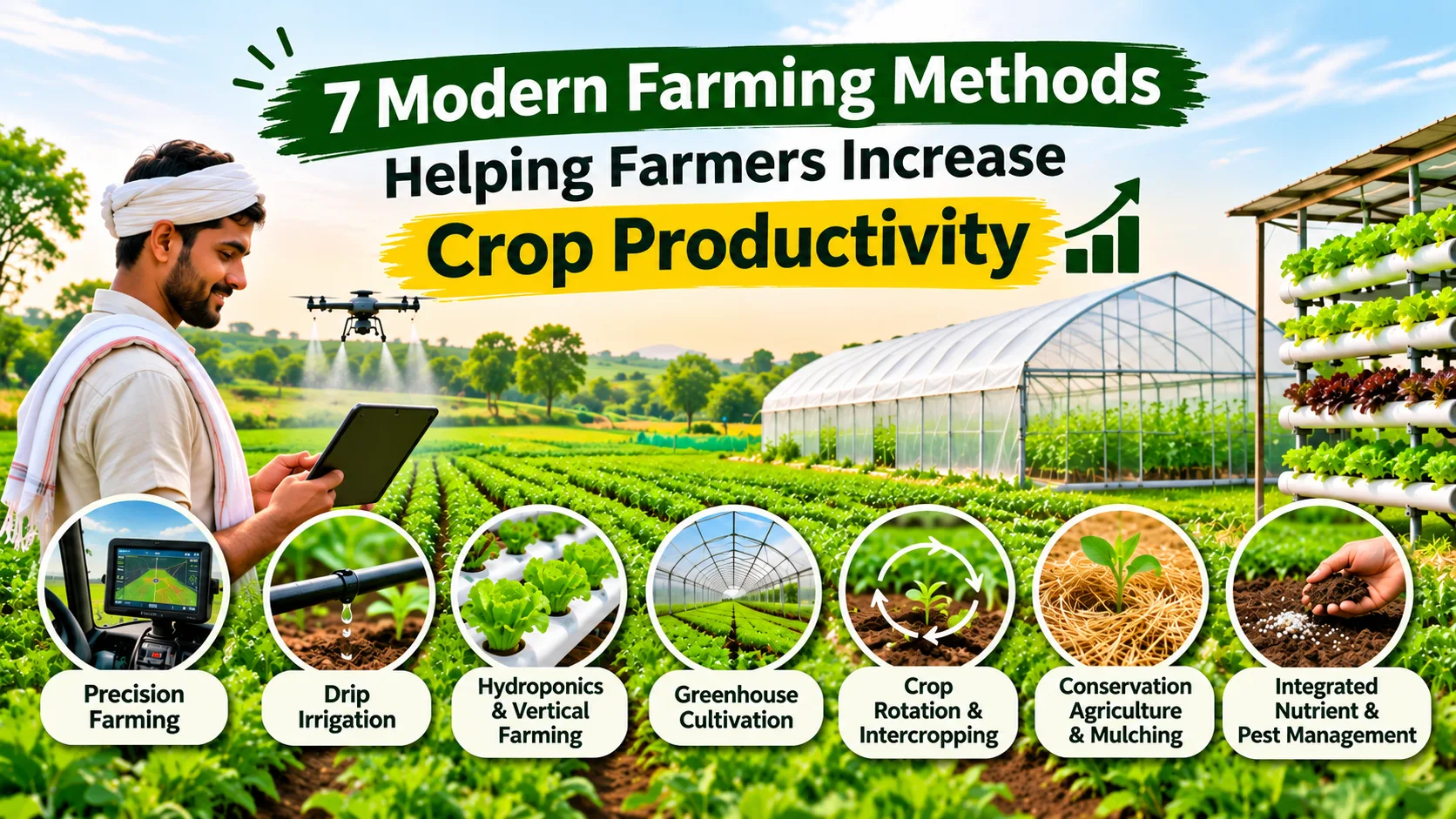
In this blog we look at seven modern farming methods that can be used to increase crop productivity and at the same time support long term agricultural sustainability.
1. Precision Farming
Precision farming is a fairly modern approach to farming which uses technology and data to manage crops more precisely. It’s about understanding the differences in the soil, the moisture and the crop across the field.
Farmers can use GPS, soil sensors, drones, satellite imagery and smart monitoring to make informed decisions.
Key benefits:
- Helps to optimise water and fertiliser application.
- Can identify crop health issues at an early stage.
- Reduces unnecessary input costs.
- Improves field management and resource efficiency.
For instance soil moisture sensors can be used to work out when irrigation is actually required rather than just watering the whole field on a set schedule.
2. Drip Irrigation and Sprinkler Irrigation
Water management is absolutely vital to successful agriculture, especially in areas where the rainfall is erratic and/or where water resources are in limited supply.
Drip irrigation delivers the water directly to the plant roots via pipes and emitters. Sprinkler irrigation works by distributing the water through pipes and nozzles under pressure, thus creating a rain effect.
Both methods help the farmer to irrigate more efficiently than conventional flood irrigation.
Key benefits:
- Reduces water wastage.
- Supports healthier crop growth.
- Improves irrigation management.
- Can reduce weed growth in between crop rows.
Farmers growing vegetables, fruit and other water sensitive crops can look at drip irrigation based on crop requirement and field conditions.
3. Hydroponics and Vertical Farming
Hydroponics is a form of cultivation where the plant grows without soil. The roots are fed their required nutrients via a nutrient solution in water.
Vertical farming works on a completely different principle, growing crops in vertically stacked layers (often within an indoor farm or greenhouse).
These are methods which are of particular value where there is a lack of agricultural land.
Key benefits:
- Makes very productive use of the limited space.
- Allows far greater control over growing conditions.
- Can support year-round cultivation.
- Reduces reliance on good agricultural land.
Leafy greens such as lettuce, spinach and herbs are all fairly suitable for hydroponics.
However these systems do require a degree of technical know how, electricity, nutrients and an initial outlay.
4. Greenhouse and Protected Cultivation
Protected cultivation is the growing of crops in a controlled or partially controlled environment using greenhouses, polyhouses and shade net houses.
These structures help to protect the plants from the elements (extreme weather, heavy rain, excessive sun) as well as from certain pest problems.
Farmers can also manage temperature, humidity, ventilation and irrigation in accordance with crop requirements.
Key benefits:
- Protects crops from bad weather.
- Supports off-season cultivation.
- Helps improve crop quality.
- Creates better growing conditions for high value crops.
Tomatoes, capsicum, cucumbers and flowers are crops that can be grown using protected culture techniques.
5. Crop Rotation and Intercropping
Crop rotation and intercropping are two fairly practical techniques which improve the use of land and contribute to soil health.
Crop rotation is the practice of growing different crops on the same land in a sequence over the different seasons. A typical example would be to grow wheat and then a legume crop.
Intercropping is the practice of growing two or more suitable crops together in the same field during a given season.
Key benefits:
- Helps maintain soil fertility.
- Improves land utilization.
- Can reduce the build up of certain crop specific pests and diseases.
- Diversifies agricultural production.
Farmers should be selecting the appropriate crop combinations in the light of soil type, climate, water availability and local growing conditions.
6. Conservation Agriculture and Mulching
Conservation agriculture is all about protecting the soil whilst maintaining the productivity of the land. The three main tenets are minimum soil disturbance, permanent soil cover and crop diversification.
Mulching is an important supporting practice in which materials such as straw, dry leaves, crop residues or suitable biodegradable sheets are laid down to cover the soil surface.
Key benefits:
- Helps conserve soil moisture.
- Reduces soil erosion.
- Suppresses weed growth.
- Supports better soil structure over the long term.
For instance farmers growing vegetables can use organic mulch to reduce moisture loss and protect the soil surface in hot weather.
7. Integrated Nutrient and Pest Management
Integrated Nutrient Management (INM) and Integrated Pest Management (IPM) both help the farmer to maintain the health of the crop through a balanced and scientific approach to farming.
INM is a combination of organic manures, compost, biofertilisers and the appropriate choice of mineral fertilisers to meet the crop nutrient requirement.
IPM combines prevention, field monitoring, biological control, cultural practices and the judicious use of pesticides to manage pests.
Key benefits:
- Supports balanced plant nutrition.
- Helps to maintain long term soil fertility.
- Reduces unnecessary chemical applications.
- Promotes healthier crop management.
- Helps to minimise crop losses due to pests.
Farmers can start off by testing their soil, keeping an eye on pest activity and then selecting the appropriate nutrient and pest management strategies.
How to choose the right modern farming method?
Not every farming system is going to be appropriate for every farm. You need to look at your own farm in terms of size, soil, climate, water and what you’re growing and your level of investment before you go in and try a new system.
For the smaller farm it would be sensible to start with drip irrigation, mulching, crop rotation and intercropping. For the farmer with the right infrastructure and the capacity to invest, precision farming, glasshouse growing and hydroponics could be viable options.
Start with one small improvement and assess the outcome. That will go a long way towards helping you make better decisions in the long term.
Frequently Asked Questions (FAQs)
1. What are modern farming methods?
Modern farming is the use of improved technology, scientific methods and more efficient use of resources to increase productivity and support sustainable agriculture.
2. Which of the modern methods of farming is best for increasing crop productivity?
There is no one best way for every farm. Precision farming, drip irrigation, crop rotation and integrated nutrient management can all be effective in increasing productivity depending on the circumstances of the particular farm.
3. How does technology assist in modern day agriculture?
Technology enables farmers to monitor soil moisture, spot crop disease, manage irrigation, apply fertiliser more accurately and make better decisions based on real time agricultural data.
4. Are modern farming methods appropriate for small farmers?
Yes. Small farmers can adopt affordable techniques such as drip irrigation, mulching, intercropping, crop rotation, and soil testing. They can gradually introduce advanced technologies as resources allow.
5. What is the difference between traditional and modern farming?
Traditional farming generally relies more on conventional tools and established cultivation practices, whereas modern farming combines scientific techniques, improved machinery, technology, and efficient resource management.
Conclusion
Adopting the right modern farming methods can help farmers improve crop productivity, manage agricultural resources efficiently, and protect soil health. Techniques such as precision farming, drip irrigation, hydroponics, crop rotation, and integrated pest management offer practical solutions to several challenges in agriculture.
The key is to select farming techniques according to local conditions rather than adopting technology without proper planning. Combining scientific knowledge with sustainable agricultural practices can help build more productive and resilient farming systems.