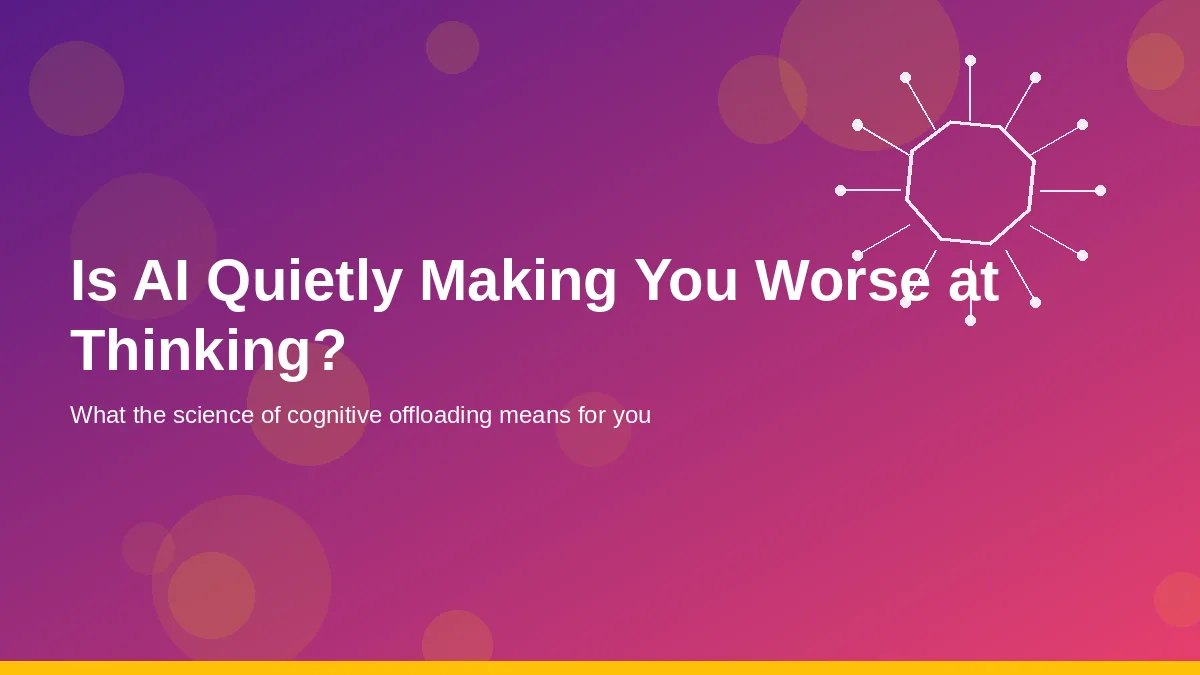
Let's be real for a second. How many times today did you let an AI tool "think" for you instead of doing it yourself? Writing that email, solving that problem, even planning your day chances are, AI touched most of it.
And here's the buzz everyone's talking about right now: this convenience might be quietly costing us something. Scientists have a term for its digital amnesia, and it's becoming one of the hottest topics in the AI-and-work conversation this year.
Let's break it down, no boring jargon, promise.
First Up: What Exactly Is Cognitive Offloading?
Simple. It's when you let something outside your brain do the mental work your brain used to do. Sound familiar? You've probably done it a hundred times already:
- Using GPS instead of remembering the route
- Using a calculator instead of doing quick math
- Using autocomplete instead of finishing your own sentence
None of that is dangerous on its own. But AI takes this to a whole new level. It doesn't just store info like an old-school notebook; it thinks, drafts, and decides for you, often before you've even finished framing the question in your head.
Fun fact: this fear is ancient! Way back in the day, the Greek philosopher Socrates was suspicious of writing itself. He thought it would wreck people's memory. His exact words?
"If men learn this, it will implant forgetfulness in their souls." — Socrates.
He was talking about the alphabet. We're talking about ChatGPT. Same worry, new century, way higher stakes.
The Numbers Are Kind of Shocking
Okay, here's where things get spicy. Researchers tested this, and the results are eye-opening.
The MIT Media Lab ran an experiment where people wrote essays using ChatGPT, a search engine, or nothing but their own brain. Right after finishing, they asked everyone to recall a line from what they'd just written. In the ChatGPT group? A massive 83% couldn't do it. Their own writing from minutes ago just didn't stick.
Then there's a study by Microsoft Research and Carnegie Mellon University, where they asked 319 professionals about how they really use AI at work. The finding? The more people trusted AI to get something right, the less they bothered double-checking it. Basically, trust in the tool replaced actual thinking. (Read it here)
Translation: AI isn't making us dumb overnight. It's just making it easy to stop asking "wait, is this even correct?"
What's Trending Right Now in 2026
This topic is blowing up even more this year, and for good reason.
Microsoft's brand-new 2026 Work Trend Index (a massive survey of 20,000 AI users across 10 countries) found something wild: almost half of all conversations with Microsoft Copilot now involve real thinking, work analysis, strategy, and big decisions,s not just fixing typos or drafting quick replies. AI has moved way beyond "help me write faster" and straight into "help me decide."
There's also a hot theory doing the rounds this year from investor Tom Slater, who says AI's real danger isn't stealing jobs; it's quietly dulling the minds of the people who keep them. And the early signs back him up: entry-level job postings have dropped a lot since 2023, and some companies are even paying junior staff less. Why does that matter? Because entry-level jobs used to be exactly where people built sharp thinking skills through practice. If AI grabs that job before people get the reps, we might end up with a workforce that's super-fast but never actually learned to think for themselves.
So. Should We Just Delete All Our AI Apps?
Nope, not even close! AI is genuinely amazing when used right. The real fix isn't ditching AI; it's using it smartly instead of blindly.
Here's the cheat sheet:
- Think first, ask AI second. Even 30 seconds of your own thinking before your prompt keeps your brain switched on.
- Learn how AI works. Once you know where it messes up, you naturally trust it a little less blindly.
- Pause before you hit accept. One quick "does this actually make sense?" catches way more mistakes than you'd expect.
- Treat AI like a teammate, not a boss. It's great at speed. You're great at judgment. Use both.
- Do the hard thing sometimes, on purpose. Especially if you're early in your career, that struggle is literally how skill gets built.
Small habits, big payoff. Your brain will thank you.
A Quick Story That Makes This Click
Picture this: someone at work gets asked to plan a whole project timeline. Fastest option? Dump it into AI, copy-paste the output, done in two minutes. Looks great... until someone in the meeting asks, "Wait, why does this step come before that one?" and there's zero answer, because the AI figured it out, not the person presenting it.
Now picture the same task done slightly differently: jot down the 3-4 things that absolutely need to happen in order, then let AI fill in the rest and clean it up. Barely any extra time spent. But now that person can explain every part of the plan, because their brain was in the driver's seat the whole time, not just watching from the back seat.
Tiny shift. Massive difference in how it plays out.
Why This Isn't Just a "Nice to Know" Thing
Here's the thing: skipping that little bit of thinking once isn't a big deal. But do it every single day, for months, across an entire team, and it quietly adds up to a workplace full of people who can't really explain their own work anymore. That's not a great look, and it's risky when something eventually goes wrong and nobody understands why, because nobody was really "in" the process to begin with.
The fix isn't complicated, though. It's just about building small, repeatable habits the kind that keep your brain switched on instead of coasting on autopilot.
The Bottom Line
Nobody's saying quit AI cold turkey; that would honestly be a step backward. AI genuinely makes work faster, smarter, and in a lot of cases, better. The real move is just making sure your own brain doesn't quietly clock out while the AI clocks in.
Think of it like going to the gym with a spotter. The spotter is there to help, catch mistakes, and make things safer, but you're still the one lifting the weight. If you let the spotter do all the lifting, you never actually get stronger. Same deal here. Let AI spot you, not replace you, and your thinking stays sharp instead of getting soft over time.
The best part? None of this requires some big dramatic change. Just a few seconds of your own thinking before you hit "ask AI," and a quick gut-check before you hit "accept." Small stuff. Big long-term payoff.
At SimpliTrain, we make training simple, reliable, and manageable from one unified platform without the need to switch between multiple systems. As AI shapes the future of learning, we believe in cognitive delegation: letting AI handle repetitive tasks while humans retain their creativity, critical thinking, problem-solving, and ability to think outside the box.
FAQ Time
What is cognitive offloading in simple terms?
It's letting something outside your brain a gadget, an app, an AI tool do mental work that you'd normally do yourself.
Is offloading to AI always bad?
Not at all. Small stuff? Totally fine to offload. Real thinking and decisions? That's where it gets risky if you lean on AI too much.
How do I know if I've become too dependent on AI?
If you can't explain why something AI gave you is correct, that's a big red flag that you skipped a step.
Can training help with this problem?
Yes! Learning how AI works, plus small habits like double-checking outputs, keeps your brain sharp instead of letting it coast.
Give me one quick habit to try today.
Before you ask AI anything, take 30 seconds to think of your own answer first. Then compare. Tiny habit, big difference.