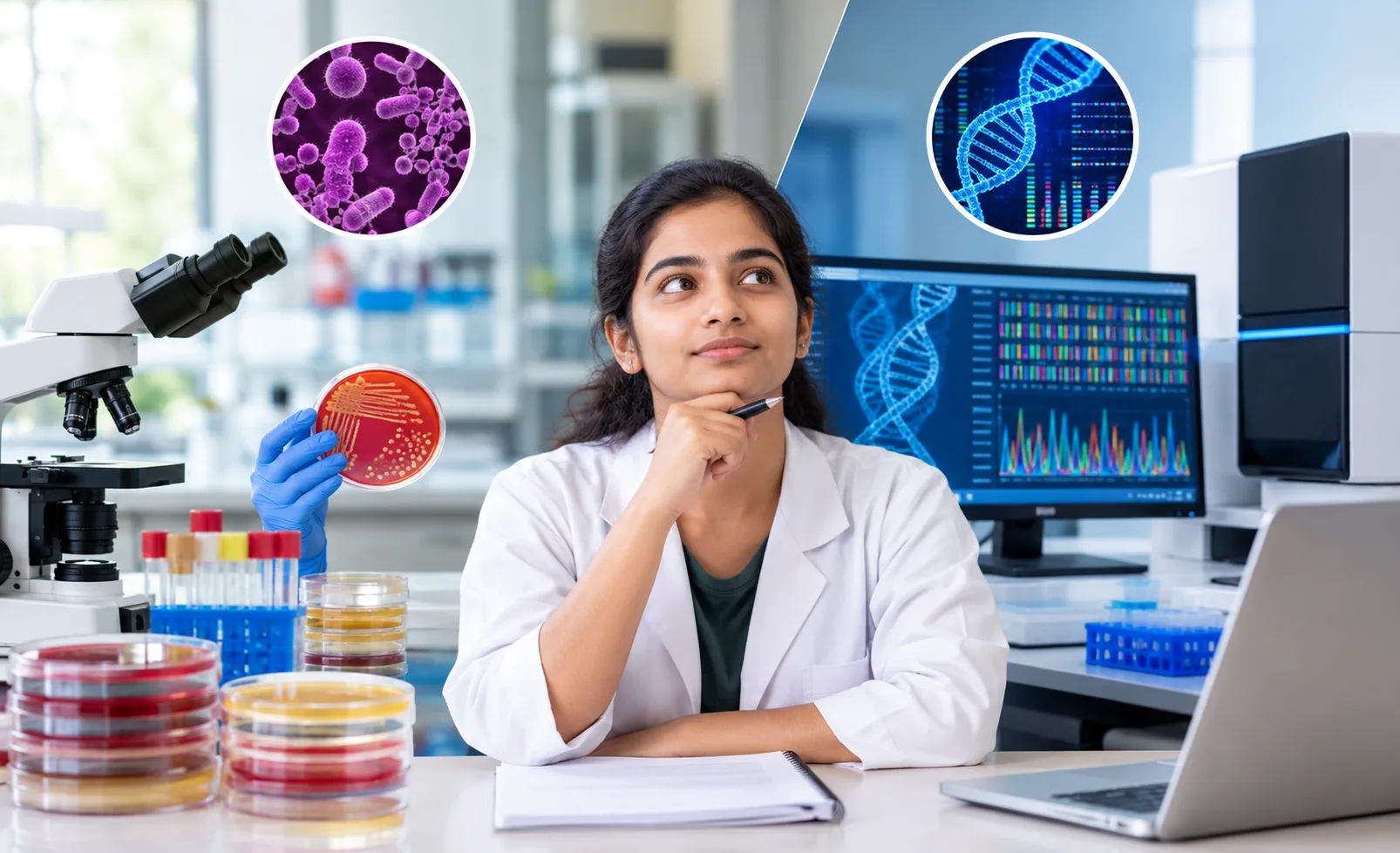
Choosing a career path in life sciences can feel overwhelming, especially when two exciting fields — clinical microbiology and genomics — seem to overlap in so many ways. Both deal with understanding living systems at a microscopic level, both open doors to diagnostics and research careers, and both are growing rapidly in Kerala's life sciences ecosystem. But they lead to very different day-to-day work and career trajectories.
If you're a student trying to decide where to specialize, here's a practical breakdown to help you choose.
What Clinical Microbiology Involves
Clinical microbiology focuses on identifying and studying disease-causing microorganisms — bacteria, viruses, fungi, and parasites — primarily in hospital and diagnostic lab settings. It's hands-on, patient-outcome focused, and forms the backbone of infectious disease diagnosis and treatment.
Clinical microbiology training programs in Kerala typically cover:
- Culturing and identifying pathogens
- Antibiotic sensitivity testing
- Diagnostic techniques used in hospital and pathology labs
- Infection control and biosafety practices
This path suits students who enjoy lab work with direct clinical relevance and want careers in hospital labs, diagnostic centers, or public health.
What Genomics and Sequencing Involve
Genomics takes a broader, more technology-driven approach — studying entire genomes to understand genetic variation, disease markers, and biological function at scale. This is where Sequencing Training Kerala programs come in, teaching students how to read and generate genetic data using next-generation sequencing (NGS) platforms.
Genomics-focused training usually includes:
- DNA/RNA extraction and library preparation
- Next-generation sequencing workflows
- Genome data interpretation and analysis
- Applications in research, agriculture, and precision medicine
Students drawn to genomics often go on to work in research institutions, biotech companies, or pharmaceutical R&D — fields where data and discovery drive the work rather than direct patient contact.
Where Kerala Fits In
Kerala has become an increasingly strong base for both fields, with institutes offering structured, practical training rather than purely theoretical courses. Veta Genomics, a Genomics Training Institute Kochi, is one such example — providing hands-on exposure to sequencing equipment and genome analysis pipelines for students looking to build real, industry-relevant skills. Alongside this, several institutes across the state offer parallel clinical microbiology programs with lab-based diagnostic training.
This means students no longer need to look outside the state for quality, industry-relevant training in either field.
How to Choose Between the Two
Here are a few questions worth asking yourself:
- Do you prefer patient-connected work or research-driven work? Clinical microbiology feels more immediate and applied; genomics is more exploratory and data-heavy.
- Are you comfortable with technology and data analysis? Genomics and sequencing increasingly rely on bioinformatics tools alongside lab skills.
- What's your long-term career goal? Hospital labs and public health favor microbiology; biotech, pharma, and research careers favor genomics.
- Do you want faster entry-level opportunities? Clinical microbiology roles are often more immediately available in hospital settings, while genomics careers may require additional specialization.
- Which hands-on training appeals to you more? If sequencing machines and genetic data excite you more than culture plates and pathogen ID, genomics may be your path.
Making the Right Choice
Neither field is "better" than the other — they simply serve different purposes within the life sciences landscape. Clinical microbiology keeps healthcare systems running by identifying infections and guiding treatment. Genomics pushes science forward by decoding the genetic basis of disease and biology itself.
The good news for Kerala students is that strong training options now exist locally for both. Institutes like Veta Genomics in Kochi are helping close the gap for students who want practical, career-ready exposure without leaving the state. Whether you choose a clinical microbiology training program or enroll in a genomics and sequencing-focused course, what matters most is aligning your training with where you see your career heading — not just which field sounds more exciting today.