
Artificial intelligence skills are becoming harder to define.
Almost anyone can enter a request into Claude and receive a polished response. The more important question is whether that person can judge the response, improve it, protect sensitive information, and use it responsibly within a real business process.
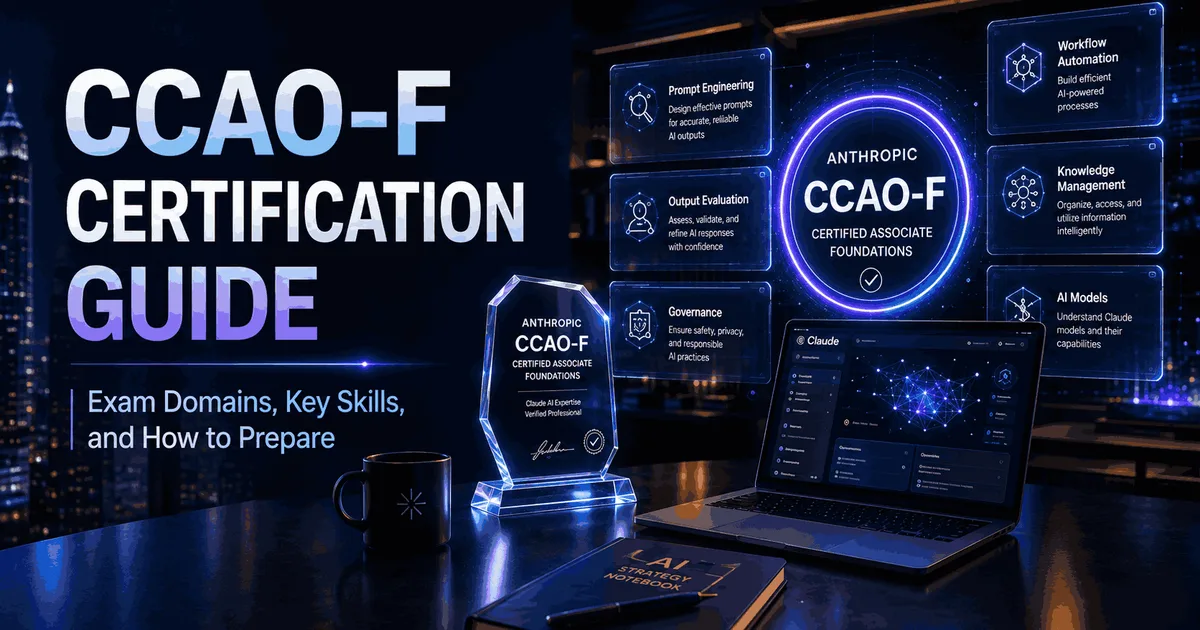
The Claude Certified Associate Foundations, or CCAO-F, is designed around that difference.
It is a foundational Anthropic certification for professionals who use Claude in everyday business work. Rather than testing software development or API engineering, CCAO-F focuses on practical judgement: how to prompt Claude, evaluate its output, choose suitable tools, improve workflows, and recognize when human oversight is essential.
That makes it relevant not only to technical teams but also to consultants, marketers, project managers, analysts, educators, operations professionals, and client-facing employees.
What Is the CCAO-F Certification?
CCAO-F stands for Claude Certified Associate – Foundations.
The credential is intended for client-facing and delivery practitioners who use Claude for business tasks, evaluate and refine its responses, select appropriate products and models, and apply responsible-AI principles.
The current certification program is delivered through Pearson and is available to organizations participating in the Claude Partner Network. Candidates begin the scheduling process through Anthropic Partner Academy.
The official exam information currently lists:
- 60 questions
- 120 minutes
- Multiple-choice and multiple-response items
- A scaled passing score of 720 out of 1,000
- A listed fee of $99
- A credential validity period of 12 months
- No coding requirement
These specifications should always be checked against the latest official exam guide before registration because certification policies may change.
Why This Certification Is Different
Many entry-level technology certifications focus heavily on terminology.
CCAO-F takes a more practical direction. Knowing what Claude Projects or Artifacts are may help, but candidates must also understand when to use them and what risks remain after they are selected.
For example, a candidate may need to decide whether a company document should be uploaded to a Project, whether an AI-generated claim needs independent verification, or whether a proposed workflow still requires human approval.
This means the exam is not only about using AI efficiently.
It is also about knowing when not to trust, automate, upload, or publish something.
Who Should Consider CCAO-F?
The certification may suit professionals who regularly use Claude for:
- Research and summarization
- Business writing
- Project planning
- Workflow improvement
- Knowledge organization
- Content development
- Stakeholder communication
- Client-delivery activities
- Operational analysis
- AI adoption initiatives
A marketing professional might use Claude to organize customer research and create a campaign brief.
A project manager might use it to summarize meeting notes, identify open risks, and prepare a status update.
A consultant might use Claude to compare source documents and produce a first draft for client review.
In each case, the value does not come from generating text alone. It comes from producing something useful while checking its accuracy, relevance, security, and suitability.
When Another Certification May Be Better
CCAO-F is not intended to prove advanced development or architecture skills.
Professionals whose main responsibilities include building API integrations, creating production agents, developing Model Context Protocol servers, or designing enterprise Claude systems should consider the Claude Developer or Architect tracks.
Pearson currently lists four certifications:
- Claude Certified Associate Foundations
- Claude Certified Architect Foundations
- Claude Certified Architect Professional
- Claude Certified Developer Foundations
The Associate track is primarily concerned with professional Claude use. The Developer credential, by comparison, is intended for people building and shipping applications and agents with the Claude API, Claude Code, custom tools, and MCP servers.
Candidates should therefore choose according to their actual role rather than selecting the most technical-sounding certification.
The Seven Skills CCAO-F Examines
The official blueprint divides the exam into seven domains.
Prompting and Task Execution
This domain represents 14% of the exam.
It assesses whether candidates can turn an unclear request into an effective Claude task. A good prompt should normally define the objective, audience, context, constraints, and expected output.
Consider the instruction:
Improve this report.
Claude has not been told what improvement means.
A stronger version would be:
Rewrite this report for a non-technical operations director. Keep it under 600 words, use only the supplied evidence, and organize it into findings, risks, and recommended actions.
The second instruction provides a clearer standard against which the result can be judged.
Candidates should also know when a complicated assignment should be divided into several smaller steps.
Output Evaluation and Validation
At 21%, this is the largest domain.
That weighting sends an important message: generating an answer is not the same as validating it.
Claude can produce clear and confident text containing inaccurate dates, unsupported claims, incorrect calculations, missing context, or invented quotations.
Candidates should know how to check:
- Whether claims match the source material
- Whether important details were omitted
- Whether calculations are correct
- Whether conclusions are supported
- Whether uncertainty is disclosed
- Whether expert review is needed
A well-formatted response may still be wrong. Professional users must judge evidence rather than presentation quality.
Product and Model Selection
This domain accounts for 12%.
Candidates need to select the right Claude product, feature, or model based on the task rather than automatically choosing the most powerful option.
The decision may depend on:
- Complexity
- Speed
- Cost
- Required quality
- Context
- Reusability
- Risk
A basic rewriting task may not require the same model as a detailed analysis involving several documents and competing requirements.
Candidates should also understand the purpose of standard conversations, Projects, Artifacts, and related Claude capabilities.
Workflow Integration and Solution Design
This section represents 16% of the exam.
It focuses on introducing Claude into real business processes.
The correct starting point is not, “How can we use AI?” It is, “What problem are we trying to solve?”
A sensible workflow-design process might include:
- Documenting the current process
- Identifying repetitive or slow activities
- Defining where Claude may help
- Selecting approved information sources
- Adding validation and approval stages
- Measuring quality, speed, and error rates
Claude does not always need to replace a person.
It may be more valuable as a drafting, research, classification, or analysis assistant whose output remains subject to professional review.
Configuration and Knowledge Management
This domain has a 12% weighting.
It covers Projects, reusable instructions, uploaded files, connected sources, and knowledge maintenance.
A well-configured Project may contain approved references, writing rules, process documentation, or product information. These resources can help Claude produce more consistent responses.
However, uploaded information is not automatically safe or trustworthy.
Candidates should ask:
- Is the document current?
- Is it approved for this use?
- Does it contain sensitive information?
- Does it conflict with another source?
- Who is responsible for updating it?
Knowledge management is an ongoing responsibility rather than a one-time upload.
Governance, Risk and Responsible Use
This domain represents 15%.
Candidates must recognize privacy, legal, ethical, and organizational risks.
Important issues include:
- Personal data
- Confidential company information
- Bias
- Transparency
- Regulatory obligations
- Organizational AI policies
- High-impact decisions
- Human accountability
Extra care is required when Claude’s output may influence employment, healthcare, finance, legal rights, education, safety, or compliance.
The fact that Claude can perform a task does not necessarily mean that it should perform it without safeguards.
Troubleshooting and Optimization
The final domain accounts for 10%.
Weak results may come from poor instructions, missing context, unsuitable source material, contradictory Project guidance, excessive task complexity, or an inappropriate model choice.
A disciplined troubleshooting method is to:
- Define what is wrong with the result.
- Compare it with the original requirement.
- Identify the most likely cause.
- Change one important variable.
- Generate a new output.
- Compare the results.
- Retest before repeating the workflow.
Changing the prompt, model, documents, and output format simultaneously makes it difficult to identify what actually fixed the problem.
Is CCAO-F Difficult?
The exam is not difficult because it requires programming.
Its challenge comes from judgement.
Several options in a scenario may appear reasonable. Candidates must identify the response that is safest, most accurate, most efficient, and most appropriate for the business requirement.
Commonly challenging areas may include:
- Distinguishing generated content from verified content
- Recognizing hidden governance risks
- Choosing the most suitable model
- Deciding when human review is necessary
- Diagnosing the cause of weak output
- Selecting every required answer in multiple-response questions
Candidates who rely only on memorized definitions may struggle. Hands-on Claude experience is likely to be much more useful.
A Practical Preparation Approach
Preparation time depends on existing experience.
A daily Claude user may need two to three weeks of focused revision. An occasional user may need four to six weeks, while a beginner may benefit from six to eight weeks of practical use and study.
A balanced four-week plan could look like this:
Week One: Prompting and Claude Products
Practice turning vague requests into structured tasks.
Review model selection, Projects, Artifacts, task decomposition, context, constraints, and output formats.
Week Two: Validation
Compare Claude-generated answers with trusted source material.
Look for unsupported claims, wrong details, omissions, calculations, and contradictions. This week deserves extra attention because validation is the largest exam domain.
Week Three: Workflows and Governance
Design one realistic Claude-assisted workflow.
Identify the business goal, required data, risks, human-review points, and success measures. Build a sample Project using only approved, non-sensitive material.
Week Four: Troubleshooting and Practice
Complete mixed-domain questions and at least one timed mock exam.
Review every incorrect answer. Do not look only at the score—identify whether the mistake came from missing knowledge, weak judgement, or careless reading.
Where CertsGate Fits Into Preparation
Official Anthropic and Pearson materials should remain the primary sources for current exam objectives, scheduling rules, and policies.
Independent study platforms can still help candidates turn a broad blueprint into an organized preparation routine.
CertsGate.com offers certification-focused study guidance and practice resources that candidates can use to review CCAO-F topics, identify weaker domains, and become familiar with exam-style decision making.
A sensible preparation mix is:
- Official exam documentation for accurate objectives
- Hands-on Claude practice for real understanding
- Structured study resources for organization
- Practice questions for identifying knowledge gaps
No third-party resource should replace the official blueprint, and candidates should avoid leaked questions or so-called exam dumps.
What to Remember on Exam Day
Candidates taking the exam online should complete Pearson’s system test in advance and confirm that their device, internet connection, camera, microphone, identification, and testing space meet OnVUE requirements.
During the exam:
- Pay attention to terms such as “best,” “first,” and “most appropriate.”
- Confirm how many choices a multiple-response question requires.
- Eliminate answers that ignore privacy or verification.
- Prefer human review for sensitive and high-impact decisions.
- Avoid selecting the strongest model without a clear reason.
- Flag difficult questions rather than spending too long on them.
Pearson currently requires a 14-day wait after the first failed attempt, 30 days after the second, and 90 days after the third. Candidates may attempt the same exam no more than four times within a rolling 12-month period.
Is the Certification Worth Pursuing?
CCAO-F may be valuable for professionals who want formal evidence that they understand responsible, practical Claude use.
The credential can demonstrate knowledge of prompting, output evaluation, model selection, workflow integration, governance, knowledge management, and troubleshooting. Successful candidates may also receive a shareable Credly badge.
However, the certification does not replace real experience.
It does not prove advanced development skills, guarantee employment, or ensure a salary increase. Its value becomes stronger when candidates can show how they have used Claude to improve an actual process, produce reliable work, or support better decisions.
The Real Lesson Behind CCAO-F
The most important idea in CCAO-F is not that professionals should use Claude more often.
It is that they should use it more deliberately.
Strong AI users do not simply generate answers. They define the task, supply appropriate context, examine the result, verify important claims, protect sensitive information, and keep humans accountable for consequential decisions.
That is what the certification is ultimately trying to measure.
And regardless of whether someone takes the exam, those are skills worth developing.