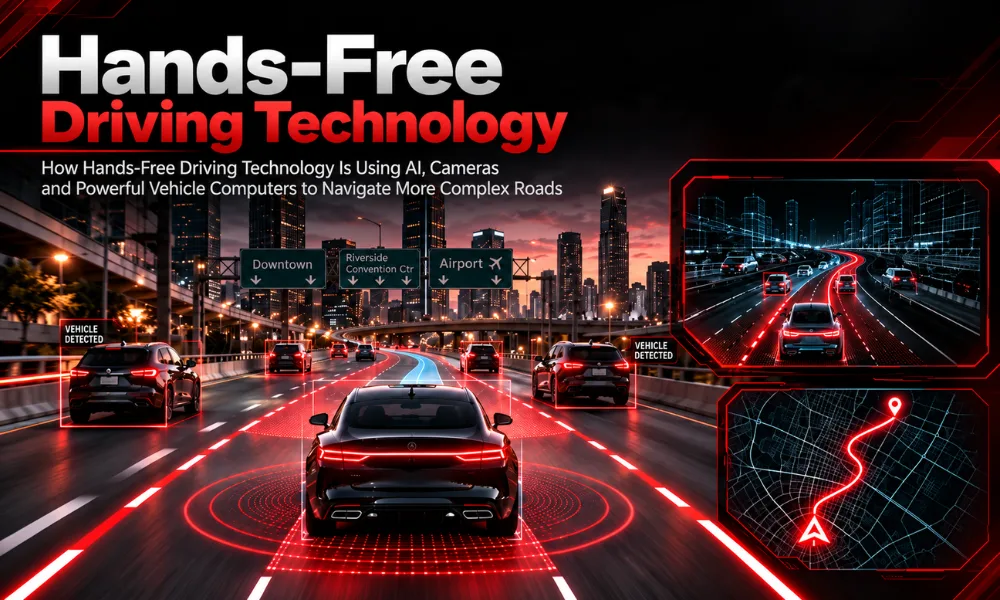
For years, hands-free driving has mostly been associated with relatively predictable motorway conditions.
Vehicles can maintain speed, follow lane markings, and keep a safe distance from surrounding traffic, but drivers generally need to take control when conditions get more complicated.
City driving presents a completely different challenge.
Traffic lights, pedestrians, cyclists, parked vehicles, construction zones and vehicles entering from side roads can all appear within seconds. Human drivers understand many of these situations almost instinctively, but teaching a computer to interpret them reliably is considerably more difficult.
That is where artificial intelligence is beginning to change the automotive industry.
On October 15, 2026, Volvo Cars and NVIDIA announced an expanded partnership to develop a new generation of automated-driving technology that can navigate more complicated environments from door to door.
What Is Hands-Free Driving Technology?
Hands-free driving technology lets a vehicle control functions such as steering, acceleration, and braking under specific conditions without requiring the driver to keep holding the steering wheel.
However, it is important to distinguish hands-free driving from fully autonomous driving.
Many current systems still require the driver to stay alert and prepared to intervene.
The next generation is intended to become significantly more capable.
Volvo says the technology it's developing with NVIDIA is designed to operate on highways, busy urban roads, and in parking situations.
AI Must Understand More Than Road Markings
Traditional driver-aid systems rely heavily on pre-established rules.
A camera might detect lane markings while radar measures the distance to the vehicle ahead.
More advanced AI-based systems need to interpret the entire driving environment.
For example, imagine approaching an intersection where a pedestrian is standing near a crossing while another vehicle begins turning across the road.
The system must identify each object, predict how it might move, and decide how the vehicle should respond.
This requires enormous computing power and continuous processing of information from multiple sensors.
Why Volvo Is Expanding Its NVIDIA Partnership
Volvo and NVIDIA have been working together since 2017, but their latest agreement significantly expands that relationship.
Future Volvo vehicles will use NVIDIA's Hyperion sensor and computing architecture together with the company's Halos safety platform and Alpamayo automated-driving software.
The objective is to create vehicles that can understand increasingly complicated driving environments.
NVIDIA describes its Alpamayo technology as reasoning AI designed specifically for self-driving vehicles and robotaxis.
Instead of only recognizing objects, the system is intended to reason about unusual or complicated road situations and determine an appropriate response.
The Car Is Becoming an AI Computer
Modern automated vehicles process information from several sources simultaneously.
These may include:
- Cameras monitoring lanes, vehicles, and pedestrians
- Radar measuring distance and relative speed.
- Driver-monitoring systems
- Navigation and map information
- Vehicle speed and steering data
- Surrounding traffic information
A central computer combines these inputs and makes decisions in fractions of a second.
This differs from earlier vehicles, where individual electronic control units performed relatively isolated functions.
Can AI Handle Busy Urban Traffic?
Urban driving is one of the most difficult environments for automated vehicles.
Roads may have unclear markings.
Pedestrians can suddenly enter traffic.
Cyclists may travel between vehicles, while buses and taxis frequently stop.
Drivers also make informal decisions that are difficult to represent through traditional programming.
Artificial intelligence offers another approach.
Instead of engineers manually programming a response for every possible situation, AI models can learn from large amounts of driving data and simulated scenarios.
NVIDIA says its Alpamayo platform is intended to support address-to-address driving across highways and metropolitan environments, including lane changes and intersections.
Driver Monitoring Will Remain Important
Hands-free does not necessarily mean attention-free.
Current advanced driver aid systems usually monitor the person behind the wheel to ensure they stay prepared to intervene.
Cameras can track head position, eye movement, and driver behavior.
If the driver becomes distracted or unresponsive, the vehicle can issue progressively urgent warnings.
Future systems could go further.
NVIDIA describes technology that can recognize an unresponsive driver and, when conditions permit, move the vehicle toward a safer place to stop.
Automation Will Likely Arrive Gradually
Volvo says its expanded collaboration is intended to enable a gradual introduction of more advanced automated-driving capabilities.
That means drivers should not expect cars to become completely autonomous everywhere overnight.
Capabilities will likely appear progressively and may initially work only under particular road, weather, or regulatory conditions.
Local laws will also strongly influence when different levels of automated driving become available.
Advanced Vehicle AI Still Depends on Reliable Electrical Power
AI may control increasingly sophisticated vehicle functions, but those computers, cameras, communication systems, and sensors still require stable electrical power.
Modern vehicles commonly rely on a low-voltage battery to power control modules, security systems, and vehicle electronics, even when they also carry a much larger EV traction battery.
A weak battery can therefore trigger unusual electronic warnings or prevent certain systems from working properly.
For motorists who experience an unexpected no-start situation or abnormal electrical behavior, 24/7 car battery assistance in the abu dhabi can help determine whether a low-voltage battery problem is responsible before more complicated electronic systems are investigated.
This connection between modern software and basic electrical reliability is becoming increasingly important as cars become more computerized.
Could Hands-Free Driving Improve Road Safety?
Safety is one of the strongest arguments for cutting-edge driver-assistance technology. Human drivers can get distracted, tired, or make mistakes. Computers don't experience fatigue the same way. They can monitor multiple directions continuously and react quickly when sensors detect a potential hazard. However, automated systems also introduce different risks.
Sensors can struggle in difficult weather, software may misinterpret unusual situations, and drivers may become too confident in the technology.
For this reason, validation and clear communication on system limits remain essential.
AI Must Learn Rare Situations Too
Driving normally is relatively easy compared with dealing with unusual circumstances.
A fallen object on a motorway, temporary construction signs, or a traffic officer manually directing vehicles may create situations that automated systems encounter infrequently.
AI developers call these edge cases.
Training systems to identify and respond safely to rare events is one of the biggest challenges in automated-driving development.
Simulation lets companies expose AI systems to millions of unusual situations without risking real vehicles or people during early testing.
What Happens to the Driver's Role?
The relationship between people and cars could change significantly.
Initially, drivers will remain supervisors.
They may let the vehicle handle regular driving while staying ready to take control.
As technology and regulation develop, higher levels of automation could eventually let drivers focus less on continuously controlling the vehicle under approved conditions.
Volvo and NVIDIA say their long-term work includes progressively advancing toward eyes-off and potentially mind-off driving capabilities.
That transition will require extremely high levels of reliability and social trust.
Conclusion
Hands-free driving technology is moving rapidly beyond basic highway assistance.
The latest Volvo and NVIDIA partnership shows how artificial intelligence, high-tech sensors, and powerful onboard computers are being combined to tackle increasingly challenging driving settings.
Future systems may navigate highways, urban streets, intersections, and parking with far less continuous driver input.
However, this evolution will happen gradually.
Technical reliability, regulation, cybersecurity, and driver trust must develop alongside the technology.
Cars may eventually handle large parts of a journey independently, but the biggest challenge isn't simply teaching an AI system to drive.
It is proving that the system can make safe decisions consistently when the road does something unexpected.