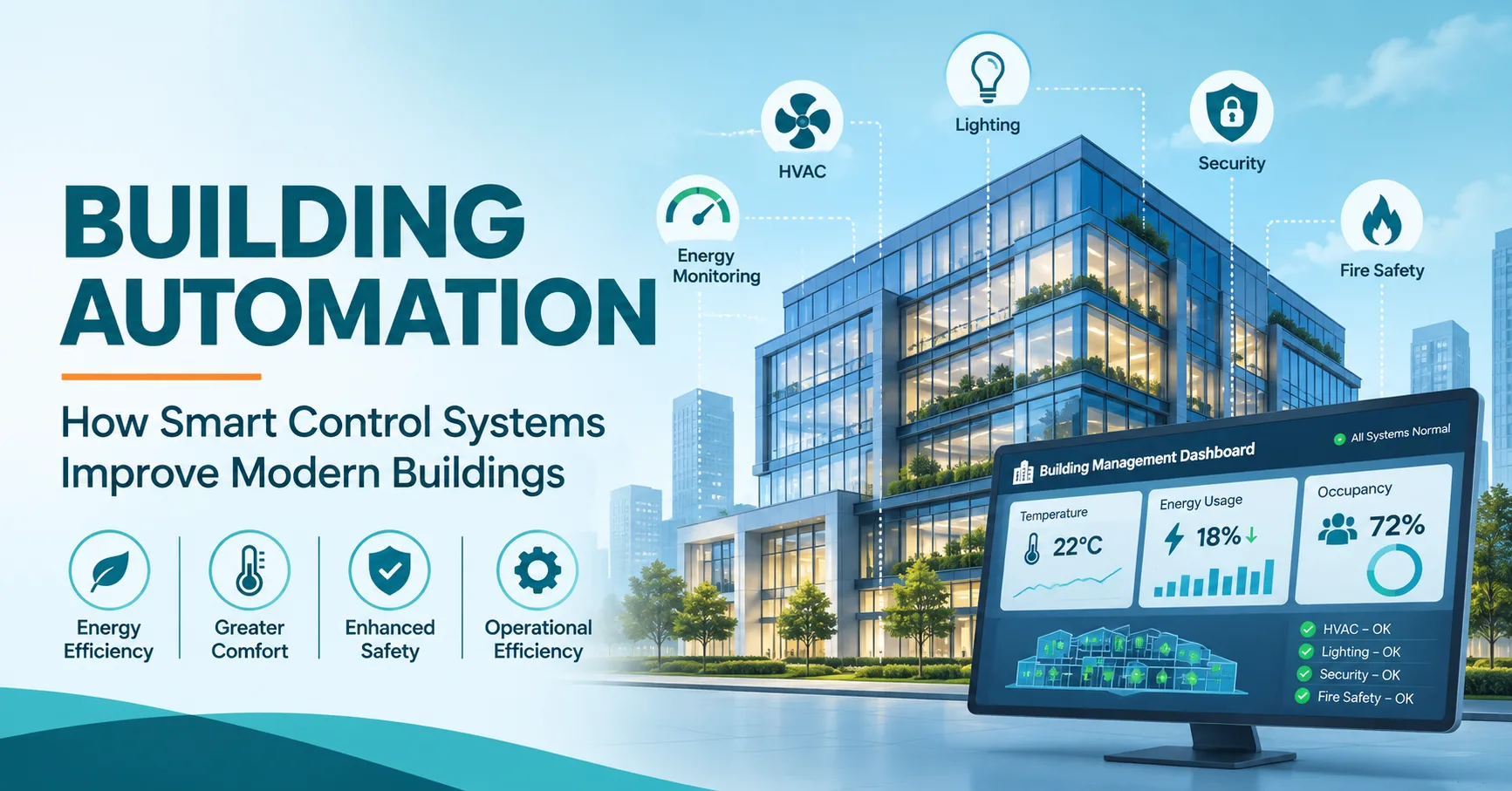
Building Automation Explained: How Smart Control Systems Improve Modern Buildings
A modern building contains many systems that need to operate together. Air conditioning must maintain suitable indoor temperatures, lighting should respond to occupancy, and electrical and safety equipment must remain under proper supervision. When these systems are managed independently, facility teams may spend considerable time checking equipment and adjusting operating conditions.
Building automation addresses this challenge by connecting different building services through a coordinated control system. It allows facility operators to monitor equipment, apply operating schedules, and respond to changing conditions from a centralized platform.
What Is Building Automation?
Building automation refers to the automatic monitoring and control of a building's mechanical and electrical systems. These commonly include heating, ventilation and air conditioning (HVAC), lighting, energy monitoring, access control, and selected fire safety interfaces.
A Building Management System (BMS) provides the software environment for supervising these connected systems. Field-level controllers collect information from sensors, execute programmed instructions, and communicate with connected equipment.
The main purpose is to make building operations more coordinated, measurable, and easier to manage.
Five Components That Make Building Automation Work
A building automation system depends on five essential components. Each performs a different function within the control process.
1. Sensors
Sensors collect information from the building environment. Temperature, humidity, occupancy, carbon dioxide, and pressure sensors provide readings that help the control system understand current conditions.
For example, an occupancy sensor can identify whether a meeting room is being used and provide information for lighting and HVAC control.
2. Controllers
Controllers process incoming information and determine the appropriate response. Direct Digital Control (DDC) controllers are commonly used to execute programmed logic for HVAC equipment and other building services.
They compare measured values with configured setpoints and generate the necessary output commands.
3. Actuators
Actuators convert controller commands into physical actions. They can operate control valves, dampers, motors, and other mechanical devices.
For instance, an actuator can adjust a chilled-water valve based on the temperature requirements of an area.
4. Communication Networks
Communication networks allow different devices and software platforms to exchange information. BACnet, Modbus, and MQTT are examples of protocols used in building automation and connected systems.
Open communication standards are particularly useful when equipment from different manufacturers needs to work together.
5. User Interface
The user interface provides facility operators with access to system information. Through graphical dashboards, operators can view equipment status, monitor alarms, change permitted settings, and review operating trends.
How Does a Building Automation System Operate?
The operation follows a continuous cycle of measurement, decision-making, and control.
Consider an office where the indoor temperature rises above the configured setpoint. A temperature sensor detects the change and sends the reading to the controller. The controller processes the information and adjusts the HVAC equipment through the relevant actuators.
The system continues monitoring the temperature and makes further adjustments according to its programmed control sequence.
The same principle can be applied to lighting schedules, ventilation control, equipment monitoring, and other building services.
Why Communication Protocols Matter
One important challenge in building automation is connecting equipment that may come from different manufacturers.
BACnet is widely used for communication between building automation devices. Modbus is commonly used to exchange information with meters, controllers, and industrial equipment. MQTT supports lightweight message exchange and is useful in connected and IoT-based applications.
Selecting suitable communication methods helps system integrators connect devices and exchange operating information without depending entirely on a single manufacturer's ecosystem.
Building Automation in Different Industries
The requirements of an office building are different from those of a hospital or pharmaceutical facility. However, all these environments benefit from better monitoring and coordination.
- Commercial buildings: HVAC scheduling, lighting control, and centralized equipment monitoring.
- Hospitals: Monitoring of environmental conditions and coordination of building services.
- Pharmaceutical facilities: Environmental monitoring and integration with relevant facility management requirements.
- IT parks: Centralized management of HVAC, electrical systems, and common infrastructure.
- Data centres: Coordination of cooling, power monitoring, and infrastructure management.
In data centres, for example, cooling performance is closely connected to server loads and equipment operating conditions. Integrating building automation information with infrastructure monitoring platforms can provide a clearer picture of facility performance.
The Practical Benefits of Building Automation
The value of automation is not limited to controlling equipment remotely. Its benefits extend to everyday facility operations.
Better energy management: Operating schedules and automatic control sequences can reduce unnecessary equipment operation.
Improved occupant comfort: Sensors and programmed controls help maintain suitable indoor conditions.
Centralized supervision: Facility teams can monitor multiple connected systems through a common interface.
Faster fault identification: Alarm notifications and operating trends help technicians identify abnormal equipment behaviour.
Simplified maintenance: Historical operating information can support troubleshooting and maintenance planning.
These benefits depend on proper system design, commissioning, configuration, and ongoing maintenance.
Choosing the Right Building Automation Approach
A successful implementation starts with understanding the building's requirements. Before selecting controllers or software, project teams should identify the equipment to be integrated, the number of monitoring points, communication requirements, control sequences, and future expansion needs.
An effective architecture should also consider interoperability, cybersecurity, reliability, and the requirements of the facility.
For Indian projects, standards such as the Energy Conservation Building Code (ECBC) are relevant when planning energy-efficient building systems. International references such as ASHRAE 135 (BACnet) and ISO 16484 also provide important guidance for building automation and control systems.
Conclusion
Building automation brings together sensors, controllers, actuators, communication networks, and management software to coordinate the operation of modern buildings. Its importance goes beyond convenience: it provides facility teams with better visibility into equipment performance, energy usage, and day-to-day building operations.
As commercial facilities, healthcare institutions, IT parks, and data centres become increasingly connected, integrated automation systems will continue to play an important role in building management.
To explore the components, protocols, standards, and applications in greater detail, read the complete guide published by EnSmart:
https://ensmart.ai/blog/what-is-building-automation-a-complete-guide