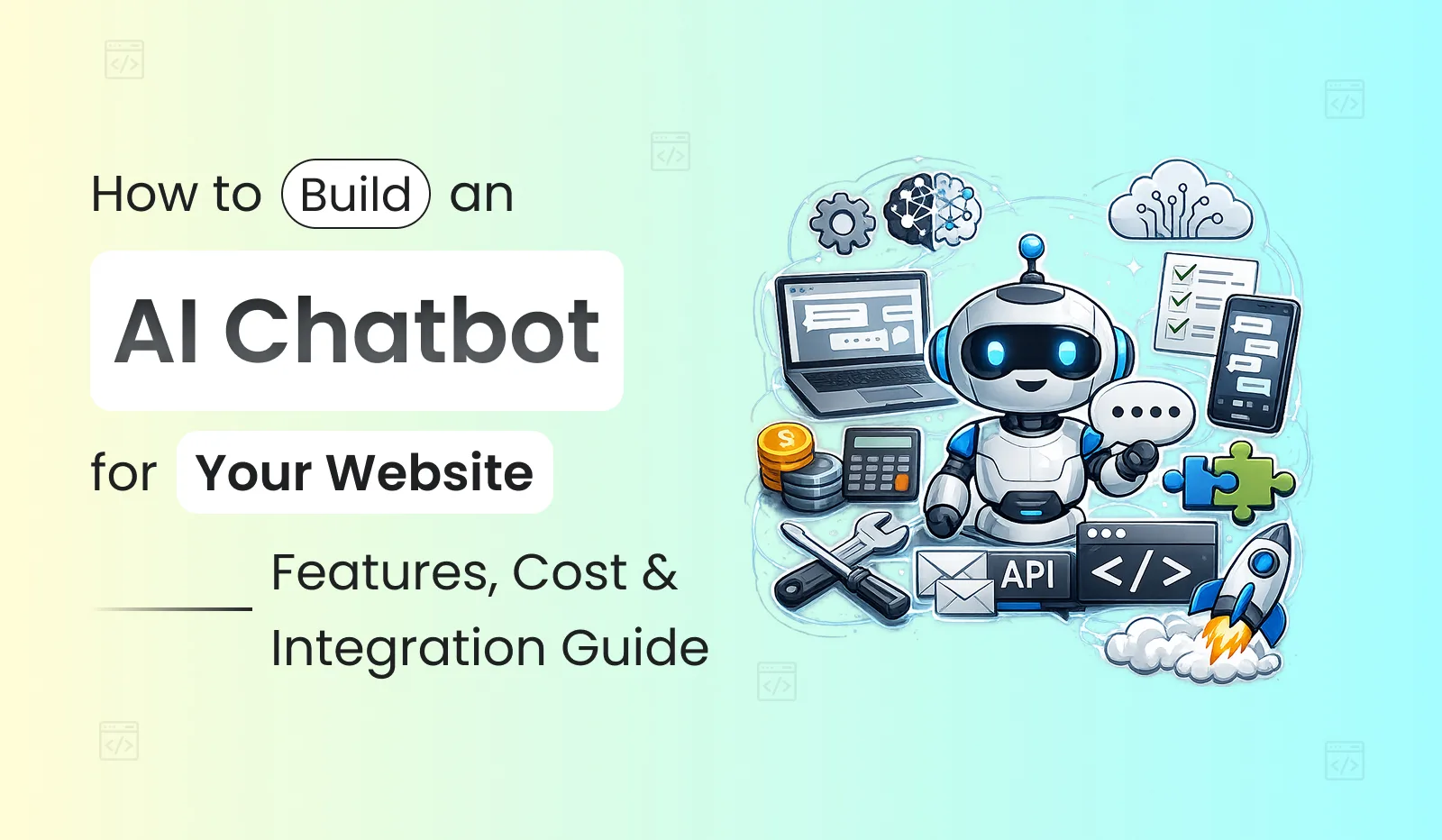
Most “AI chatbot” guides describe four types of chatbots and then leave you to figure out which one you actually need, what architecture it runs on, and what it costs to build and operate at real traffic volumes. This guide answers all three — including the Chatlivo Phase 2 AI integration as the worked production example.
Before choosing a model, a framework, or a vendor: define the one specific problem your chatbot solves. MIT’s Project NANDA found that 95% of organisations saw no measurable financial return from their AI pilots. The gap between the 5% that captured real value and the 95% that didn’t was not the technology — it was whether they defined success and scoped the use case tightly before building. “Add an AI chatbot” is not a use case. “Reduce first-response time for support tickets on our pricing and features pages from 4 hours to under 1 minute” is a use case — and it tells you exactly which chatbot type, which architecture, which integrations, and what success looks like. An AI chatbot that can only answer questions is a search bar with extra steps. The value appears when it connects to your real business systems. See how Chatlivo adds AI on top of live chat →
By 2026, AI chatbots have split into four genuinely different products with different architectures, different cost profiles, and different production outcomes. The rule-based chatbot that follows a decision tree, the ML-based bot that classifies intent, the LLM-powered conversational bot, and the agentic AI chatbot that can take real actions — these are not points on a quality spectrum. They’re different tools for different problems, and choosing the wrong one wastes money that compounds with every month of maintenance.
Primocys is building the Chatlivo Phase 2 AI chatbot right now — a RAG-based AI on top of an existing live chat SaaS with 100+ active users. When this guide describes RAG pipeline architecture, LangChain implementation, or the Python microservice pattern for AI workloads, it’s describing decisions we’re making in active development, not theory from competitor reading. That distinction matters.
$15.5B
Chatbot Market 2028
95%
MIT: Why AI Pilots Fail
RAG
Top Chatbot Stack (2026)
$8K
AI Chatbot Starts $8K
128K+
2026 LLM Context Limits
4 AI Chatbot Types — Which One Fits Your Budget
Every “AI chatbot” article groups all chatbots together as if they’re variations of the same product. They’re not. The gap between a rule-based chatbot and an agentic chatbot is roughly the gap between a calculator and an autonomous software agent. The architecture, cost, timeline, and appropriate use case are genuinely different for each.
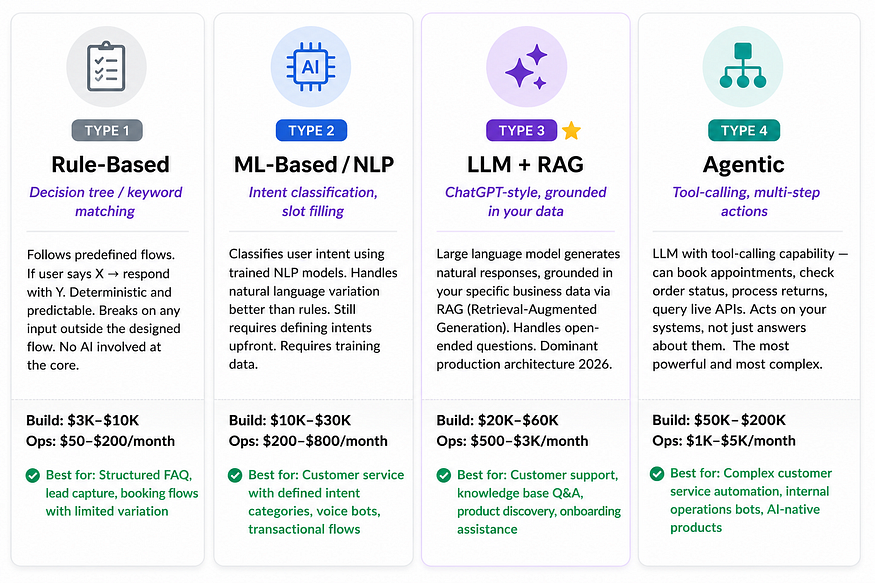
The most common and most expensive chatbot mistake: choosing Type 4 when you need Type 3: Agentic chatbots that can take real actions (booking, ordering, refunding) are genuinely powerful and genuinely expensive — both to build and to operate safely. Every action the bot can take is an action that can go wrong and needs guardrails. Founders who jump directly to agentic architecture before validating that users actually want to interact with a chatbot for those workflows consistently overspend by 3–5× on their first chatbot. Start with a LLM + RAG chatbot that answers questions accurately. Add agentic tool-calling in Phase 2, once you know which actions users are repeatedly asking the chatbot to take.
RAG vs LLM Chatbot Architecture — What It Does
RAG — Retrieval-Augmented Generation — is described in every 2026 AI chatbot guide. Most describe what the acronym stands for and then move on. Here’s what it actually does and why it matters for a chatbot you’re building for your specific business.
The Problem RAG Solves: Hallucination
A pure LLM chatbot powered by GPT-4o will answer questions about your business confidently. The problem: it’s using its general training data, which knows nothing specific about your pricing, your policies, your product features, or your return process. It will generate plausible-sounding answers that are completely wrong for your specific business. A customer asks “what’s your cancellation policy?” and the LLM invents a reasonable-sounding policy — that’s not yours. This is called hallucination, and it’s the reason most raw LLM chatbots in customer-facing roles cause more support tickets than they deflect.
How RAG Grounds Your Chatbot in Real Data
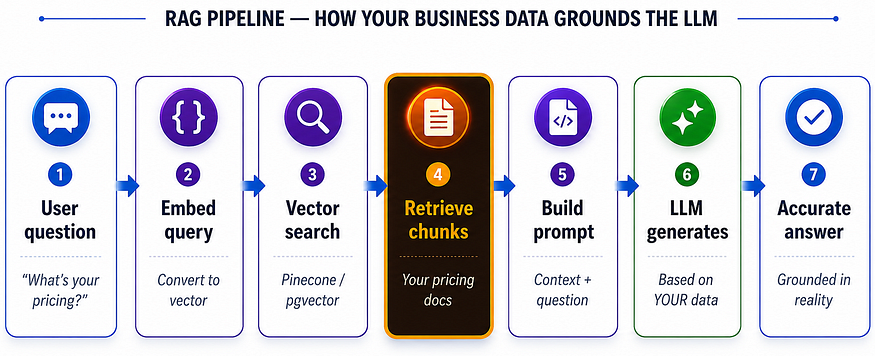
The critical step: the retrieval happens BEFORE the LLM is called. The LLM never generates from scratch — it generates from the context retrieved from your actual documentation. Hallucination rate for well-implemented RAG drops to near zero for questions your knowledge base covers. Questions not covered by the knowledge base trigger a graceful fallback to human agent handoff, not a confidently wrong answer.
Chatlivo AI Chatbot — Our Own Implementation
Chatlivo is Primocys’s live chat SaaS — 100+ users, live at chatlivo.com, and a real example of adding an AI chatbot to a SaaS website rather than a static one. Phase 1 shipped: live chat widget, WhatsApp integration, chatbot flow templates, WordPress plugin. Phase 2 is what we’re building right now: an LLM-powered AI chatbot and an AI reply assist feature for human agents.
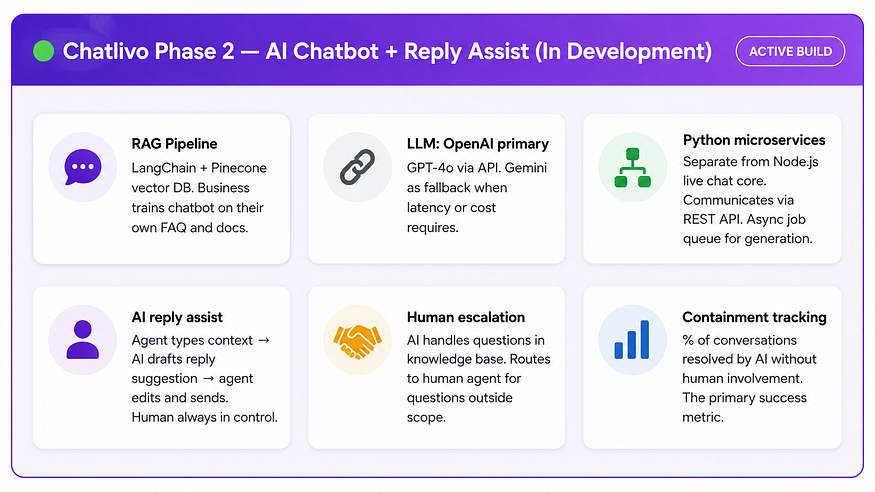
The architectural decision we made: AI chatbot as a Python microservice communicating with the Node.js live chat backend via REST — not rewriting the chat infrastructure in Python. This keeps the real-time WebSocket performance of the existing system and adds AI as a layer that can be upgraded independently. The same pattern works for any SaaS product adding AI features: don’t rebuild the core, add AI as a microservice. Try Chatlivo free (Phase 2 AI coming soon) →
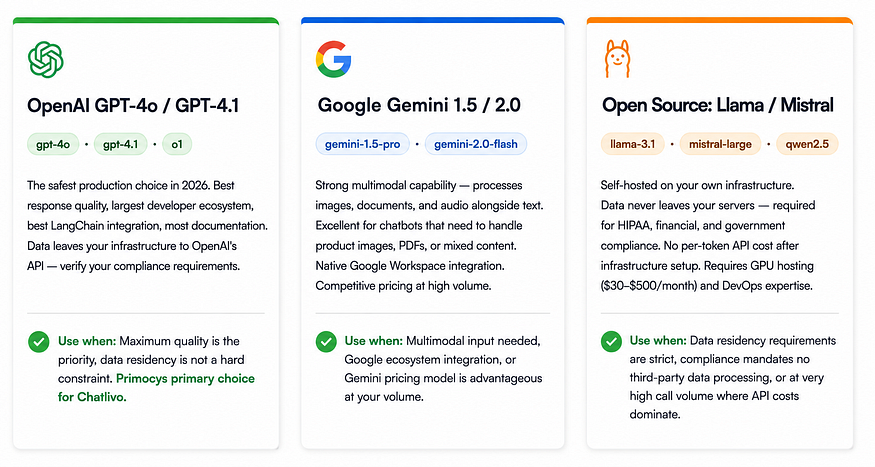
OpenAI vs Gemini Chatbot — Choosing Your LLM 2026
Not Sure Which AI Chatbot Fits Your Website?
We’re building the Chatlivo RAG chatbot right now with this exact stack. Tell us your use case — get an architecture recommendation and a fixed price in 24 hours.
LangChain Chatbot Development — 8 Steps to Launch
01. Define the single use case — not five, one
Write down the specific, measurable problem: “Reduce first-response time for pricing questions from 4 hours to under 1 minute.” Not “add a chatbot to our website.” The use case determines the chatbot type, the knowledge base scope, the integrations required, and what success looks like. MIT’s research is clear: 95% of AI pilots fail because they don’t do this step.
— Chatlivo Phase 2 use case 1: Handle FAQ questions from new Chatlivo users without requiring a human agent (containment target: 60%).
02. Prepare and structure your knowledge base
Gather every document, FAQ, product description, policy, and help article that the chatbot needs to answer accurately. Clean them — remove outdated information, consolidate duplicates, write clear and complete answers. Chunk them into logical sections (not too long, not too short — 200–500 tokens per chunk is the typical production sweet spot). The quality of your RAG output is directly proportional to the quality of your knowledge base content.
— Bad RAG knowledge base: dump of every internal document. Good RAG knowledge base: curated, customer-facing answers to 100 real questions real customers have asked.
03. Set up the vector database and embedding pipeline
Chunk your knowledge base documents, convert each chunk to a vector embedding using your LLM’s embedding API (OpenAI text-embedding-3-small is the standard), and store the embeddings in a vector database. Pinecone is the simplest managed option. pgvector as a PostgreSQL extension is the best choice if you’re already on Postgres and want to minimise infrastructure components. FAISS is a good open-source self-hosted option.
— Chatlivo uses pgvector as a PostgreSQL extension — no separate vector database service to manage, already GDPR-compliant within our existing PostgreSQL instance.
04. Build the retrieval + generation pipeline with LangChain
LangChain is the standard framework for building RAG pipelines in Python in 2026. It handles the retrieval chain (query embedding → vector search → chunk retrieval), prompt construction (system prompt + retrieved context + user question), LLM call, and response parsing. Using LangChain means your RAG pipeline is readable, maintainable, and upgradable — swapping GPT-4o for Gemini or Llama 3 is a one-line change in your LangChain configuration.
— Primocys uses LangChain for all AI microservices — Chatlivo Phase 2 and EmoTales story generation. The same Python pattern works across both B2B SaaS and consumer AI apps.
05. Design the human escalation path — this is not optional
Every AI chatbot needs a clear, fast path to a human agent. The chatbot should recognise when it can’t answer accurately (question is outside the knowledge base scope), when the user is frustrated (repeated rephrasing of the same question), and when the user explicitly requests human help. The handoff must be instant — pre-fill the agent with the conversation history so the user doesn’t have to repeat themselves. Chatbots that don’t have a clean escalation path generate more support tickets than they deflect.
— Chatlivo: AI handles chatbot conversations until confidence falls below threshold, then instant handoff to the live agent dashboard with full conversation context visible to the agent.
06. Build as a microservice — don’t rewrite your existing backend
If you already have a Node.js API, a PHP backend, or a Django app, don’t rewrite it in Python to add AI. Build the AI chatbot as a separate Python microservice that communicates with your existing backend via a REST API. The Python microservice handles RAG, LLM calls, and conversation context. Your existing backend handles authentication, conversation storage, and the user-facing chat widget. This is the pattern Primocys uses for Chatlivo and EmoTales — and the upgrade path from no AI to AI without a platform rebuild.
— The Node.js live chat core in Chatlivo communicates with the Python AI service via REST. Each can be deployed, scaled, and updated independently.
07. Implement conversation memory management
LLMs are stateless by default — each API call has no memory of previous calls. For a multi-turn conversation to make sense, you need to pass conversation history as context with each new LLM call. The challenge: LLM context windows are large (128K+ tokens in 2026) but not unlimited, and each token costs money. Use a sliding window approach — pass the last 6–10 turns of conversation — for most chatbot use cases. For longer conversations, summarise earlier turns rather than dropping them entirely.
— LangChain’s ConversationBufferWindowMemory handles this automatically. Set k (number of turns to remember) based on your average conversation length and acceptable token cost.
08. Test for hallucination before every deployment
Build a test suite of 50–100 real customer questions with known correct answers. Run your chatbot against this suite before every deployment and track the hallucination rate (% of answers that are confidently wrong). Add any new question that generates a wrong answer to your test suite. Set a hallucination threshold (typically below 5% for customer-facing chatbots) as a deployment gate — don’t release an update that increases hallucination rate past the threshold. Users forgive a plain-looking chatbot. They don’t forgive a chatbot that confidently gives them wrong information.
— The most important sentence in AI chatbot development: users forgive plain design, they don’t forgive wrong answers.
09
Test for hallucination before every deployment
Build a test suite of 50–100 real customer questions with known correct answers. Run your chatbot against this suite before every deployment and track the hallucination rate (% of answers that are confidently wrong). Add any new question that generates a wrong answer to your test suite. Set a hallucination threshold (typically below 5% for customer-facing chatbots) as a deployment gate — don’t release an update that increases hallucination rate past the threshold. Users forgive a plain-looking chatbot. They don’t forgive a chatbot that confidently gives them wrong information.
— The most important sentence in AI chatbot development: users forgive plain design; they don’t forgive wrong answers.
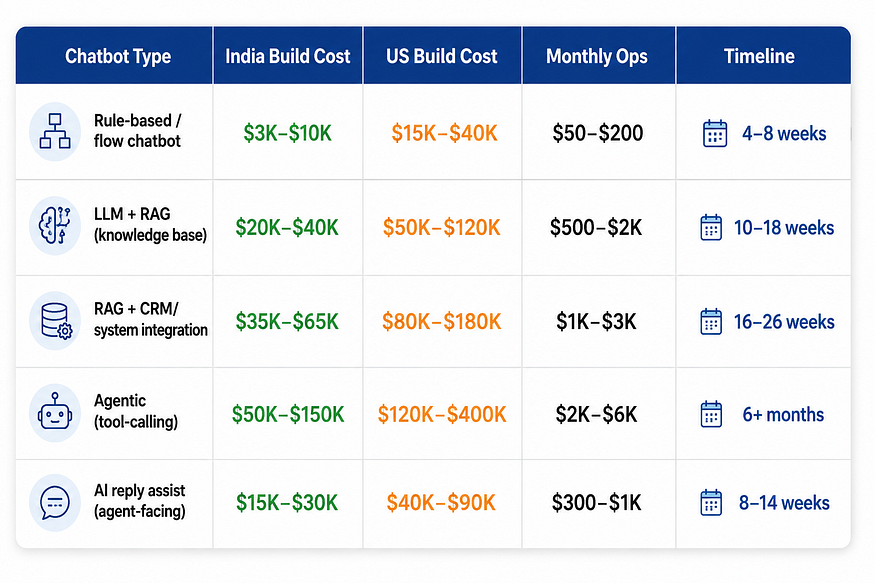
AI Chatbot Development Cost — India vs US 2026
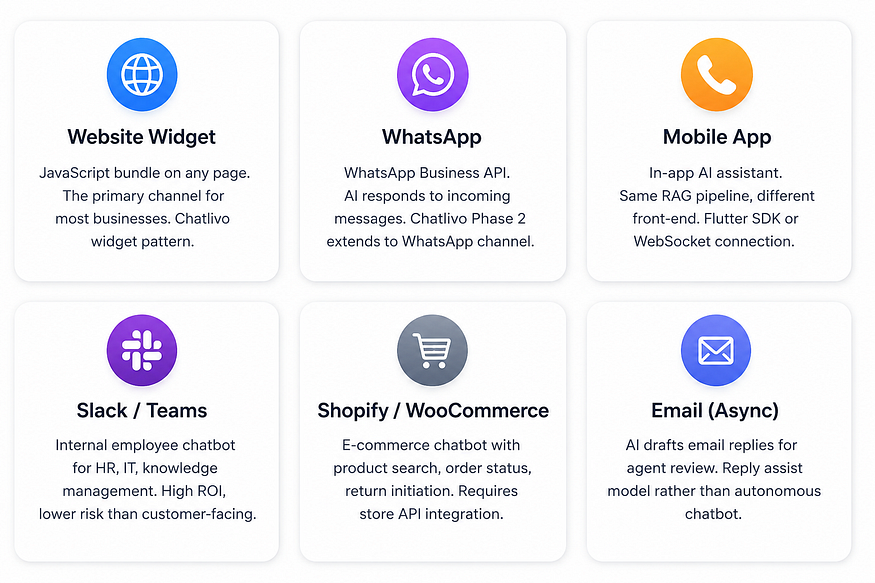
AI Chatbot Deployment — Website, WhatsApp & More
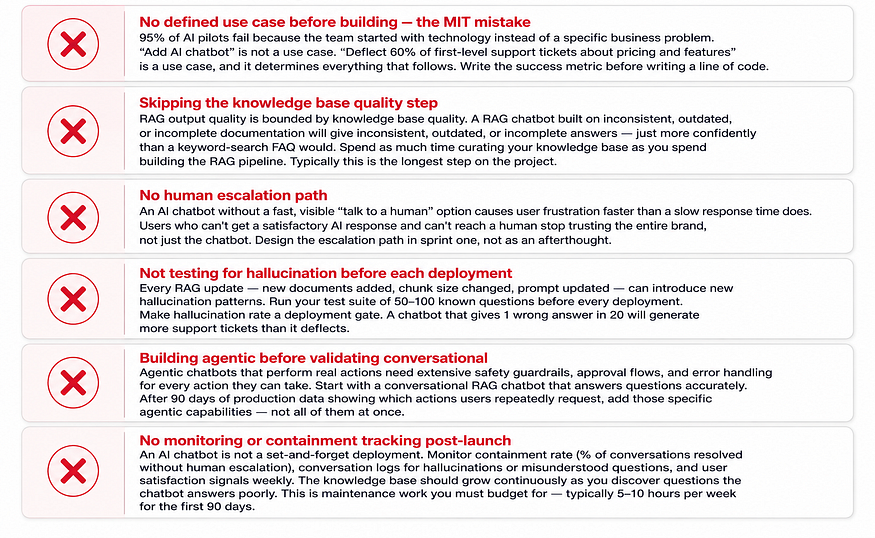
6 AI Chatbot Mistakes That Kill Projects Early
“Users forgive plain design. They don’t forgive wrong answers. An AI chatbot that confidently gives a customer the wrong cancellation policy or the wrong product price doesn’t save you support tickets — it generates complaint tickets. Get the accuracy right before you get the interface right. RAG architecture exists precisely for this reason.”
Primocys · AI Chatbot Development
We’re Building the Chatlivo AI Chatbot Right Now. We Can Build Yours.
Chatlivo Phase 2 AI is in active development — RAG pipeline, LangChain, OpenAI integration, Python microservices on top of a live Node.js SaaS. The architecture in this guide is what we’re implementing. If you need an AI chatbot for your website, your SaaS, or your mobile app, we build from production experience, not from reading competitor guides.
RAG pipeline from day one
LangChain + vector DB (pgvector or Pinecone). Knowledge base preparation included in scope.
LLM selection guidance
OpenAI, Gemini, or open-source based on your compliance requirements and volume.
Python AI microservices
Separate from your existing backend. No rewrite required. REST API integration.
Human escalation built in
Confidence threshold routing, conversation context handoff, agent dashboard integration.
Multi-channel deployment
Website widget, WhatsApp, mobile app, Slack — same RAG pipeline, multiple interfaces.
Fixed price from $15,000
RAG knowledge base chatbot, agreed scope, full source code. No hourly surprises.
Conclusion: Build Your AI Chatbot the Right Way
Building an AI chatbot for your website in 2026 isn’t about picking the flashiest architecture — it’s about matching the chatbot type to the actual problem you’re solving. A rule-based flow is enough for structured lead capture; a RAG chatbot grounded in your real business data is the right call for open-ended customer support; agentic tool-calling only earns its cost once you know exactly which actions users want automated. Whichever type fits your website or SaaS product, the same rule holds: define the use case before you touch the tech stack, and never ship an AI chatbot without a tested escalation path to a human.
Primocys is building the Chatlivo RAG chatbot with this exact stack right now — RAG, LangChain, OpenAI. If you’re ready to add AI to your website, get a free estimate from Primocys, or try the Chatlivo live chat platform to see the product this guide is built around.
Ready to Add AI to Your Website or SaaS?
We’re building the Chatlivo AI chatbot right now using the exact architecture in this guide. Tell us your use case — we’ll give you a scope, an architecture recommendation, and a fixed price within 24 hours.