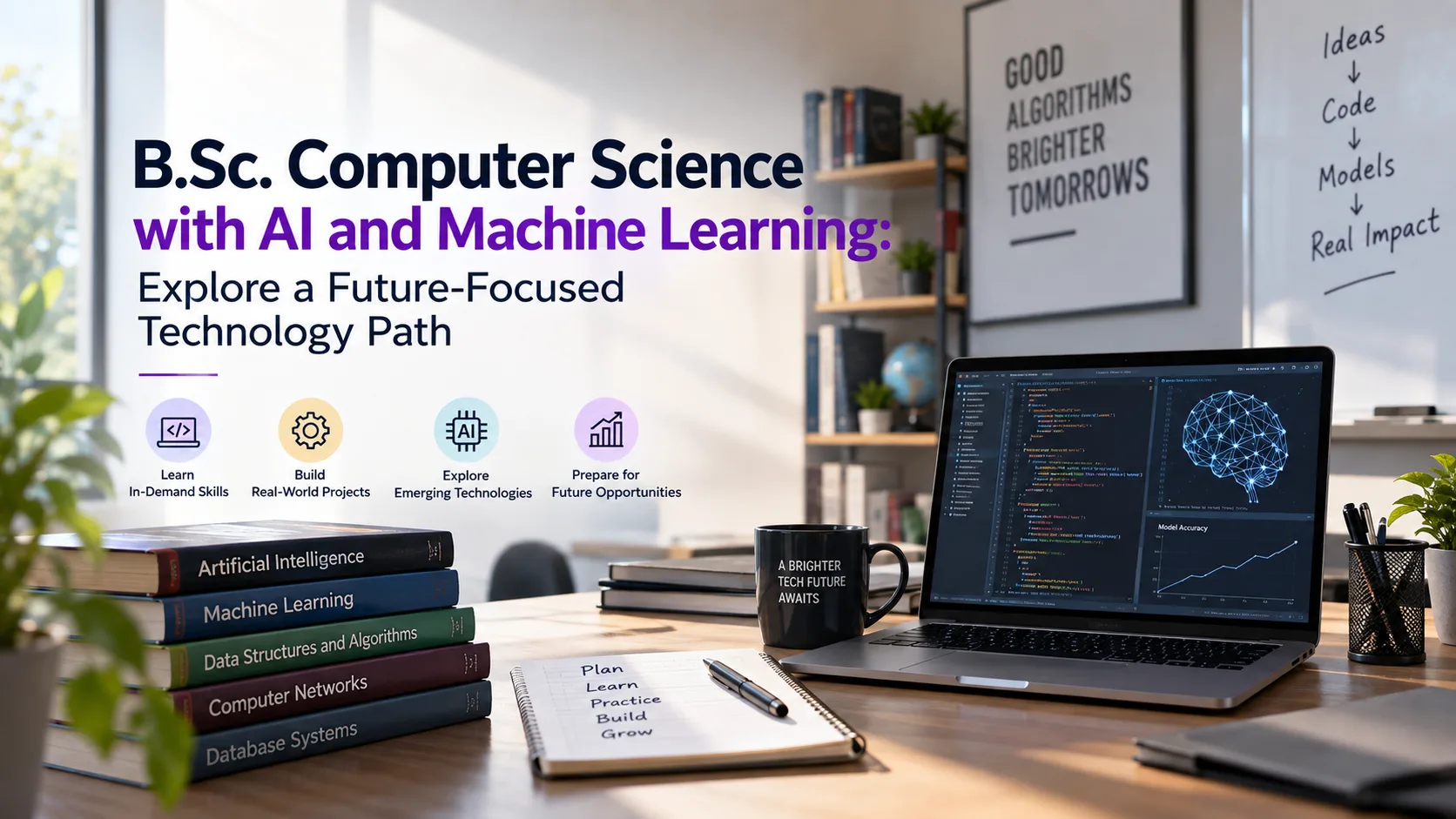
Artificial Intelligence and Machine Learning are becoming important areas of computer science. Students interested in programming, intelligent applications, data-driven systems, and emerging technologies can explore specialized undergraduate programmes that combine computer science with AI and machine learning.
A BSc Computer Science with Artificial Intelligence and Machine Learning can provide students with a foundation in computer science while introducing specialized concepts related to intelligent systems.
Understanding the subjects, skills, projects, and learning areas involved can help students decide whether this field matches their interests.
What Is BSc Computer Science with AI and Machine Learning?
BSc Computer Science with AI and Machine Learning combines core computer science education with specialized learning in artificial intelligence and machine learning.
Students can develop knowledge across areas such as programming, algorithms, databases, computer systems, mathematics, artificial intelligence, machine learning, and data-related technologies.
Students who are new to the field can first explore:
https://mhcognition.com/blogs/what-is-bsc-cs-ai-ml
The combination is useful because AI and machine learning are built on several computer science fundamentals. Understanding programming and algorithms can help students progress toward more advanced AI concepts.
What Subjects Can Students Learn?
The exact curriculum varies between institutions, but students can expect a combination of computer science and AI-related subjects.
Common learning areas can include:
- Programming
- Data structures
- Algorithms
- Database management
- Computer networks
- Operating systems
- Mathematics
- Statistics
- Artificial intelligence
- Machine learning
- Data analysis
- Software development
Students can explore a detailed overview of AI and Machine Learning syllabus areas.
The goal should be to build a strong foundation before moving into advanced specialization.
Programming and Algorithms
Programming is one of the most important foundations for students studying AI and Machine Learning.
Students need programming knowledge to work with algorithms, data, applications, and machine learning models.
Algorithms are equally important because AI and machine learning involve computational methods for processing information and identifying patterns.
Students should therefore spend time practising programming rather than treating it as just another academic subject.
Artificial Intelligence Fundamentals
Artificial intelligence covers a broad range of concepts related to intelligent systems.
Students may explore topics such as search techniques, knowledge representation, reasoning, intelligent agents, natural language processing, computer vision, and machine learning depending on the curriculum.
Understanding AI fundamentals helps students see how different technologies can be combined to create intelligent applications.
Machine Learning
Machine learning is a major specialization within AI.
Instead of programming every decision manually, machine learning approaches allow systems to identify patterns from data and use those patterns to make predictions or classifications.
Students can gradually learn concepts such as:
- Training data
- Features
- Models
- Classification
- Regression
- Clustering
- Model evaluation
- Prediction
- Data preprocessing
A strong foundation in mathematics, statistics, programming, and data handling can help students understand these concepts more effectively.
Mathematics and Statistics
Mathematics and statistics are important parts of AI and machine learning education.
Students may encounter areas such as probability, statistics, linear algebra, and mathematical concepts used in algorithms and machine learning.
These subjects may seem challenging initially, but understanding the underlying concepts can help students understand how machine learning models work rather than relying only on software libraries.
Practical Learning and Projects
Practical projects allow students to apply theoretical concepts to real problems.
Students can work on projects such as:
- Student performance prediction
- Recommendation systems
- Image classification
- Sentiment analysis
- Chatbot applications
- Data analytics dashboards
- Object detection
- Predictive models
- Natural language applications
Students looking for project inspiration can explore:
https://mhcognition.com/blogs/bsc-cs-ai-ml-final-year-project-ideas
The purpose of a project is not simply to demonstrate a technology. Students should understand the problem, data, approach, implementation, testing, and results.
Why Project-Based Learning Matters
AI and machine learning involve experimentation. A model may not perform as expected on the first attempt.
Students can learn valuable problem-solving skills by testing different approaches, analysing results, identifying errors, and improving their implementations.
Projects can also help students build portfolios that demonstrate their practical understanding.
What Skills Should Students Develop?
Students pursuing this field can work on several technical and professional skills.
Technical Skills
- Programming
- Data structures
- Algorithms
- Databases
- Statistics
- Machine learning
- Artificial intelligence
- Data analysis
- Software development
Practical Skills
- Project development
- Debugging
- Data preprocessing
- Model evaluation
- Technical documentation
- Version control
Professional Skills
- Communication
- Presentation
- Teamwork
- Problem-solving
- Research
- Continuous learning
Developing these skills alongside academic knowledge can help students become more comfortable with practical technology projects.
Career Areas to Explore
AI and machine learning can connect with several technology areas.
Depending on their skills and experience, graduates may explore areas such as:
- Machine learning
- Artificial intelligence
- Data analytics
- Software development
- Data science
- Computer vision
- Natural language processing
- AI application development
- Research and development
Students should remember that career development depends on their education, practical experience, technical skills, projects, internships, and continued learning.
Choosing an AI and Machine Learning Programme
Students should carefully examine a programme before applying.
Important areas to compare include:
- Computer science fundamentals
- AI and machine learning subjects
- Programming languages
- Mathematics and statistics
- Laboratory facilities
- Practical projects
- Faculty expertise
- Industry exposure
- Internship opportunities
- Project-based learning
Students interested in exploring a dedicated programme can learn more here:
https://mhcognition.com/learning/bsc-cs-ai-and-ml
Students can also explore information about BSc CS AI and ML in India.
How Can Students Prepare Before Starting?
Students do not need advanced AI knowledge before beginning an undergraduate programme.
They can start by strengthening basic mathematics, programming logic, problem-solving, and computer fundamentals.
Learning basic Python can also provide useful preparation for students interested in data and machine learning.
Reading about AI applications and experimenting with small coding projects can gradually improve familiarity with the field.
Final Thoughts
BSc Computer Science with Artificial Intelligence and Machine Learning combines computer science fundamentals with specialized learning in AI and machine learning.
Students can develop knowledge in programming, algorithms, databases, mathematics, statistics, artificial intelligence, machine learning, and practical application development.
The most useful approach is to build strong fundamentals and then apply them through projects. Students should compare the curriculum, practical exposure, project opportunities, and overall learning environment before selecting a programme.
For students interested in exploring this pathway, the BSc CS Artificial Intelligence and Machine Learning programme can be found here:
https://mhcognition.com/learning/bsc-cs-ai-and-ml
With consistent learning and practical experimentation, students can build a foundation for exploring the growing range of applications connected with artificial intelligence and machine learning.