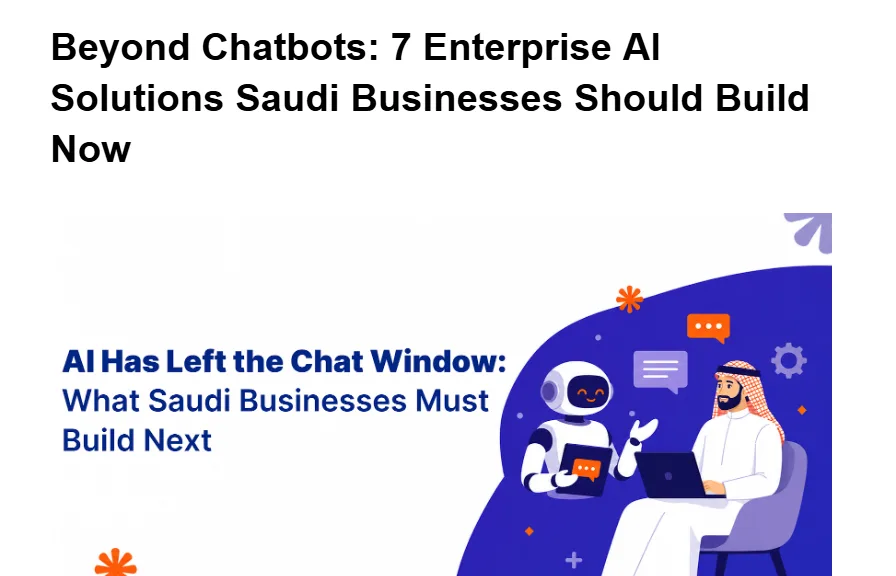
Artificial intelligence is moving beyond simple chat windows.
Businesses are beginning to use AI inside customer journeys, operational workflows, internal knowledge systems, analytics platforms, and decision-making processes. The opportunity is no longer limited to answering customer questions. AI can now help organizations understand information, recommend actions, automate repetitive work, and support employees across complex business processes.
For Saudi organizations, this creates an important decision: should they experiment with another isolated AI tool, or build an AI capability that produces measurable business value?
Choosing an experienced AI development company in Saudi Arabia should begin with that question. The goal is not to add AI because the market is discussing it. The goal is to solve a valuable business problem more accurately, securely, and efficiently.
Here are seven enterprise AI solutions Saudi businesses should consider building now.

1. Arabic and English Conversational AI
A basic chatbot follows scripted questions and answers. A modern conversational AI assistant can understand intent, maintain context, retrieve information, and guide users toward an outcome.
For example, a customer should be able to ask:
- Why was my application delayed?
- Which product is suitable for my requirements?
- Can I change my appointment?
- What documents are still missing?
- What is the status of my service request?
The assistant should understand the request, access approved business information, and help complete the next step.
This is particularly valuable in Saudi Arabia, where businesses may need to serve customers in both Arabic and English. A successful solution must account for language direction, business terminology, tone, context, and the way users naturally express requests.
Conversational AI can support:
- Customer service;
- Sales qualification;
- Appointment scheduling;
- Product discovery;
- Employee support;
- Application assistance;
- Order and request tracking; and
- Frequently asked questions.
Organizations exploring this use case can begin with Arabic and English chatbot development services designed around their industry, customer journey, and existing systems.
The most valuable chatbot is not the one that produces the longest response. It is the one that helps the user complete a task with fewer steps.
2. AI Agents for Controlled Workflow Automation
AI agents can do more than provide information. They can interpret a request, decide which approved tools to use, and complete a sequence of actions.
An enterprise AI agent might:
- Collect information from multiple systems;
- Prepare a customer response;
- Update a CRM record;
- Create a support ticket;
- Generate a report;
- Compare supplier documents;
- Route an approval request; or
- Recommend the next action to an employee.
However, giving an AI system the ability to act introduces new risks. It may interpret instructions too broadly, use the wrong data, or take an action without sufficient approval.
This is why enterprise AI agents need boundaries.
A responsible agentic AI solution should include:
- Clearly defined permissions;
- Approved tools and data sources;
- Human approval for high-impact actions;
- Complete activity logs;
- Spending and transaction limits;
- Testing environments;
- Data-access controls;
- Rollback procedures; and
- Escalation rules.
AI autonomy should increase gradually. A system may begin by recommending an action, then prepare the action for approval, and only later complete low-risk actions automatically.
For repetitive, rules-based activities, businesses can combine AI with robotic process automation services. RPA handles predictable steps, while AI supports interpretation, classification, and decision assistance.
This combination can be useful for finance, HR, procurement, insurance, logistics, customer service, and administrative operations.
3. Intelligent Document Processing
Many organizations still depend on employees to read, classify, verify, and transfer information from documents.
These may include:
- Invoices;
- Contracts;
- Application forms;
- Identity documents;
- Claims;
- Purchase orders;
- Medical records;
- Inspection reports; and
- Compliance documents.
Intelligent document processing uses AI to extract information, understand document types, identify missing fields, compare records, and route documents to the correct workflow.
For example, an AI-powered document system could receive an invoice, identify the supplier and amount, compare it with a purchase order, flag inconsistencies, and prepare it for approval.
This does not mean every document should be processed without human review. High-value, unusual, incomplete, or low-confidence documents should be sent to an employee for verification.
A strong implementation should measure:
- Processing time per document;
- Extraction accuracy;
- Number of manual corrections;
- Cost per transaction;
- Exception rate; and
- Time saved by employees.
Document automation is often a practical starting point because the existing manual workload is visible and its business impact can be measured.
4. Predictive Analytics and Decision Support
Traditional reporting explains what has already happened. Predictive analytics helps organizations estimate what may happen next.
Saudi businesses can use machine learning and advanced analytics to improve:
- Demand forecasting;
- Inventory planning;
- Customer retention;
- Fraud detection;
- Revenue forecasting;
- Maintenance planning;
- Workforce scheduling;
- Risk assessment; and
- Sales prioritization.
A retail company may forecast demand by product and location. A financial organization may identify unusual transaction patterns. A logistics business may predict delays. A service provider may identify customers who are likely to leave.
The model itself is only one part of the solution. The organization also needs reliable data pipelines, understandable dashboards, suitable alerts, and a process for acting on the prediction.
Mobcoder Saudi’s data analytics and business intelligence services can help businesses convert fragmented information into dashboards, forecasts, and decision-support systems.
The objective is not to predict everything. It is to improve decisions where earlier information creates financial or operational value.
5. Enterprise Knowledge Assistants
Employees often lose time searching through policies, procedures, emails, manuals, shared drives, and internal systems.
A secure enterprise knowledge assistant can help employees ask questions in natural language and receive answers based on approved organizational information.
Useful applications include:
- HR policy support;
- Technical troubleshooting;
- Sales enablement;
- Compliance guidance;
- Product information;
- Employee onboarding;
- Standard operating procedures; and
- Internal service support.
Unlike a public AI assistant, an enterprise knowledge system should retrieve information only from approved company sources. It should also provide references so employees can review the original document before acting.
Access controls are essential. An employee should only receive information they are authorized to view. Finance, HR, legal, healthcare, and executive information may require different permission levels.
A well-designed knowledge assistant can reduce repetitive internal questions while making organizational knowledge easier to find and use.
6. AI-Powered Personalization and Recommendation Systems
Customers increasingly expect digital experiences to reflect their needs, history, location, and preferences.
AI-powered recommendation systems can personalize:
- Products;
- Services;
- Content;
- Offers;
- Next-best actions;
- Learning materials;
- Support journeys; and
- Customer communication.
For example, an e-commerce platform may recommend products based on browsing behaviour and purchase history. A financial platform may show relevant services based on customer needs. A learning platform may adapt content based on progress. A healthcare application may personalize reminders and educational material.
Personalization should be useful rather than intrusive. Businesses must clearly define which customer information may be used and avoid recommendations based on unreliable or inappropriate assumptions.
Success can be measured through:
- Conversion rate;
- Average order value;
- Customer engagement;
- Repeat purchases;
- Content completion;
- Recommendation acceptance; and
- Customer retention.
The best recommendation systems improve relevance while preserving user trust.
7. Computer Vision for Physical Operations
Computer vision allows software to interpret images and video.
It can support Saudi organizations operating in manufacturing, construction, logistics, retail, healthcare, insurance, transportation, and security-sensitive environments.
Potential applications include:
- Product quality inspection;
- Equipment monitoring;
- Safety-compliance detection;
- Inventory counting;
- Damage assessment;
- Document and identity verification;
- Visual search;
- Queue analysis; and
- Facility monitoring.
A computer vision project should be designed for the environment in which it will operate. Lighting, camera position, image quality, movement, privacy requirements, and unusual conditions can all affect performance.
Organizations should test these systems using realistic local data rather than relying only on controlled demonstrations.
High-impact decisions should also include human review, particularly where an incorrect result could affect safety, eligibility, employment, healthcare, or financial outcomes.
How to Choose the Right AI Use Case
Not every process needs artificial intelligence.
Before investing in custom AI development services, businesses should evaluate each potential use case against five questions.
Is the problem valuable?
The process should affect revenue, cost, speed, risk, customer experience, or employee productivity.
Is the work repeated often enough?
Automating a process that occurs only occasionally may not justify the implementation and maintenance cost.
Is suitable data available?
AI systems need accurate, accessible, and appropriately governed information.
Can success be measured?
The organization should define a baseline and target before development starts.
Can the solution be integrated?
An isolated AI demonstration has limited value. The solution should connect with the systems, teams, and workflows where work actually happens.
Businesses planning broader operational modernization may benefit from a structured digital transformation strategy before selecting individual technologies.

Build an AI Business Case Before Building the AI
AI projects should begin with an outcome, not a model.
A clear business case should define:
- The current process;
- The existing cost or problem;
- The desired improvement;
- The responsible business owner;
- The required data;
- The systems that must be integrated;
- The risks and controls;
- The pilot duration; and
- The expected financial or operational value.
For example, “build an AI customer service assistant” is not a complete business case.
A stronger objective would be:
Reduce the average time required to resolve repetitive customer enquiries while maintaining response accuracy and escalating sensitive cases to trained employees.
This objective is measurable and connects the technology to an operational outcome.
A Practical Enterprise AI Implementation Roadmap
1. Discover
Identify high-friction processes, user needs, data sources, system dependencies, and measurable business opportunities.
2. Prioritize
Rank use cases according to business value, implementation complexity, data readiness, risk, and time to impact.
3. Design
Define the user journey, system architecture, integrations, approval rules, security controls, and success metrics.
4. Prototype
Build a focused solution that tests the most important technical and business assumptions.
5. Pilot
Deploy the solution in a controlled environment with a limited user group and real operational data.
6. Measure
Compare performance against the original baseline. Review accuracy, adoption, time saved, cost, exceptions, and user feedback.
7. Scale
Expand only after the solution demonstrates value, reliability, security, and operational readiness.
This staged approach is central to successful enterprise digital solution development. It reduces unnecessary investment and helps teams learn before making a company-wide commitment.
What to Look for in an AI Development Company in Saudi Arabia
A capable AI partner should offer more than model development.
Look for a team that can:
- Understand the business process;
- Design Arabic and English experiences;
- Assess data readiness;
- Integrate with existing ERP, CRM, cloud, and enterprise platforms;
- Design security and approval controls;
- Build scalable software around the AI model;
- Define measurable KPIs;
- Support testing and user adoption; and
- Monitor and improve the system after launch.
The partner should also be willing to recommend a simpler solution when AI is not necessary. In some cases, workflow redesign, traditional automation, analytics, or custom software may solve the problem more reliably.
Mobcoder Saudi brings together AI, automation, analytics, cloud, product, and digital transformation services so that AI can be implemented as part of a complete business system rather than an isolated feature.
From AI Experimentation to Measurable Business Value
The next stage of AI adoption will not be defined by how many organizations launch a chatbot.
It will be defined by how effectively businesses use intelligence to improve customer journeys, automate operations, support employees, and make better decisions.
Saudi organizations have an opportunity to build AI solutions around local languages, industries, customer expectations, and business requirements. But lasting value will depend on disciplined implementation.
Start with a meaningful problem. Establish a measurable baseline. Prepare the data. Set clear limits on what the system can do. Keep people involved in high-impact decisions. Prove value in a controlled pilot before scaling.
Mobcoder Saudi Technology Co. helps organizations move from AI strategy to deployment through custom AI development, conversational AI, machine learning, intelligent automation, analytics, enterprise integration, and ongoing optimization.
The goal is not another disconnected proof of concept. It is a secure and scalable solution that earns its place in the business.
Speak with Mobcoder Saudi to identify high-value AI opportunities and develop a practical implementation roadmap.
Frequently Asked Questions
1. Which AI solutions are most useful for Saudi businesses?
High-value solutions include Arabic and English conversational AI, intelligent document processing, predictive analytics, enterprise knowledge assistants, AI workflow agents, recommendation systems, and computer vision. The right solution depends on the business problem, available data, and expected outcome.
2. Can enterprise AI support both Arabic and English?
Yes. AI solutions can support Arabic and English conversations, content, documents, and user journeys. Arabic implementation should account for right-to-left layouts, regional terminology, language variations, and industry-specific vocabulary.
3. Can AI integrate with existing ERP, CRM, and business systems?
Yes. AI can connect with ERP, CRM, databases, document systems, cloud platforms, and internal applications through secure APIs, middleware, data pipelines, or controlled automation.
4. Which business processes are suitable for AI automation?
Suitable processes usually involve repetitive work, large document volumes, frequent enquiries, forecasting, classification, knowledge retrieval, or repeated operational decisions. The process should also have measurable outcomes and clearly defined exception handling.
5. What is the difference between AI and RPA?
RPA handles predictable, rule-based tasks, while AI interprets language, documents, images, patterns, and complex information. They can work together, with AI making interpretations and RPA completing structured system actions.
6. Why should businesses begin with an AI pilot?
A pilot helps test data quality, model accuracy, system integration, user adoption, security requirements, and business value before wider implementation. It reduces risk and provides evidence for deciding whether to scale.
7. How is the success of an AI solution measured?
Success may be measured through processing time, accuracy, reduction in manual work, response quality, customer satisfaction, employee adoption, exception rates, forecasting performance, or operational efficiency.
8. What should businesses look for in an AI development company in Saudi Arabia?
Look for a partner that understands business workflows, supports Arabic and English experiences, assesses data readiness, integrates with enterprise systems, builds security and governance controls, defines measurable KPIs, and supports the solution after deployment.