
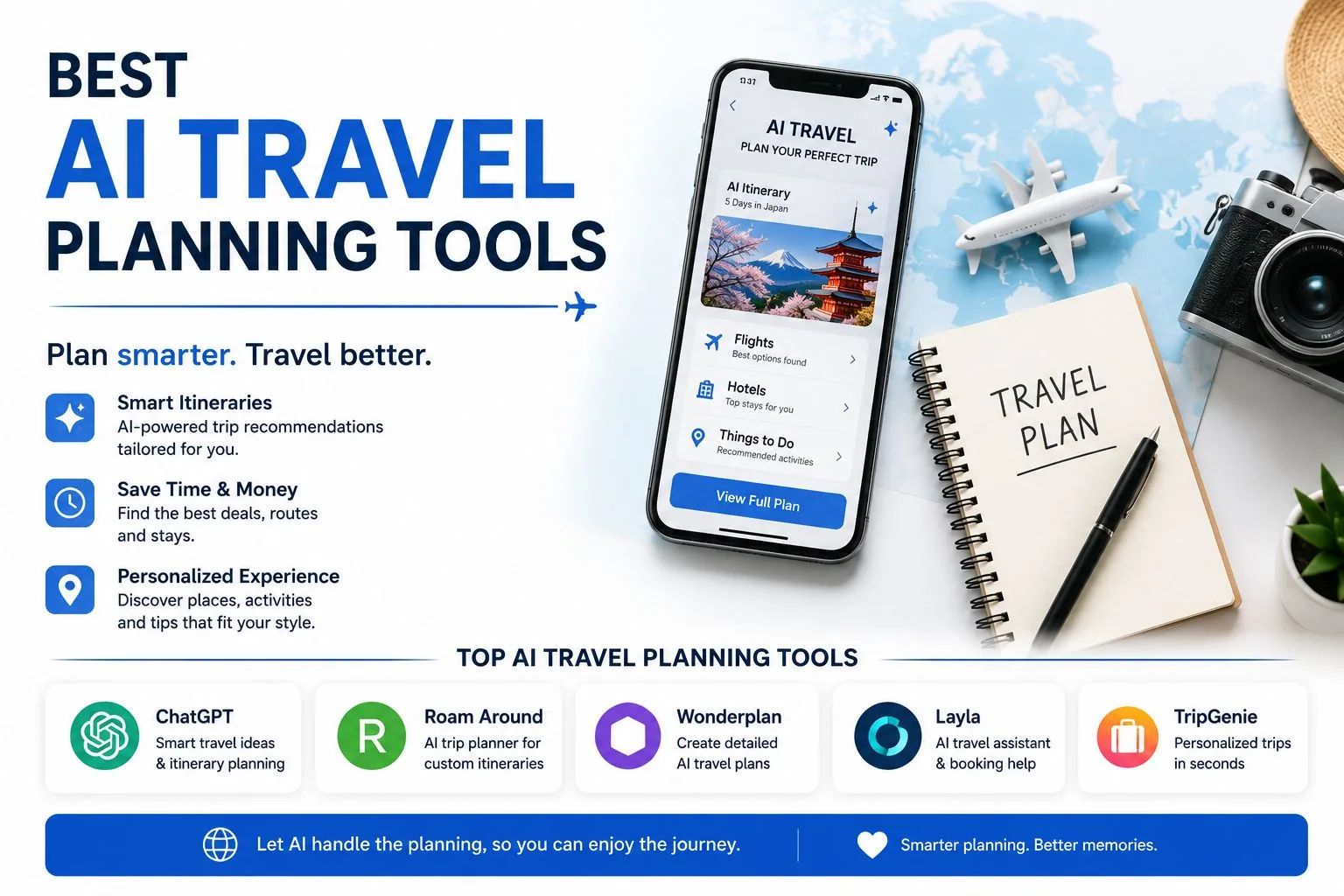
Planning a trip used to mean dozens of browser tabs, half-finished spreadsheets, and a notes app full of half-remembered recommendations. That is changing fast. AI travel planning tools now help travellers build itineraries, compare prices, and organise every part of a trip in a fraction of the time it used to take.
But here is the catch: not every AI tool does the same job. Some are great for brainstorming. Some are built for real-time flight and hotel prices. Others are made for group trips or day-by-day itinerary building. Picking the wrong one for the job is the most common mistake travellers make.
This guide breaks down the best AI travel planning tools available today, what each one is actually good at, and how you can use them to plan a trip to a destination as rich in history as Jaipur.
What Is an AI Travel Planner?
An AI travel planner is a tool that uses artificial intelligence to build trip itineraries and help you organise the logistics around them. Some tools only generate a list of suggestions and stop there. Others go further, letting you edit the plan, track your budget, share it with travel companions, and even book flights and hotels directly.
A genuinely useful AI travel planner should be able to:
- Build a realistic day-by-day itinerary with proper timing and routing, not just a generic list of attractions
- Handle real trip complexity, such as multi-city routes, group preferences, and budget limits
- Offer some way to edit, save, and share the plan
- Point you toward accurate, current information rather than outdated guesses
Most tools on the market today are strong on the first point and weak on the rest. Knowing this helps you set the right expectations before you start.
The Best AI Travel Planning Tools Right Now
1. ChatGPT - Best for Brainstorming and Research
ChatGPT remains one of the most popular starting points for trip planning. It is fast at generating destination ideas, drafting rough itineraries, explaining local customs, and putting together packing lists. Ask it for a week-long plan covering a few cities and it will return a structured outline in seconds.
Its biggest limitation is that it cannot check live flight prices, confirm that a restaurant is still open, or verify hotel availability. Treat it as a brainstorming partner, not a final planning tool, and always double-check details before booking.
2. Google Gemini - Best for Real-Time Data
Gemini has an advantage most dedicated travel apps do not: direct access to Google Maps, Google Flights, Google Hotels, and (if you allow it) your own inbox for existing bookings. That means it can pull in real flight prices, real hotel availability, and accurate opening hours instead of relying on outdated training data.
The trade-off is presentation. Gemini's answers often come as blocks of text rather than a clean, structured itinerary, so you may need to do some manual organising afterward.
3. Layla AI - Best Dedicated Trip Planner
Layla is built specifically for trip planning rather than general conversation. It turns your requirements into a structured, editable itinerary, supports collaborative planning for groups, and links directly to flight and hotel bookings. Independent reviews consistently rank it as one of the most complete dedicated planners available, particularly for travellers who want more than a plain text itinerary.
4. Mindtrip - Best for Visual, Map-Based Planning
Mindtrip works like a chatbot layered on top of an interactive map. Type in a destination or describe what kind of experience you want, and it suggests cafés, museums, and neighbourhoods with practical details like opening hours and addresses. You can drop suggestions directly into your itinerary and organise a trip with friends through group chat.
It is worth double-checking specific details it suggests, since occasional inaccuracies do turn up, especially for smaller or lesser-known places.
5. Kayak AI - Best for Real-Time Flight and Hotel Pricing
Kayak AI combines a major travel search engine with a conversational interface. Instead of just suggesting where to go, it shows you what flights and hotels actually cost right now, searches across many providers, and lets you book directly. If your main need is pricing accuracy rather than itinerary inspiration, this is the stronger choice.
6. Perplexity - Best for Verifying Details
Perplexity is not a trip planner in the traditional sense. It is an AI search tool that pulls information from current web sources and shows you where the answer came from. This makes it useful for the step most other tools skip: verifying opening hours, transport options, or entry requirements before you rely on them.
7. Stippl and Similar Full-Suite Planners
A newer category of tools goes beyond itinerary generation to offer a complete trip management system: editable day-by-day timelines, automatic budget tracking, shared packing lists, and live trip sharing with everyone travelling with you. These are worth considering if you want one app to handle the entire trip from planning to the actual travel days, rather than switching between several tools.
How to Combine These Tools the Right Way
No single AI tool currently does everything well, and most experienced travellers now use a layered approach instead of relying on just one app:
- Start with a brainstorming tool like ChatGPT or Gemini to shortlist destinations and rough out an itinerary structure.
- Move to a dedicated planner like Layla or Mindtrip to turn that rough plan into a proper day-by-day schedule.
- Check pricing with a tool built for it, such as Kayak AI, before you commit to bookings.
- Verify the details - opening hours, ticket requirements, transport timings - with a search tool like Perplexity rather than trusting AI-generated guesses blindly.
This combination takes a little more effort than using one app, but it consistently produces more accurate and more usable results.
Using AI Travel Tools to Plan a Jaipur Trip
Jaipur is one of the most rewarding cities in India for travellers who love history, architecture, and old-world charm, but it is also a city where AI tools alone will not get you very far. The city's forts, palaces, and old bazaars carry stories, timings, and local customs that generic AI answers often get wrong or oversimplify. This is exactly the kind of trip where a layered approach works best.
Start by using a brainstorming tool to build a rough outline. Ask it to design a route covering the famous historical monuments of Jaipur, and it will usually suggest the obvious names - Amber Fort, City Palace, Hawa Mahal, and Jantar Mantar. That is a reasonable starting point, but it will rarely tell you the best time of day to visit each site, which entrances have shorter queues, or which spots get overrun with tour groups by mid-morning.
This is where local knowledge becomes essential. Every historical landmark Jaipur is known for has its own rhythm. Amber Fort, for example, is best visited early in the morning before the heat and crowds build up, while Hawa Mahal is best photographed in the soft light of early morning from across the street. An AI itinerary generator has no way of knowing this unless it is fed accurate, current information, which is exactly the verification step a tool like Perplexity - or a proper local travel guide - is useful for.
Once you have a rough plan from an AI tool, it helps to cross-check it against a resource built specifically around Jaipur. This is where a site like The Jaipur Vista becomes genuinely useful, since it focuses only on Jaipur and can go into the kind of detail a general AI itinerary usually misses: which of the famous historical places in Jaipur are worth a half-day visit versus a quick stop, how to time visits around the Pink City's heat, and which lesser-known corners of the old city are worth the detour.
A practical way to plan a Jaipur trip using AI tools looks like this:
- Use ChatGPT or Gemini to draft a rough 3–4 day outline covering the major historical sites
- Refine the timing and routing using a dedicated planner like Layla or Mindtrip
- Cross-check monument timings, entry fees, and seasonal advice against a Jaipur-focused travel resource
- Verify anything time-sensitive, such as festival dates or temporary closures, closer to your travel date
This approach gives you the speed of AI planning without losing the accuracy that only comes from real, local expertise.
Common Mistakes to Avoid With AI Travel Planning
Trusting AI-generated details without checking them. Opening hours, prices, and even whether a place still exists can be wrong in an AI-generated itinerary. Always verify anything important before you build your day around it.
Using one tool for every task. A brainstorming tool is not a booking tool, and a booking tool is rarely a good source of cultural or historical context. Match the tool to the task.
Ignoring local sources. For destinations with deep history, like Jaipur, a general AI assistant simply does not have the depth of a resource built specifically around that city. Local guides and destination-specific sites fill in the gaps AI tools consistently miss.
Skipping the group-coordination step. If you are travelling with others, use a tool that supports shared itineraries and group input from the start, rather than trying to merge separate plans later.
Final Thoughts
AI travel planning tools have genuinely made trip planning faster and, in many cases, better organised. But the tools work best as a starting point, not a finish line. A rough itinerary from ChatGPT or Gemini, refined through a dedicated planner, and checked against real local knowledge, will always beat a plan generated by any single AI tool on its own.
For a city like Jaipur, where the value of a visit often comes down to timing, context, and small local details, that final step - checking your plan against a resource that actually knows the city - makes all the difference between a rushed checklist of monuments and a trip that actually does justice to the historical monuments of Jaipur.