
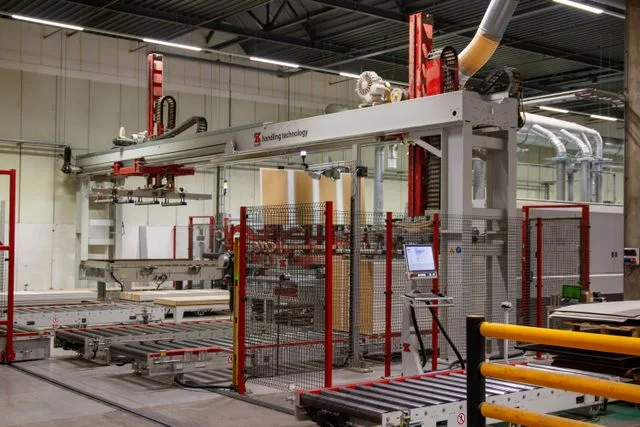
Modern warehouses are under increasing pressure to store more inventory while maintaining fast, reliable, and cost effective operations. Limited floor space, rising labor expenses, and growing order volumes can make traditional storage methods difficult to scale. An automated pallet shuttle system offers a practical solution by combining high density pallet storage with automated material movement.
Designed for warehouses that handle large volumes of palletized inventory, an automated pallet shuttle system uses powered shuttle vehicles to move pallets through deep storage lanes. Rather than requiring forklifts to enter the rack for every storage and retrieval task, the shuttle handles pallet movement within the storage structure. This approach allows businesses to use more of their available space for inventory while reducing unnecessary equipment travel.
What Is an Automated Pallet Shuttle System?
An automated pallet shuttle system is a high density warehouse storage solution that uses battery powered shuttle vehicles to store and retrieve pallets inside specially designed rack lanes. The shuttles travel along rails within the racking, moving pallets into available positions and bringing them back when inventory is needed.
Unlike traditional selective pallet racking, which generally provides direct access to each individual pallet, shuttle systems are designed around deep lane storage. Multiple pallets can be positioned behind one another, allowing the warehouse to significantly reduce the amount of aisle space required.
The level of automation can vary. Some systems use forklifts to deliver pallets to the storage lanes while operators control the shuttle remotely. More advanced systems can connect the shuttles with automated lifts, conveyors, sensors, and warehouse software to create a largely automated storage and retrieval process.
How an Automated Pallet Shuttle System Works
The storage process begins when a pallet arrives at its designated rack lane. In a semi automated operation, a forklift places the pallet onto the shuttle at the front of the lane. The shuttle then travels along the rails and positions the pallet in the appropriate storage location.
Once the pallet has been placed, the shuttle can return toward the aisle or remain available within the storage area, depending on the system configuration. Sensors help determine pallet positions and can assist with accurate load placement.
When a pallet needs to be retrieved, the shuttle moves to the appropriate location, picks up the pallet, and transports it toward the aisle. The pallet can then be removed by a forklift or transferred to another automated handling system.
In a fully automated warehouse, software can coordinate this entire process with lifts, conveyors, and other material handling equipment.
Maximizing Warehouse Storage Density
One of the most significant advantages of an automated pallet shuttle system is increased storage density. Traditional warehouse layouts often dedicate substantial floor space to forklift aisles. Although these aisles are necessary for direct access, they reduce the amount of space available for actual inventory.
Deep lane shuttle storage minimizes this requirement. Pallets can be stored several positions deep, allowing businesses to create more pallet locations within the same footprint.
Vertical space can also be used more effectively. Multiple levels of pallet storage can be installed to take advantage of available ceiling height. When deep lanes and vertical storage are combined, the warehouse can accommodate significantly more inventory without expanding its physical footprint.
For companies operating in expensive or space constrained facilities, this can provide a major operational benefit.
Reducing Forklift Travel
Forklifts are essential to many warehouse operations, but excessive travel can consume time and increase equipment usage. Operators may spend significant portions of their shifts entering rack aisles, positioning pallets, reversing, and traveling back toward the main aisle.
An automated pallet shuttle system reduces the need for forklifts to enter deep storage lanes. Forklifts can deliver pallets to designated transfer points while the shuttle handles movement within the rack.
This allows forklifts to focus on other warehouse activities while automated equipment performs repetitive storage and retrieval movements. Reducing unnecessary travel can improve productivity and contribute to more efficient use of material handling equipment.
Improving Warehouse Throughput
Storage capacity is only one part of warehouse performance. Businesses also need to move inventory efficiently. A storage system that creates additional pallet positions but slows retrieval may not provide the desired operational results.
Automated pallet shuttle systems can help improve throughput by providing consistent pallet movement. The shuttle performs storage and retrieval tasks according to programmed commands, reducing the variability that can occur with repetitive manual handling.
More advanced installations can coordinate shuttle activity with conveyors and automated lifts. This allows pallets to move between different parts of the warehouse with fewer manual transfers.
The result can be a smoother flow of goods from receiving through storage and eventually to picking, production, or shipping.
2 Way and 4 Way Pallet Shuttle Systems
Automated pallet shuttle technology can be configured in different ways depending on the warehouse's storage and throughput requirements.
A 2 way pallet shuttle moves forward and backward within an individual storage lane. This type of system is useful for high volume inventory with relatively straightforward storage and retrieval requirements. Forklifts can still deliver and remove pallets while the shuttle performs the movement inside the rack.
A 4 way pallet shuttle provides greater flexibility by allowing the shuttle to travel in multiple directions. It can move forward, reverse, cross aisles, and work across different storage levels when integrated with suitable lifting equipment.
This multidirectional capability allows a single automated system to serve multiple storage lanes and levels. It can be particularly useful for facilities with multiple high volume SKUs and demanding throughput requirements.
Supporting FIFO and LIFO Inventory Management
Inventory rotation is an important consideration when designing a warehouse storage system. Depending on its configuration, an automated pallet shuttle system can support both first in, first out and last in, first out inventory strategies.
FIFO is commonly used when older inventory needs to be processed before newer inventory. This can be important for products with expiration dates, production dates, or limited shelf lives.
LIFO can be appropriate for products that do not require strict chronological rotation. Deep lane storage can provide excellent density while allowing inventory to be stored and retrieved efficiently.
The ability to accommodate different inventory strategies makes shuttle storage suitable for a wide range of warehouse environments.
Reducing Labor Requirements
Labor is one of the largest operating expenses for many warehouses. Repetitive pallet movement can require significant amounts of employee time, particularly in facilities with high inventory volumes.
Automation can reduce the amount of manual work involved in storage and retrieval. Instead of requiring operators to perform every movement with a forklift, the shuttle handles pallet transportation within the rack.
A semi automated system still requires forklift operators, but it can reduce the amount of travel and repetitive positioning they perform. A fully automated installation can take automation considerably further by integrating shuttles with conveyors, lifts, and warehouse control systems.
The goal is not necessarily to eliminate employees but to allow the workforce to spend more time on higher value activities while automated equipment handles repetitive movement.
Integration With Warehouse Software
The performance of an automated pallet shuttle system can be enhanced through integration with warehouse management and control software. A warehouse management system can maintain information about inventory and storage locations, while warehouse execution and control systems can coordinate physical equipment.
Software integration can determine where pallets should be stored and when they should be retrieved. Automated equipment can then execute those commands with limited manual intervention.
Sensors can also help track pallet positions and movement. This improves inventory visibility and can reduce the risk of misplaced loads or inaccurate storage records.
For larger distribution centers, this type of coordination can make it easier to manage high volumes of inventory while maintaining a consistent flow of goods.
Applications for Automated Pallet Shuttle Systems
An automated pallet shuttle system is especially well suited to facilities that handle high volume palletized inventory. Distribution centers can use deep lane storage to increase capacity while maintaining efficient material movement.
Manufacturing facilities can use shuttle storage for raw materials, components, work in progress, and finished goods. Food and beverage operations can also benefit from high density storage, particularly where inventory must be managed efficiently across multiple SKUs.
Cold storage and freezer facilities are another strong application. Temperature controlled space is expensive to build and operate, so maximizing pallet capacity within the available footprint can have a significant financial impact.
Planning an Automated Pallet Shuttle System
Implementing an automated pallet shuttle system requires more than simply selecting a rack and shuttle. The design needs to reflect the warehouse's inventory, building, and operational requirements.
Pallet dimensions and weights should be evaluated along with SKU quantities, storage depth, turnover rates, required throughput, and inventory rotation requirements. Ceiling height and floor conditions must also be considered when determining rack levels and equipment requirements.
The warehouse layout should be analyzed to determine how pallets will move between receiving, storage, picking, production, and shipping. Existing forklifts and other material handling equipment should also be considered.
Future growth is another important factor. A scalable system can make it easier to expand storage capacity or add automation as inventory volumes increase.
Creating a More Efficient Warehouse
An automated pallet shuttle system can provide a powerful combination of high density storage, automated pallet movement, and improved warehouse efficiency. By moving pallets within deep storage lanes, the system reduces the amount of space required for forklift aisles and allows more of the facility to be dedicated to inventory.
The benefits can extend beyond storage capacity. Reduced forklift travel, consistent pallet movement, improved throughput, software integration, and scalable automation can all contribute to a more productive warehouse environment.
For businesses handling high volumes of palletized inventory, especially where space is limited and operational efficiency is a priority, an automated pallet shuttle system can provide a flexible foundation for modern warehouse storage. With careful planning and the right level of automation, businesses can make better use of existing facilities while creating a storage operation that is prepared to support future growth.